Aisling I

18 July 2016 | Genoa
11 July 2016 | Genoa Italy
04 July 2016 | Genoa
02 July 2016 | Genoa
25 June 2016 | Porto Azzurro Elba
11 April 2016 | Marina di Ragusa
21 March 2016 | Halifax
01 March 2016
14 January 2016
30 September 2015
25 September 2015 | Crotone Italy
18 September 2015 | Erikoussa
10 September 2015 | Preveza
10 September 2015 | Preveza
24 July 2015 | Preveza
20 July 2015 | Varko Bay
13 July 2015 | Vlicho Bay
09 July 2015
03 July 2015 | Preveza Greece
21 June 2015
Vieste and a tour of the Gargano
27 June 2012
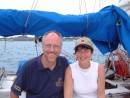
Bonnie and Rick
All is quiet in the harbour and the setting sun leaves red tendrils in the sky. We slip off the dock lines, pass the entrance and are on our way. The overnight sail from Bari to Vieste is as easy as it gets, with Martha keeping Rick company on his watch and Wally joining me on my mine. The hours fly by and before we know it, we are dropping our anchor in the small cove behind the lighthouse on Isola Santa Eufemia. We hope to stay in a spot where we can swim from the boat, but it is not to be. After catching a few hours of sleep, we decide the anchorage is too rolly for comfort and make a quick phone call to Caterina, a Canadian (Torontonian!) who operates the Centro Ormeggi in Vieste. The price of 35 euros a night sounds pretty reasonable for this part of the world, so we head for the marina.
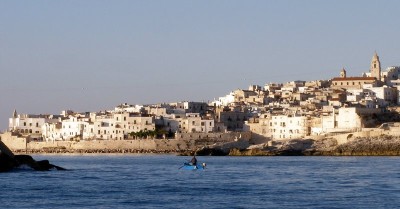
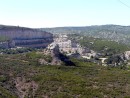
We are instantly charmed by Vieste, which sits high on a promontory of white chalk cliffs. As in many of these coastal towns, the new town is a jumble of concrete structures, while the haphazard streets of the old village on the hill are filled with quaint tiny shops and homes. Many of the marble streets are so narrow that only carts and people can make passage.
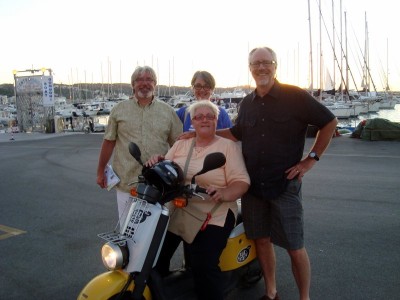
Wally and Martha are delighted when Caterina immediately takes on the task of investigating options for their transport to Florence, where they are hoping to visit the Uffize gallery before flying back to Halifax on Tuesday. With everything left in good hands, they head out to explore the town, taking my Italian cellphone with them so that we can track them down later. Just as we are walking up the hill from the marina, they call us from a little café. We join them for a drink, then visit a nearby specialty shop where we splurge on a few delicacies. Back onboard, we open a bottle of prosecco, taste some of our purchases and cook a simple meal of chicken, couscous and salad.
Katerina recommends that Wally and Martha should take the overnight train from Foggia to Florence on Sunday evening. We will rent a car, explore the Gargano and drop Wally and Martha off at the station. This means that they can spend another day with us, but we hope they are not too disappointed about missing the Uffizi, which is closed on Mondays.
Part of the charm of Vieste is that there are few historic sites to make us feel obliged to get out and tour. We all relax and pursue our own amusements: Rick and I visit the market, Wally goes off to a beach and Martha does a little shopping. When we all convene back onboard Aisling, Wally and Martha invite us to dinner in the town. The Lonely Planet's description of the Enoteca Vesta ("If your wine is as important as your food, this is the place for you") certainly makes it sound like the perfect restaurant for Wally!
Our happy anticipation is somewhat dimmed when Wally begins to pack up his belongings and discovers that a box with three bottles of very special wine that he had purchased in Tuscany is nowhere to be found. We search everywhere and it is clearly not onboard. The box must have been left behind on the train from Rome to Brindisi, or in the taxi to the train station. It's a huge disappointment, but he cheers up a bit when we suggest that he may be able to find replacements in Florence.
We all dress up and head out, pausing for Wally and Martha to say goodbye to Caterina.
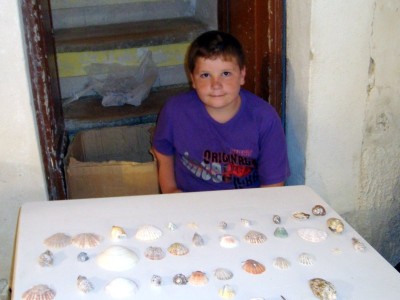
On the way up the hill, we pause to look at the merchandise being displayed by a young man, Roberto. We ask the prices of his sea shells and he hands me a few small ones. "Un regalo" (a gift) he says, "Capisce?" (Understand?) At first I think he is suggesting that I buy them as gifts, but then I realize he is giving them to me as a gift. Ah, a smart young entrepreneur! He has us eating out of his hand now. Wally and I hand over a few euros and come away with a larger shell and a red painted starfish.
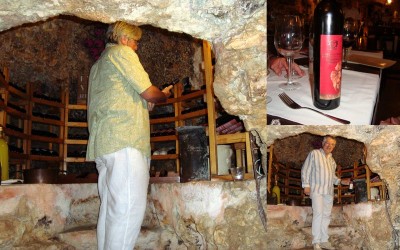
Enoteca Vesta is set in a small grotto (previously the site of a furniture-making shop) with a wine cellar that is truly a cave. Wally climbs into the cave and views the wine selection with all the passion of a fashionista gazing at the latest haute couture collection. He strikes up an immediate rapport with the restaurant's owner, Bruno, and together they chose a lovely falanghina to accompany a spectacular parade of antipasti that seems to go on and on.
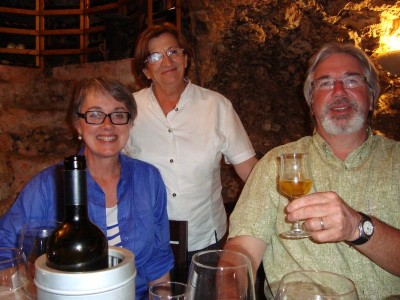
It is far too much food, but Bruno insists that we try at least half-portions of their two traditional pastas- troccoli with chick peas and orecchiette with anchovies and rape (to be accompanied by a wonderful Gioia del Colle). And surely we cannot refuse the desserts....a ricotta cake and an orange tart, with just a taste of a Trani muscato...At the end of the evening, the behind-the-scenes maestro (Bruno's wife Dorotea, the chef) comes out to take a bow. She says that she needs a rest, and based on the size of our bill she can probably afford to take one! But it has truly been a meal and an evening to remember.
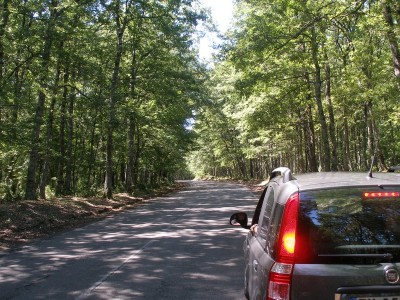
The next morning, we are all up early. Martha attends Mass while Rick picks up our Fiat Panda rental car and by mid-morning we are on the way to the Gargano National Park. Our drive to Monte St. Angelo takes us through the Foresta Umbra, said to be a remnant of Italy's ancient forest. We drive under a canopy of oak, beech and pine
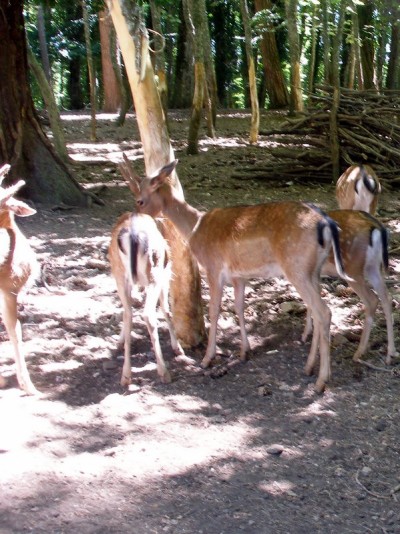
Near the visitor's centre, a few small Gargano deer are mooching for food. It looks like a wonderful place for hiking, or to have a picnic, but we have much to see and little time.
We continue our uphill climb to Monte Sant' Angelo, the town where in the 5th century AD, according to legend, the Archangel Michael visited the Bishop of Siponto in a grotto, leaving behind a red cloak and a footprint. Monte St. Angelo has been an important pilgrimage site for more than a millennium. St. Thomas Aquinas, Pope John Paul and St. Francis of Assisi all made pilgrimages here.
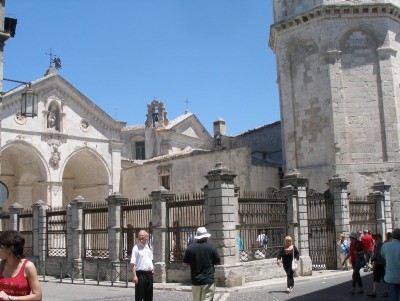
We won't get to see the footprint today, because it was covered by a statue of the archangel in the 16th century. In any case, when we arrive at the grotto, mass is underway and the room is crowded with pilgrims. No doubt there are many who, like us, have simply driven here for the day. For others, this journey may have great significance. The town itself is crowded with bars, restaurants and kiosks selling pasta and religious souvenirs. It's an interesting contrast to the sacred atmosphere in the grotto.
Now we need a shady spot to have lunch. We settle in at Le Clarisse, where the owner/chef, Guiseppe, comes out of the kitchen to explain the menu. Wally and Martha chose pasta al forno, which Wally says is just like baked macaroni. Rick and I decide to try troccoli with rape, a local seasonal speciality, and it is delicious.
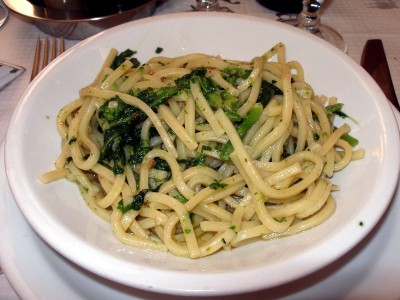
Before we leave, Rick convinces Guiseppe to explain how to prepare the pasta. Obviously, troccoli and rape will be difficult to get in Canada, but we've already discovered that we can make a pretty good facsimile using arugula and spaghetti. (Write to us if you'd like the recipe.)
We seem to be on a pilgrimage today ourselves. Our next stop will be San Giovanni Rotondo, site of the tomb of St. Pio (Padre Pio). Padre Pio arrived in this tiny hamlet in 1916, as a capuchin friar. One of Padre Pio's great accomplishments was building a "Home for the Relief of Suffering", but even prior to this, pilgrims travelled to San Giovanni Rotondo to seek his spiritual guidance. His motto of "Pray, hope and don't worry" sounds just like something my grandmother would have said! We arrive in San Giovanni Rotondo exactly 10 years and one day after Padre Pio was canonized by Pope John Paul II (who also made a pilgrimage here).
I'm gasping for breath by the time we make our way up the steep flight of stairs to the courtyard of the church. When I wonder aloud what the altitude is, Rick whips out his smartphone and sits down on a wall, trying futilely to get his GPS to work. "Go ahead without me" he says. Truth be told, he has little interest in seeing the tomb of a 20th century saint. Martha, Wally and I continue inside.
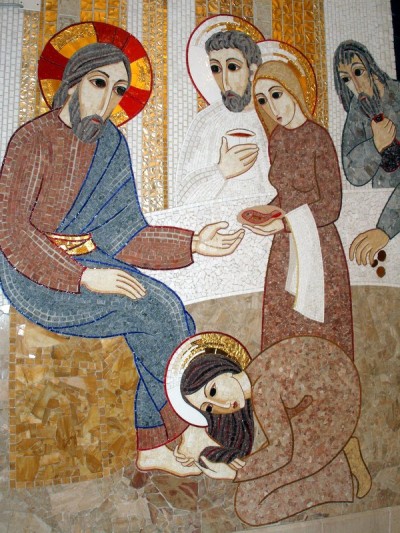
We join the line-up of pilgrims filing past the tomb and gaze around at the glittering splendor of the sanctuary. "This is tacky!" mutters Wally, "Where's the shag rug?" Martha glares at him. Why hadn't we left him outside with Rick? "No really, think of how many mouths the money that went into building this church could have fed!" Someone calls out "Silenzio!" (we are not the only ones talking) and no more is said. It must be a bit of a trial for Martha to be visiting these holy sites in the company of two Protestants and an agnostic! But the mosaics are very beautiful, and Padre Pio's cell is touchingly simple. Martha helps me pick out a Padre Pio rosary for my mother's friend Dolly before we leave.
Our time together is drawing to a close. It's a quick ride to Foggia, where we have coffee and gelato at a café near the train station before waving goodbye to Wally and Martha. They will have a long wait for their train, but we want to get back to Vieste before dark. Driving back along the coast road, the car feels very empty. It is always more fun to explore these places with friends.
The first part of the return trip goes quickly, with a four lane highway and many tunnels straightening out the drive between Foggia and Manfredonia . From there on, travelling 12 nautical miles takes us about 40 minutes.The coast is steep-to and the road twists and turns around every cove, with hairpin after hairpin. Coming the other way are all the weekend visitors leaving Vieste and its beaches. We can tell this is Italy because almost every driver thinks he is in a race and driving a Ferrari, even though in reality he is probably in a Panda. Rick reminisces about his boyhood friend Smitty, who used to speed along in a hot car with a cigarette in his mouth, arm out the window, talking to the beautiful girl in the seat next to him rather than looking at the road.
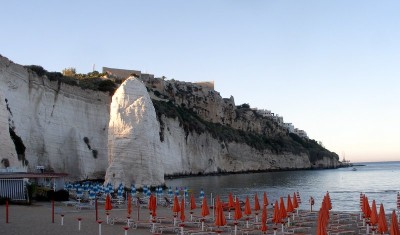
Finally, the pinnacle rock of Vieste comes into view.
Vieste is starting to feel like home, but it is time to get moving again. Time to do the laundry, fill the water tanks and head for Croatia! Ciao!
We are instantly charmed by Vieste, which sits high on a promontory of white chalk cliffs. As in many of these coastal towns, the new town is a jumble of concrete structures, while the haphazard streets of the old village on the hill are filled with quaint tiny shops and homes. Many of the marble streets are so narrow that only carts and people can make passage.
Wally and Martha are delighted when Caterina immediately takes on the task of investigating options for their transport to Florence, where they are hoping to visit the Uffize gallery before flying back to Halifax on Tuesday. With everything left in good hands, they head out to explore the town, taking my Italian cellphone with them so that we can track them down later. Just as we are walking up the hill from the marina, they call us from a little café. We join them for a drink, then visit a nearby specialty shop where we splurge on a few delicacies. Back onboard, we open a bottle of prosecco, taste some of our purchases and cook a simple meal of chicken, couscous and salad.
Katerina recommends that Wally and Martha should take the overnight train from Foggia to Florence on Sunday evening. We will rent a car, explore the Gargano and drop Wally and Martha off at the station. This means that they can spend another day with us, but we hope they are not too disappointed about missing the Uffizi, which is closed on Mondays.
Part of the charm of Vieste is that there are few historic sites to make us feel obliged to get out and tour. We all relax and pursue our own amusements: Rick and I visit the market, Wally goes off to a beach and Martha does a little shopping. When we all convene back onboard Aisling, Wally and Martha invite us to dinner in the town. The Lonely Planet's description of the Enoteca Vesta ("If your wine is as important as your food, this is the place for you") certainly makes it sound like the perfect restaurant for Wally!
Our happy anticipation is somewhat dimmed when Wally begins to pack up his belongings and discovers that a box with three bottles of very special wine that he had purchased in Tuscany is nowhere to be found. We search everywhere and it is clearly not onboard. The box must have been left behind on the train from Rome to Brindisi, or in the taxi to the train station. It's a huge disappointment, but he cheers up a bit when we suggest that he may be able to find replacements in Florence.
We all dress up and head out, pausing for Wally and Martha to say goodbye to Caterina.
On the way up the hill, we pause to look at the merchandise being displayed by a young man, Roberto. We ask the prices of his sea shells and he hands me a few small ones. "Un regalo" (a gift) he says, "Capisce?" (Understand?) At first I think he is suggesting that I buy them as gifts, but then I realize he is giving them to me as a gift. Ah, a smart young entrepreneur! He has us eating out of his hand now. Wally and I hand over a few euros and come away with a larger shell and a red painted starfish.
Enoteca Vesta is set in a small grotto (previously the site of a furniture-making shop) with a wine cellar that is truly a cave. Wally climbs into the cave and views the wine selection with all the passion of a fashionista gazing at the latest haute couture collection. He strikes up an immediate rapport with the restaurant's owner, Bruno, and together they chose a lovely falanghina to accompany a spectacular parade of antipasti that seems to go on and on.
It is far too much food, but Bruno insists that we try at least half-portions of their two traditional pastas- troccoli with chick peas and orecchiette with anchovies and rape (to be accompanied by a wonderful Gioia del Colle). And surely we cannot refuse the desserts....a ricotta cake and an orange tart, with just a taste of a Trani muscato...At the end of the evening, the behind-the-scenes maestro (Bruno's wife Dorotea, the chef) comes out to take a bow. She says that she needs a rest, and based on the size of our bill she can probably afford to take one! But it has truly been a meal and an evening to remember.
The next morning, we are all up early. Martha attends Mass while Rick picks up our Fiat Panda rental car and by mid-morning we are on the way to the Gargano National Park. Our drive to Monte St. Angelo takes us through the Foresta Umbra, said to be a remnant of Italy's ancient forest. We drive under a canopy of oak, beech and pine
Near the visitor's centre, a few small Gargano deer are mooching for food. It looks like a wonderful place for hiking, or to have a picnic, but we have much to see and little time.
We continue our uphill climb to Monte Sant' Angelo, the town where in the 5th century AD, according to legend, the Archangel Michael visited the Bishop of Siponto in a grotto, leaving behind a red cloak and a footprint. Monte St. Angelo has been an important pilgrimage site for more than a millennium. St. Thomas Aquinas, Pope John Paul and St. Francis of Assisi all made pilgrimages here.
We won't get to see the footprint today, because it was covered by a statue of the archangel in the 16th century. In any case, when we arrive at the grotto, mass is underway and the room is crowded with pilgrims. No doubt there are many who, like us, have simply driven here for the day. For others, this journey may have great significance. The town itself is crowded with bars, restaurants and kiosks selling pasta and religious souvenirs. It's an interesting contrast to the sacred atmosphere in the grotto.
Now we need a shady spot to have lunch. We settle in at Le Clarisse, where the owner/chef, Guiseppe, comes out of the kitchen to explain the menu. Wally and Martha chose pasta al forno, which Wally says is just like baked macaroni. Rick and I decide to try troccoli with rape, a local seasonal speciality, and it is delicious.
Before we leave, Rick convinces Guiseppe to explain how to prepare the pasta. Obviously, troccoli and rape will be difficult to get in Canada, but we've already discovered that we can make a pretty good facsimile using arugula and spaghetti. (Write to us if you'd like the recipe.)
We seem to be on a pilgrimage today ourselves. Our next stop will be San Giovanni Rotondo, site of the tomb of St. Pio (Padre Pio). Padre Pio arrived in this tiny hamlet in 1916, as a capuchin friar. One of Padre Pio's great accomplishments was building a "Home for the Relief of Suffering", but even prior to this, pilgrims travelled to San Giovanni Rotondo to seek his spiritual guidance. His motto of "Pray, hope and don't worry" sounds just like something my grandmother would have said! We arrive in San Giovanni Rotondo exactly 10 years and one day after Padre Pio was canonized by Pope John Paul II (who also made a pilgrimage here).
I'm gasping for breath by the time we make our way up the steep flight of stairs to the courtyard of the church. When I wonder aloud what the altitude is, Rick whips out his smartphone and sits down on a wall, trying futilely to get his GPS to work. "Go ahead without me" he says. Truth be told, he has little interest in seeing the tomb of a 20th century saint. Martha, Wally and I continue inside.
We join the line-up of pilgrims filing past the tomb and gaze around at the glittering splendor of the sanctuary. "This is tacky!" mutters Wally, "Where's the shag rug?" Martha glares at him. Why hadn't we left him outside with Rick? "No really, think of how many mouths the money that went into building this church could have fed!" Someone calls out "Silenzio!" (we are not the only ones talking) and no more is said. It must be a bit of a trial for Martha to be visiting these holy sites in the company of two Protestants and an agnostic! But the mosaics are very beautiful, and Padre Pio's cell is touchingly simple. Martha helps me pick out a Padre Pio rosary for my mother's friend Dolly before we leave.
Our time together is drawing to a close. It's a quick ride to Foggia, where we have coffee and gelato at a café near the train station before waving goodbye to Wally and Martha. They will have a long wait for their train, but we want to get back to Vieste before dark. Driving back along the coast road, the car feels very empty. It is always more fun to explore these places with friends.
The first part of the return trip goes quickly, with a four lane highway and many tunnels straightening out the drive between Foggia and Manfredonia . From there on, travelling 12 nautical miles takes us about 40 minutes.The coast is steep-to and the road twists and turns around every cove, with hairpin after hairpin. Coming the other way are all the weekend visitors leaving Vieste and its beaches. We can tell this is Italy because almost every driver thinks he is in a race and driving a Ferrari, even though in reality he is probably in a Panda. Rick reminisces about his boyhood friend Smitty, who used to speed along in a hot car with a cigarette in his mouth, arm out the window, talking to the beautiful girl in the seat next to him rather than looking at the road.
Finally, the pinnacle rock of Vieste comes into view.
Vieste is starting to feel like home, but it is time to get moving again. Time to do the laundry, fill the water tanks and head for Croatia! Ciao!
Comments

| Vessel Name: | Aisling I |
| Vessel Make/Model: | Slocum 43 |
| Hailing Port: | Halifax, NS, Canada |
| Crew: | Rick and Bonnie Salsman |
| About: | |
| Extra: | |
| Social: |
|
Aisling I's Photos - Aisling I (Main)
Photos 1 to 7 of 7 |
1 |
 |
 |
 |
 |
 |
 |
 |
1 |
 |
 |
 |
 |
 |
 |
 |
 |
 |
 |
 |
 |
 |
 |
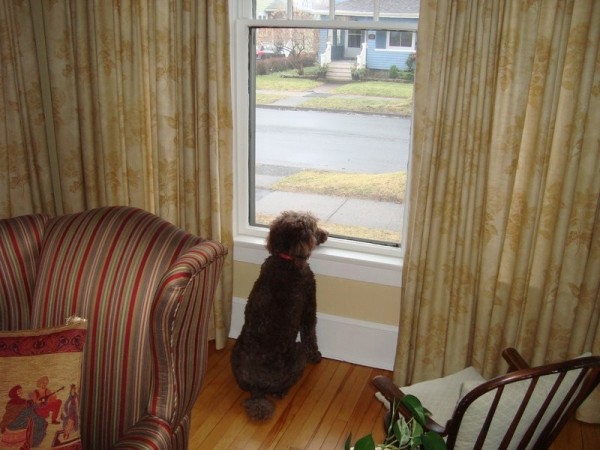 |
During the winter, we babysat Murphy Brown (a lovely poodle that belongs to our friends Wally and Martha) for 10 days. I had some fun capturing her in some of her favourite spots!
8 Photos
Created 16 May 2012
|
 |
 |
 |
 |
 |
 |
 |
 |
 |
 |
Pics of Aisling at anchor, up top and down below.
23 Photos
Created 2 November 2008
|
 |
 |
 |
 |
 |
 |
 |
 |
 |
 |
 |
 |
 |
 |
 |
 |
 |
 |
 |
 |
 |
 |
 |
 |
 |
 |
 |
 |
 |
 |
 |
 |
 |
 |
About Aisling 1
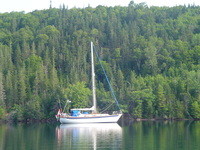
Who: Rick and Bonnie Salsman
Port: Halifax, NS, Canada
Quick Links
- Miscellaneous
- Greece-other
- Croatia and Montenegro 2012
- Sicily 2011-2014
- Italy (Mainland) 2012
- Weather and Technical
- Turkey
- Greece-Aegean
- Syracuse 2009
- Tunisia
- Malta
- Greece Ionian & Gulf of Corinth
- Sicily 2008
- Corsica and Sardinia
- Southern France
- Transatlantic part 2-Azores to Baiona
- Azores 2007
- South Spain & Balearics-2008
- South Spain & Gibraltar 2007
- Portugal 2007
- Atlantic Spain
- Transatlantic part 1-Halifax to Azores
- Previous Trips
- pre departure
- Show All Posts
SailBlogs Friends