SailBlogs
Bookmark and Share
Magic's Adventure
Matura Beach & the Turtles
Donna
09/14/2008, Chaguaramas Bay, Trinidad

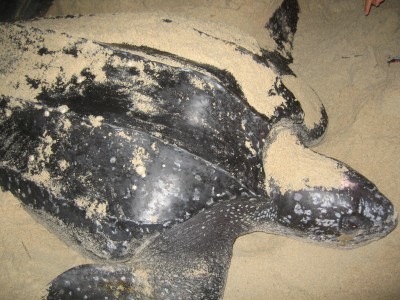
Matura Beach lies on the north-eastern coast of Trinidad and is one of several beaches in this part of the Caribbean used by giant leatherback turtles to lay their eggs. These are the largest of all sea turtles and during the season, which runs from March to the beginning of September, these magnificent creatures haul themselves up onto the beaches during the cover of darkness to lay white, soft shelled eggs which they tenderly camouflage and then leave to their own devices.

The female leatherback turtle can weigh up to 1,400lbs (500kg) when fully grown, and their shell can be up to 5ft in length. They are seriously endangered. Their diet consists mainly of jellyfish and other soft bodied invertebrates and they feed both on the surface and at depth. Many leatherback turtles have been remotely monitored by scientists with tracking devices as part of the effort to further understand and therefore protect these wonderful creatures. One of these turtles was tracked during a journey of 6,835 miles (11,000 km) from Trinidad to north of the Canary Islands, to the Bay of Biscay then to Spain, Morocco and Mauritania before the track was lost back at the Canary Islands. Another turtle was tracked diving to a depth of 4,265ft (1.3km). They are truly amazing animals.

After dark a nesting female will drag herself onto the beach. It is here that she is at her most vulnerable. Unlike other turtles which have a hard shell, hers is soft and cartilaginous and leaves her exposed to attack. Apart from man and feral dogs which will harass her in this helpless state, she is also at risk from dehydration. She has to finish her egg-laying task before the sun comes up. She chooses her nest site with care and then starts to excavate the sand with her powerful front flippers. She digs a pit large enough for her body and then starts to dig the actual nest with her back flippers, clearing the sand first with one flipper and then the other. Once she has dug as far as her flippers can reach, she starts to lay her eggs. Her nest will be approximately 2ft (70cm) deep and once her eggs are laid she packs the sand back into the hole, again using her back flippers. She will then camouflage the nest by moving the sand around with her front flippers until she is happy with the condition of the nest. Only then will she haul herself back to the surf and head out for open water.

The female will lay between 80 - 100 eggs each time she nests, and she may nest between 5 and 7 times each season. She will only nest, however, every 2 to 5 years. She can 'choose' the sex of the hatchlings in each batch; for males she will lay her eggs close to the waters edge where the temperature is cooler, for females she will lay further away from the sea where the sand is warmer. After hatching, the youngsters as a group will climb out of the nest by collapsing the sand above and around them. They time their exit to coincide with darkness (some miss their timing) and then scurry to the sea. It is believed that only 1 in 1,000 will survive. Apart from man, the youngsters are preyed upon by sharks and other large fish, crabs and, whilst they are still on the beach, feral dogs and birds of prey.

Our trip started at 4.30pm with our departure in Jesse James' tour bus heading for Matura. The time of our return was not known; that would depend on the turtles. The drive to Matura would take about 2 hours, not including the stop for dinner on the way. We were also unexpectedly delayed by a flat tyre, and finally reached Matura around 9pm. We were OK, the action hadn't started yet. The turtle watching at Matura is run by a volunteer group called 'Nature Seekers'. The group was formed by local residents in 1990 to try to stop the slaughter of leatherback turtles on their beach. At that time more than 30% of all turtles coming to shore were being killed. Today that number is 0%. For their work Nature Seekers have won a number of environmental awards and have turned their community into a destination for tourists in Trinidad.

On arrival we were given a talk on the turtles, and told what we could expect to see. We then went to a holding area to await a call from our guide if and when a female was seen emerging from the surf. Every night volunteers patrol the beach watching for the females coming ashore. They are in radio contact and when a female is spotted they will notify the guide and the group of observers will be taken to the turtle. Otherwise no non-volunteers are allowed on the beach. We could be in for a long wait.

Fortunately we weren't. Within about 30 minutes our guide's radio crackled into life and we were on our way down the beach. Luckily the moon had been full a day or so before our trip, so we had some light with which to see our way. No torches (flashlights) are allowed. A few hundred yards down the beach we found our female. Her shell was approximately 4ft in length and our guide estimated that she probably weighed in at about 900lbs. She had already started digging her pit, and we watched her put the finishing touches to it and then change to her back flippers to excavate her nest. This whole process probably took well over an hour, but it seemed like minutes so enthralled were we observing this incredible creature.

And then she started laying her eggs. At this stage we were allowed to approach the turtle, touch her and take photos, but no flash. Apparently once the female starts to lay she enters into what is described as a trancelike state and becomes unaware of anything going on around her. I've read several descriptions of the process on various turtle websites (see link below) but somehow cannot reconcile myself to the fact that she is not at all disturbed by a group of people surrounding her, touching her and taking her photograph while she is laying. It just doesn't seem possible. Having said that, I'm sorry to admit that we were juts as eager to get close to her as everyone else and it was a memorable experience to enjoy just a few moments with this wonderful creature. As soon as she had stopped laying we retreated back into the tree-line, and seemingly without undue haste she went on to cover and camouflage her nest before heading slowly back to the ocean.

On our way back down the beach we were delighted to find some newly hatched turtles emerging from the sand and scurrying down the beach towards the sea. While we watched a few, with obviously a similar sense of direction to my own, headed off towards the trees and we gently turned them around and assisted them to the waters edge. The chances of survival for these delightful mini-turtles are small, but the gusto with which they rush towards the open water suggests that each one will put up a fight all the way.

We walked back to the bus with a sense of awe and had a very quiet journey back to Chaguaramas not, as I originally thought, because everyone had fallen asleep, but because we all seemed to be deep in thought and contemplation about the incredible experience we had enjoyed for the last 3 hours. One day we hope to see these turtles again, but it is more of a hope that they will soon be removed from the endangered list and that their numbers will be allowed to grow without risk from man. Fingers crossed.
Link to Leatherback Turtle website

Trinidad
| | More
Trinidad
Donna
09/07/2008, Scotland Bay, Trinidad

It's Sunday afternoon, September 7th and we are sitting at anchor in Scotland Bay on the north-west coast of Trinidad. It is the first time in over two months that we have been at anchor and we are relieved to be out of the hustle and bustle of Chaguaramas and into the relative calm of the bay. We say 'relative' as this is also a popular spot for the local Trindadians to bring their power boats and 'lime' - generally hang out, chat, drink and play loud music. They also like to water-ski, which can make for a noisy and uncomfortable time on a sail-boat, but at least it's Sunday so by 5pm they will all have left leaving us to share the peace of the bay with the few other non-local yachts also anchored here. So in the meantime we're just sitting, listening to the howler monkeys bickering in the surrounding rainforest and watching the green parrots as they fly overhead back to their roosting spots, chattering to each other all the way.

Well that was the plan. Unfortunately, or fortunately depending on your point of view, a squall with winds up to 33kts came out of nowhere to hit us about 20 minutes ago which sent the locals fleeing for cover . A soaked Dave is standing watch in the companionway keeping an eye on the couple of boats closest to us. We have dragged a little ourselves, that is for sure, not enough that it's causing a problem right now, but sufficiently so that we may have to re-anchor once the conditions have settled down a bit. It is now still pouring with rain and the thunder and lightning has followed the wind so we're reluctant to venture on deck until we have to. At least Magic has stopped heeling. Being at a 45� angle when we're sailing is one thing, having to hang on while moving around an anchored boat is quite another.

It's close to 4pm and the winds have finally started to subside. But the tide must be on the turn as 1 - 2 ft swells have started rolling up the bay. Magic is beam on to the swells, and with her 6ft draft acting as a pendulum she has started to roll, violently. We've scrambled to stow items which had been left out of lockers and to secure crockery so that we will suffer no breakages, and have tried to get comfortable to ride out the roll, but it's a frustrating motion and tempers are starting to fray.

5.30pm and the swells are finally starting to calm down. The rain, however, still hasn't stopped and there appears to be no sign of a break in the downpour. But at least Magic is steady enough for us to start dinner and after we eat we've decided to watch a movie before we head to bed.

Monday morning, and we've woken to a totally different scenario from yesterday. The wind is still brisk, it's been gusting all night and has woken us periodically, but the sun is shining and the breeze is a welcome relief from the stifling heat. We were up early enough to hear Eric, the Trindadian weather-man who broadcasts on local TV but who also delivers a weather report to any listeners on SSB at 6.30am every morning. It appears that the nasty weather we experienced yesterday was courtesy of Hurricane Ike who, although several hundred miles north of us, was strong enough for us to feel his outlying effect here in Trinidad. The good news is that the weather for our area for the next week or so looks to be reasonably settled. After that, who knows? If there's one thing that has been confirmed to us during our cruising life so far it's that weather forecasting is more art-form than science.

Back in Chaguaramas early Tuesday morning we find that our discomfort over the weekend pales when compared to the experiences some of our friends have had. It appears that many of the boats on the moorings and anchored in the bay had to flee to find whatever cover they could, the waves and swells entering the bay making the anchorage untenable. Our good friends Tim and Linda on Matsu were forced to watch in horror as their boat rolled in her slip at Coral Cove Marina, her mast colliding with the mast of the boat next to her. It was too dangerous to actually be aboard 'Matsu', so they just had to hope that her lines, and the cleats on the dock, would hold long enough to prevent her smashing herself against the pilings and pontoons. Paul and Susanne on 'Thankful' were not so fortunate. Also in Coral Cove, Thankful's forward cleats were ripped out of her deck during a particularly violent roll and although the damage could have been worse there are now additional repairs for Paul to make before they head out again. Over the next few days we heard many other horror stories and were grateful that, on this occasion, by chance rather than design we happened to be in the right place at the right time.

So, what are we doing in Trinidad on the first place? Our original plan when we set off from Annapolis last November was to lay Magic up in Grenada for the summer. However, as we approached the dreaded hurricane season we were uneasy about the number of tropical waves rolling off the West African coast, and moreover the fact that it was early in the season to be seeing these waves with such monotonous regularity. Although 'officially' outside the hurricane belt, Grenada had been devastated by 'Ivan' in 2004 so after much discussion we decided to head for Trinidad which is situated just that little bit further south and therefore, theoretically, just that little bit safer.

We were not at all sure what to expect of Trinidad. As for most things in the cruising world when you ask the opinion of other 'yachties' some hate the place, some love it. And we have found it to be a place of contrasts, from the warm welcome of folks like Jesse James (no, seriously) who run businesses relying on the yachting community to the graffiti 'Yachties Go Home' sprayed in black paint on the walls of a local township. From the heat, dirt and hustle of Port of Spain to the relative cool, peace and beauty of the Asa Wright Nature Centre situated in the northern Trinidadian rainforest. To us, in a way, it's been reminiscent of the Dominican Republic; sometimes we love it, sometimes we don't. But Trinidad has certainly been an experience and one we won't forget in a hurry.

We arrived in Trinidad on July 1st after a 15 hour passage from Prickly Bay, Grenada. The conditions were perfect and we had great sail marred only by the necessity of running our engine every few hours to top up our ailing batteries. We were moored at the Chaguaramas Customs dock by 7.50am and safely on a mooring in the bay by 8.30am. We had a couple of objectives for our time in Trinidad. The first, obviously, was to keep Magic safe for the hurricane season. The second was to haul her, get up to date on routine maintenance tasks, bottom paint etc., and the third was to take delivery of new batteries we had ordered from the US which were to be delivered shortly before we were due to be hauled which, in turn, was due to happen shortly before we flew back to the USA for a few weeks.

We left the Customs dock and picked up a mooring in the bay. After a belated breakfast we sat down to plan our course of action over the next few weeks. We had a lot to accomplish before Magic was hauled, so although we had had very little sleep the night before we dropped the dinghy and headed ashore to speak to possible contractors and confirm our haul at the Power Boats yard.

And then we started to feel the heat. If there's a breeze in the evening, which there often is, the overnight temperatures in Trinidad can be pleasantly cool (well, just below 80�). However, as soon as the sun comes up the temperature climbs into the 90�s and the humidity soon reaches into the late 80%'s. Dave somehow managed to cope with the heat and humidity, at least in the early morning, and continued to work on deck. For me, though, these conditions were unbearable and I confined myself to chores below deck, cleaning out and re-arranging lockers and taking stock of our remaining provisions. After a few days on the mooring the conditions became too hot even for Dave to bear and we took the decision to 'bite the bullet' and head into the marina. Oh bliss! Air conditioning! Plugged in to mains power we could run our A/C and also keep our now terminally ill batteries topped up with juice. It meant that we could work for a few hours in the morning and then head below into the cool for a few hours before going out again to run other errands. Among other things, we had sails and canvas repairs to arrange and we needed a survey for insurance purposes.

For the next few weeks our routine continued in much the same way; work on deck in the early morning, retreat below for lunch and a break, run errands or relax in the afternoon and then around 4pm we would take a dip in the small marina pool before dinner. We occasionally broke our routine with trips to the fresh produce and fish market on Saturday morning, or to the HiLo grocery store or even to Movie Towne to see a new release and on Sunday afternoons Dave would venture to Crews Inn for the regular weekly Mexican Train Dominoes tournament! However, one of the highlights of our stay in Trinidad, and of the whole trip so far, was our visit to Matura Beach in north-eastern Trinidad to see the leatherback turtles lay their eggs. The whole experience is one that neither Dave nor I will ever forget, and I have written a separate log note as such an event certainly warrants a tale all of its own. So read on and see for yourselves the magnificence of the severely endangered giant leatherback turtle.

And yes, there was one other break from 'the norm' that I debated whether or not to mention, but decided that it really needed to be included - the July 4th party. We had expected there to be several announcements in the days leading up to Independence Day for parties, but were surprised that no US boats were advertising any activities at all. This couldn't be allowed! We called over to our good friends Jake & Carol on 'Offline'. Weren't they preparing a party for July 4th?? No, they hadn't really thought about it, but give him an hour, Jake said, and he would see what they could come up with.

Less than an hour later, Jake was back on the radio. OK, the party's on! Jake & Carol had hot dogs and buns, we agreed that we could get some salads together, and we all started working the radio to invite anyone we could reach. At 4pm we all gathered in the pavilion at Coral Cove. DJ Jake in the space of a few hours had put together a medley of American songs ranging over the last � century. At first the non-American attendees even outnumbered the US contingent, but as the afternoon wore on, and presumably word (and music) spread, the numbers evened up. The food was barbequed to perfection, the drink flowed and the music was great. Everyone was dancing (the less said about Dave's back injury caused by some somewhat less than sensible gymnastics, the better!), and at the end of the evening almost everyone ended up in the pool. We have to say that it was probably one of the best July 4th parties we have been to, and that's saying something as we've attended some dandies!

All too soon the date for Magic's haul-out was upon us. Even though we had had almost three weeks to prepare, there was still the usual last minute scramble to get the final tasks completed. At 8am we prepared to leave the slip to head for Power Boats. Dave put Magic into reverse to back her out of the slip and ................... 'Houston, we have a problem'. We had almost no power! We limped out of the slip and made our way slowly, very slowly, down the bay to Power Boats. We now had an interesting maneuver to perform; we had to reverse Magic into the haul-out pit in 25kts of wind with almost no help from the prop. Luckily, Tom (Sojourn) was on board to help us, and as we were approaching the pit Mike and his son Phillip (Adamo) were coming along in their dinghy. With some nifty maneuvering by Dave, and some added help from Phillip pushing Magic's bow with the dinghy, we managed to get her into the pit and secured. As usual when we haul, the back-stay had to come down and then the travel-lift was put into position. At this stage of the process, Dave did his usual disappearing act. He cannot stand to see the boat lifted from the water and taken to the spot where she will be secured on stands. Only when Magic is in position, and the stands are in place will he appear again. It is a ritual we go through every time the boat is hauled, and then the same in reverse when she is launched again. At least on this occasion, as soon as she was lifted from the water we could see what had caused our power problem. Magic's prop was covered in about �" of barnacles! We had cleaned our prop in Grenada shortly before we left, so the build-up had occurred in a period of just over three weeks. Trinidad is notorious for the rapidity of barnacle growth, and it appears that the notoriety is more than justified.

In less than 30 minutes Magic was secured in the prime spot in Power Boats yard - directly in front of the roti hut! In the short space of time that we had been in Trinidad, Dave & I had become devotees of the lunchtime roti ritual. Curried chicken, potato and chick peas wrapped in warm Indian flatbread may not sound like much of a gourmet treat, but they are absolutely delicious. And the Power Boats roti hut serves the best around. If you hadn't got your order in by noon, chances are you'd be out of luck as everything is sold out quickly. We would be greeted every morning by the smell of spices, garlic and bread cooking and our mouths would water. At 11.30am we'd head down the ladder from Magic to the hut and place our order. We'd then spend a very pleasant hour or so chatting with friends over our lunchtime treat, until it was time to head back to work once again.

We had rented a room at Power Boats as we were not looking forward to leaving aboard 'on the hard'. The heat as well as the inconvenience of going up and down the ladder a dozen times a day (not to mention in the middle of the night!) incentivized us sufficiently to treat ourselves to accommodation ashore. The rooms were basic, but functional and we at least able to indulge in a long shower after a hard days work on the boat. As it was, we only had three days to put the finishing touches to Magic before we flew out back to the US. Under normal circumstances this would have been easy to achieve, but we had to keep reminding ourselves that we were leaving Magic in the tropics in the middle of the rainy season and extra precautions therefore had to be taken if we wanted to find her in perfect shape when we returned. So we worked our way through our task list, and when our taxi came to pick us up at 4am on the morning of July 29th to take us to the airport, we were ready to go. We had an 18 hour journey ahead of us, but our good friends Mike & Roberta would be waiting at Baltimore airport for us when we arrived and we were looking forward to seeing them. At 4am we waved good-bye to Magic and loaded our bags in the car. We were Annapolis bound.

Trinidad
| | More
Grenada
Donna
08/21/2008, Clarkes Court Bay, Grenada

We pulled into 'the lagoon' in St. Georges Harbor shortly after 12 noon on Friday, June 20th. We had made an early start from Tyrrel Bay, Carriacou with Daniell Storey, Sojourn and Blue Water Cat. The weather had been unsettled for several days and although squalls had been forecast for today we had hoped to reach our destination before they arrived. We were out of luck. Just before 7am a squall containing 24kts of wind hit us and visibility was reduced to less than a couple of hundred yards. Dave was soaked, again. Dave on Daniell Storey called us on the VHF. He could see a blip on his radar that looked as if it was heading towards us. We turned on our radar and peered into the gloom, but could see nothing. A short while late another sailing boat appeared out of the rain on our port side. Although not too close to us, we were not able to see him until the last minute and it's this type of surprise that is always unwelcome in fog or heavy rain.

The lagoon is aptly, and inappropriately named at the same time. It is a piece of water almost totally surrounded by land and as a result is calm in almost all weathers. On the other hand rather than being a beautiful clear blue, as its name would imply, the water in the lagoon is a murky brown and totally unsuitable for swimming. There are many beautiful anchorages in Grenada but we chose the lagoon because of the unsettled weather we mentioned earlier. We felt that Magic would be safest here. And she was safe, the only downside was the heat. The lack of wind in this sheltered spot kept the boat very hot and we spent quite a bit of time ashore trying to make the best of any breeze and the cooling effects of the many rain showers. In total we spent nine days anchored in the lagoon. But we did see some of Grenada in the process.

St Georges is the capital of Grenada. It has a beautiful waterfront and a wealth of history, but aside from this it is not dissimilar to other capitals in the Caribbean. It has a mall area specifically dedicated to the cruise ships that visit the island during the season, it has banks and cell-phone stores and, of course, the main government buildings are located here. Although the duty-free cruise ship mall was very useful to us when it came to topping up on the rum, the biggest attraction St. Georges held for us was the fresh markets. There is a fresh produce market which also houses the spice market, and a fish market. All are colorful, noisy, bustling and an experience to visit. The fish market was a particular favorite. Although there is not a huge selection of fish, everything is very fresh and the ladies selling the goods are very knowledgeable and only too willing to offer advice. We bought fish at the market more than once while we were in St. Georges, our most memorable being two beautiful yellowfin tuna steaks freshly cut from a fish that must have weighed close to 200lbs.

The fresh produce market also held a fascination, supplying mainly locally grown Caribbean fruit and vegetables. Mangoes were in season while we were in Grenada and we were spoilt by the variety of different types each of which had a distinctive texture and flavor. Our favorites were the 'July's', named, we suspect, because they tend to be in season around July. These have a beautifully sweet flavor and little to no fiber. We enjoyed them with our breakfast almost every day.

Grenada is known as the 'Spice Island' and walking around the spice market you can easily see why. The variety of herbs, spices and seasonings and sauces is quite something. Again, all the stallholders are more than willing to explain the uses of each item, whether it was a seasoning for cooking or an ingredient in a natural remedy. We treated ourselves to some of Grenada's famous nutmeg, some vanilla and a few hot sauces although some of the remedies we were offered we politely declined.

As we mentioned earlier, we were in Grenada during some quite unsettled weather which, apart from keeping us in 'the lagoon' for Magic's safety also made us reluctant to wander too far away from the boat. So when we had a couple of days that were forecast to be sunny and dry we finally ventured away from St. Georges. We took a local bus to the Grand Etang National Park which is located about 8 miles from the capital. It is more than 2,000 ft above sea level and has extremely diverse vegetation ranging from rainforest to elfin woodland to cloud forest. The park also has a group of Mona monkeys inhabiting the forest. Although indigenous to western Africa, these monkeys were transported to Grenada on slave ships during the 18th century and have thrived here ever since. They are used to being fed by visitors and often when a tourist bus shows up they will appear on the fences surrounding the park center waiting for their banana treat. We saw no sign of the monkeys when our bus stopped at the park entrance, so instead we hiked to another of the parks' attractions, the crater lake.

The park has many hiking trails, and one of the easier ones takes you to the Grand Etang Lake. The lake fills the crater of one of the islands extinct volcanoes and is a prime spots for viewing some of Grenada's more colorful birds. Unfortunately, although the forecast had been for good weather, the skies had clouded over when we reached the lake so there wasn't much birdlife to be seen, but the area itself is beautiful and was well worth the effort.

Next we decided to hike to the Seven Sisters Falls, a series of waterfalls, which get higher and progressively more difficult to access. It was a long walk down the road to the start of the falls trail, but we managed to get there with the rain still holding off. The trail took us through private farm land, so we were careful to keep to the path. A little way down the trail we actually met with the farmer who was tending his nutmeg trees and was happy to stop and speak with us. Grenada lost over 80% of its nutmeg trees during Hurricane Ivan in 2004 and they are only now just starting to recover. The farmer gave us samples of his nutmegs surrounded by the red, almost plastic-like mace and told us of the difficulties that had been faced by those who had lost their trees. It was a sad reminder of how devastating Mother Nature can be. We chatted for a few moments and then continued on with our hike.

As the trail meandered through the rainforest the trails became much wetter and muddier. We slid down hills and clambered over tree roots and finally found ourselves at the base of the Seven Sisters. Here we found two of the falls. The others were higher up the trail, but due to the conditions we decided not to venture further. We had brought a picnic lunch with us so found a spot to sit and enjoy our meal. Some of our group went for a quick swim in the pool to cool off. And then the heavens opened. We found some old corrugated tin roofing and held it over our heads to give some shelter but it appeared that the rain was going to continue for a little while yet. The trail on the way down had been slippery and we were concerned that, after more rainfall, it would be even more treacherous on the way back up. Reluctantly we all decided that we better make tracks, rain or no rain, and headed back up the trail.

Luckily the trail seemed no worse and we were back at the trail head still reasonably dry and in good time. Now we just had to figure out a way back to St. Georges. Dave was on the case. A taxi had just pulled up at the trail head with some tourists who wanted to hike the falls. Although the driver did not have the time to takes us all the way back, he would be able to take us to the nearest 'major' town, Grenville, and from there we would easily be able to pick up a bus to take us back to St. Georges. We were able to pick up a ride from Grenville, and had the whole bus to ourselves. So that when we saw the Mona monkeys on our way back through the park we were able to ask the driver to stop so that we could take a look. Dave still had a banana left and struck up quite a rapport with one particular animal so much so that we wondered if we would have to prevent the monkey getting back on the bus with us. But once his banana had gone the attraction had too and our Mona friend disappeared back into the forest.

We got back to the boats just after 5pm. It had been a long and tiring day, but we had seen quite a lot and were not unhappy with our trip. We had not as yet managed our island tour, but that was going to have to wait until our next trip to Grenada. Meanwhile we still had one more treat in store for this visit. An international cricket match!

We had heard a few days before about the one-day test between the West Indies and Australia that was being played in St. Georges the following week. Cricket is a very popular sport in Grenada and we weren't sure about the availability of tickets, but a trip to the stadium resulted in the purchase of some good seats so on Friday 27th June we were off to the cricket. Dave is a big fan but had not been to a match for many years. We had several of our American cruising friends who had expressed interest in seeing a match and we felt that a one-day international would be a good introduction for them. By definition, the time constraints of a one-day test usually mean a more exciting game as both teams are willing to take greater risks to earn runs and tactics are put to one side.

It was going to be a long day so we planned on a picnic lunch and Dave, Jimmy (Blue Water Cat) and Tom (Sjourn) took the bus to the local brewery to buy cases of beer. The only problem on the horizon was, yet again, the weather. It was not impossible that the match would be rained off, but we were optimistic and Friday dawned bright and sunny. Dave & I had tickets along with Dave & Michelle (Daniell Storey), Jimmy & Donna (Blue Water Cat), and Tom (Sojourn). The match was due to start at 9.30am so we had arranged for a taxi to pick us up at 9am. Sure enough, when we found our seats they were good and gave us an excellent view of the play. Both teams came onto the pitch, Australia won the toss and opted to bat. Within the first 15 minutes the Ozzies lost two wickets; the start of the match looked promising. They then started to get their act together and began to score some runs. As the match approached the lunchtime break however, the play seemed to stagnate and we could see why the game of cricket has occasionally been likened to the excitement of watching paint dry. Our American contingent had been involved in the match, asking questions and cheering when the West Indies fielded well, but a little boredom was starting to creep into all our expressions. Australia had used their 50 overs just before 1pm and we all welcomed the respite called 'lunch'.

After lunch the West Indies came out to bat. They too lost several wickets in the opening overs and after a while their performance too became definitely lackluster. At 4pm the heavens opened and 'rain stopped play'. It looked certain that, given their performance up to now, the home team had little chance of beating the Australians. We took the decision to leave and head back to the boats. We had enjoyed the day but had hoped for more action on the field. We were enjoying a drink in a local bar that evening and spoke with some other cruisers who had also been at the match. Apparently after the rain stopped the West Indies came back onto the field with a renewed sense of purpose and started hitting runs. Although they weren't able to match the Australian score they did come close. We had missed what was probably the best play of the day. C'est la vie!!

The following Sunday we finally pulled out of the lagoon and headed to the south east coast of Grenada so that we could stage our departure for Trinidad. We had originally intended to anchor off of Hog Island but the wind was, as usual, right on the nose and so instead we bailed out at Prickly Bay. On this side of the island we were able to attend the famous 'burger night' at Clarkes Court Bay Marina which also gave us the opportunity to take a look at the marina we had Magic booked into for the time we would be back in the UK later in October.

At 4.30pm on Monday we hauled anchor along with Matsu, Offline, Kiva and Sweet Dreams. The forecast was good for our run to Trinidad.

Windward Islands
| | More

Newer ]  |  [ Older ]


Powered by SailBlogs