
s/v Ceili
"You live with a ship a few years and cuss her enough and all of a sudden one day you wake up and discover you're in love." ----Ernest K. Gann, CMA 1930 and Author of "Twilight For The Gods" and Captain of the brigantine ALBATROS
13 May 2012
09 April 2012
02 April 2012
26 March 2012
18 March 2012 | Vero Beach
12 March 2012 | Green Turtle Cay, Abacos, Bahamas
20 February 2012 | Sea of Abaco
20 February 2012
15 February 2012
03 February 2012 | Marsh Harbour
01 January 2012 | Marsh Harbour, Abacos
24 December 2011
23 December 2011
22 December 2011
22 December 2011
18 December 2011
17 December 2011
17 December 2011
13 December 2011
08 December 2011 | West End, Bahamas
Things That Don't (always) Work
09 April 2012
Bill
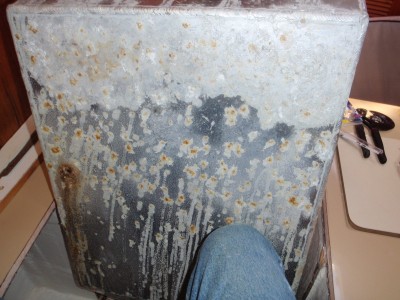
"Dear, Do You Think This Might Explain That Bad Bilge Smell?"
In November (11/18/11) , we discussed things that really work onboard Ceili. It's fair to say that we have also experienced our share of things that don't work (very well) in our 10 months of living aboard full time. Here is a rundown of those things that have annoyed us the most on our cruise.
1. TOHATSU OUTBOARD:We purchased our 9.8 hpTohatsu new 2 years ago. Tohatsu also makes outboards branded Nissan and Mercury. Our outboard received excellent care....oil changes every 50 hours and was equipped from new with a Racor water separator and fuel filter. It was covered when not in use and seemed to lead a pretty pampered life (maybe that was the problem...tough love might have been better, we think). While in Marsh Harbor, it began to act surly, and was difficult to start. Then it failed to start at all. I disassembled and tested as much as I was able to, and unable to get it started, finally surmised that it was an electrical/ ignition problem. But these new four strokes aren't like the simple 2 strokes we all learned on.....they're more like a modern car with electronic ignition and black boxes which defy the backyard mechanic. So, after a lot of angst, it was off to "James", the local Marsh Harbor outboard mechanic with a good rep (did I mention that there were no Tohatsu service centers in the Bahamas, and that the engine was still under warranty?). James was a find, though, and diagnosed the problem in less time than it took me to schlep the recalcitrant 84 lb. iron lump to his shop.
The bad news: a bum exciter coil that was not available in the Bahams and would take a week to get from the US (it actually would eventually take 2 weeks). But, James was willing to loan me a used, 10 year old 2 hp Yamaha 2-stroke that he had lying around in the shop, so at least we wouldn't be rowing the dinghy while we explored the Abacos.
At this point I must digress and confess that I became very fond of that little Yamaha. I could lift it with one hand, and walking back the 1 mile to Ceili with it seemed like child's play compared to schlepping the "lump", as we now call the Tohatsu. Not only that, the little bugger always started on the first pull, and though it smoked like a bastard, never let us down in the 2 weeks we used it.
When the Tohatsu was fixed, I sadly returned the Yamaha. All seemed well, until several days later, I decided to make a high speed run out of the harbor towards Mermaid Reef, just to make sure that all was well for our next trip. On the way back (fortunately), the "lump" began to misfire and buck, and then quit altogether. I deployed an anchor to keep from drifting out to sea, and was eventually able to get it restarted, though it would only idle roughly. I was able to limp back to Marsh Harbor, arriving just before dusk. I called James, and he agreed to check it out the next morning.
Of course when James took it for a spin, it refused to act up. The worst of all mechanical problems....the "intermittent" malfunction which cannot be duplicated by the mechanic. James suggested a carburetor problem (dirt), and I was a little skeptical. But, in less than an hour, the carburetor was removed, stripped, cleaned and reinstalled. I was amazed at his effeciency, even if I was suspicious of the diagnosis. But, time has proven James right, and the engine has been running OK (crossed fingers) ever since.
But, like a jilted lover, I had lost all faith that the "lump" would ever be trustworthy again. James, who was by now becoming a part of the family, agreed to part with his little Yamaha. I made sure that the Tohatsu was in the room when the deal was done, as a not so subtle threat against further indescretion.
2. ISLAND PACKET HOLDING TANK
This is a notation made in Ceili's maintenance Log just before our trip South:
HOLDING TANK REPLACEMENT!!! READ THIS!!!
If you are a new owner reading this, you should be extremely grateful that this job has been done by the previous owners (us). Why I.P. (Bob Johnson) ever decided to use aluminium for their holding tanks has never been well explained, but as of late they have switched to fiberglass, probably because of stories like this one.
We "babied" our aluminum tank, using only freshwater, frequent pump outs, flushing, etc. And it failed after 16 years. We were "lucky", as many other IP owners have had their tanks fail after only 7 or 8 years.
Tank removal and replacement was a gargantuan task, even a "bitch". The tank is buried low, and access meant cutting through the forward berth and two more levels beyond that. The process took about 10 DAYS!!! Of full time work.
We had a new tank fabricated by C&H Plastics, of Johnston, RI to IP dimensional drawings. The tank is constructed of extra-thick 1/2 inch HDPE, which will not corrode and will hopefully outlive the boat. The tank also has a 1/2 HDPE baffle on center, and was welded, spot tested and water tested prior to installation. The thick plastic should hopefully resist odor permeation for a long time. ARE YOU LISTENING , BOB!!!????
All new odorsafe sanitation hose was installed to both heads and all connections, including the vent hose. The direct overboard diversion valve was removed, making the system a " Through Holding Tank Overboard Discharge System," via macerator if desired.
Another problem of the original IP design was no accomodation for installation of a tank level monitor, so one was installed, using the SCAD external tank sensor unit.
The tank capacity was measured after installation at 28 useable gallons, which brings the tank level to just below the vent opening on the tank. The monitor is set to show FULL at approximately 80% of this, or about 23 gallons. This should avoid the problem of overfilling and possibly obstructing the vent. Plastic tanks are more pressure sensitive than metal ones, and the vent must be kept clear and functioning at all times.
If you have detected a degree of criticism/exasperation as you read this, you would be correct.However, the IP40 is a wonderful boat, generally with very few vices (this being one of them). She is well worth the time we spent in this endeavor, with the intention of never having to repeat it.
Happy Sailing!!!!
Bill and Linda Daley
S/v CEILI
In November (11/18/11) , we discussed things that really work onboard Ceili. It's fair to say that we have also experienced our share of things that don't work (very well) in our 10 months of living aboard full time. Here is a rundown of those things that have annoyed us the most on our cruise.
1. TOHATSU OUTBOARD:We purchased our 9.8 hpTohatsu new 2 years ago. Tohatsu also makes outboards branded Nissan and Mercury. Our outboard received excellent care....oil changes every 50 hours and was equipped from new with a Racor water separator and fuel filter. It was covered when not in use and seemed to lead a pretty pampered life (maybe that was the problem...tough love might have been better, we think). While in Marsh Harbor, it began to act surly, and was difficult to start. Then it failed to start at all. I disassembled and tested as much as I was able to, and unable to get it started, finally surmised that it was an electrical/ ignition problem. But these new four strokes aren't like the simple 2 strokes we all learned on.....they're more like a modern car with electronic ignition and black boxes which defy the backyard mechanic. So, after a lot of angst, it was off to "James", the local Marsh Harbor outboard mechanic with a good rep (did I mention that there were no Tohatsu service centers in the Bahamas, and that the engine was still under warranty?). James was a find, though, and diagnosed the problem in less time than it took me to schlep the recalcitrant 84 lb. iron lump to his shop.
The bad news: a bum exciter coil that was not available in the Bahams and would take a week to get from the US (it actually would eventually take 2 weeks). But, James was willing to loan me a used, 10 year old 2 hp Yamaha 2-stroke that he had lying around in the shop, so at least we wouldn't be rowing the dinghy while we explored the Abacos.
At this point I must digress and confess that I became very fond of that little Yamaha. I could lift it with one hand, and walking back the 1 mile to Ceili with it seemed like child's play compared to schlepping the "lump", as we now call the Tohatsu. Not only that, the little bugger always started on the first pull, and though it smoked like a bastard, never let us down in the 2 weeks we used it.
When the Tohatsu was fixed, I sadly returned the Yamaha. All seemed well, until several days later, I decided to make a high speed run out of the harbor towards Mermaid Reef, just to make sure that all was well for our next trip. On the way back (fortunately), the "lump" began to misfire and buck, and then quit altogether. I deployed an anchor to keep from drifting out to sea, and was eventually able to get it restarted, though it would only idle roughly. I was able to limp back to Marsh Harbor, arriving just before dusk. I called James, and he agreed to check it out the next morning.
Of course when James took it for a spin, it refused to act up. The worst of all mechanical problems....the "intermittent" malfunction which cannot be duplicated by the mechanic. James suggested a carburetor problem (dirt), and I was a little skeptical. But, in less than an hour, the carburetor was removed, stripped, cleaned and reinstalled. I was amazed at his effeciency, even if I was suspicious of the diagnosis. But, time has proven James right, and the engine has been running OK (crossed fingers) ever since.
But, like a jilted lover, I had lost all faith that the "lump" would ever be trustworthy again. James, who was by now becoming a part of the family, agreed to part with his little Yamaha. I made sure that the Tohatsu was in the room when the deal was done, as a not so subtle threat against further indescretion.
2. ISLAND PACKET HOLDING TANK
This is a notation made in Ceili's maintenance Log just before our trip South:
HOLDING TANK REPLACEMENT!!! READ THIS!!!
If you are a new owner reading this, you should be extremely grateful that this job has been done by the previous owners (us). Why I.P. (Bob Johnson) ever decided to use aluminium for their holding tanks has never been well explained, but as of late they have switched to fiberglass, probably because of stories like this one.
We "babied" our aluminum tank, using only freshwater, frequent pump outs, flushing, etc. And it failed after 16 years. We were "lucky", as many other IP owners have had their tanks fail after only 7 or 8 years.
Tank removal and replacement was a gargantuan task, even a "bitch". The tank is buried low, and access meant cutting through the forward berth and two more levels beyond that. The process took about 10 DAYS!!! Of full time work.
We had a new tank fabricated by C&H Plastics, of Johnston, RI to IP dimensional drawings. The tank is constructed of extra-thick 1/2 inch HDPE, which will not corrode and will hopefully outlive the boat. The tank also has a 1/2 HDPE baffle on center, and was welded, spot tested and water tested prior to installation. The thick plastic should hopefully resist odor permeation for a long time. ARE YOU LISTENING , BOB!!!????
All new odorsafe sanitation hose was installed to both heads and all connections, including the vent hose. The direct overboard diversion valve was removed, making the system a " Through Holding Tank Overboard Discharge System," via macerator if desired.
Another problem of the original IP design was no accomodation for installation of a tank level monitor, so one was installed, using the SCAD external tank sensor unit.
The tank capacity was measured after installation at 28 useable gallons, which brings the tank level to just below the vent opening on the tank. The monitor is set to show FULL at approximately 80% of this, or about 23 gallons. This should avoid the problem of overfilling and possibly obstructing the vent. Plastic tanks are more pressure sensitive than metal ones, and the vent must be kept clear and functioning at all times.
If you have detected a degree of criticism/exasperation as you read this, you would be correct.However, the IP40 is a wonderful boat, generally with very few vices (this being one of them). She is well worth the time we spent in this endeavor, with the intention of never having to repeat it.
Happy Sailing!!!!
Bill and Linda Daley
S/v CEILI
Comments
| Vessel Name: | CEILI |
| Vessel Make/Model: | Island Packet 40 (hull #50) |
| Hailing Port: | Providence, RI |
| Crew: | Bill and Linda Daley |
| About: | Currently sailing the coast of New England in anticipation of heading South someday. Ceili is currently moored in East Greenwich, R.I. We have been sailing for awhile now, and are both USCG licensed captains (hence, no crew!) |
| Extra: | "Ceili" (kay'- lee) is gaelic for "joyful celebration." It reflects our Irish roots. |
Gallery not available
s/v CEILI
Who: Bill and Linda Daley
Port: Providence, RI
Table of Contents
Interesting Links
- Bahamian Chicken Souse
- Aldrich Mansion
- Amokura
- AtLantic Highlands Harbor
- Baltimore Promenade
- Block Island
- C and D Canal
- Capt. Billy Joel Designer Man
- CEILI on YouTube
- Coecles Harbor Marina
- Concordia Yawls/Padanaram
- Coronet/IYRS
- Current NY weather RADAR
- Current Wind Observations
- Cuttyhunk
- Cuttyhunk Fishing Club Slide Show
- Dark 'n Stormy Redux
- Dunkirk's Heroes Return
- Dutch Harbor
- Father's Day Rescue
- Fishers Island
- GAM Single Sideband Antenna
- Glebe Creek Screenworks
- Goslings Rum
- Greatland Laser Flare
- Island Packet 40 Specs
- Island Packet Photos
- Island Packet Yachts
- Katama Breach
- Lopolight
- Maine harbors
- Marine Traffic/AIS
- Masquerade Sailblog
- McMurdo FastFind PLB
- Montauk
- National Hurricane Center
- New Bedford YC/Padanaram
- Newport
- Ocean Marine Systems
- OUR BOAT PROJECTS
- Pangaea Expedition
- Queens's Wave
- Rapid Diver
- S/V ONWARD
- Safety at Sea Seminar
- Scott Boomlock
- Seven Drowned in Tarpaulin Cove
- Shelter Island
- Sleighride
- Star Island Marina-Montauk
- Stonington,CT
- Sydney Boats Ablaze
- THE BEST Ginger Beer
- The Greatest Great White
- WebCam: Edgartown Marine
- WebCam:Block Island
- WebCam:Cape Cod Canal
- WebCam:Hyannis Harbor
- WebCam:Newport
- YANMAR Help!!!