05/10/2008, Grand Haven, MI
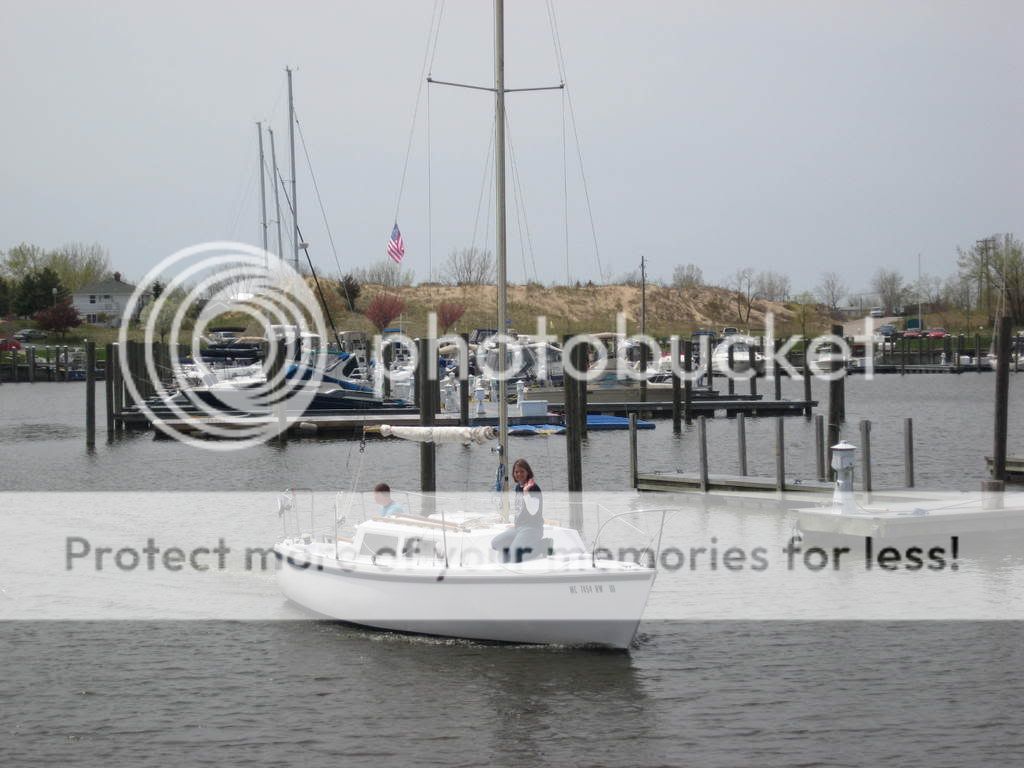
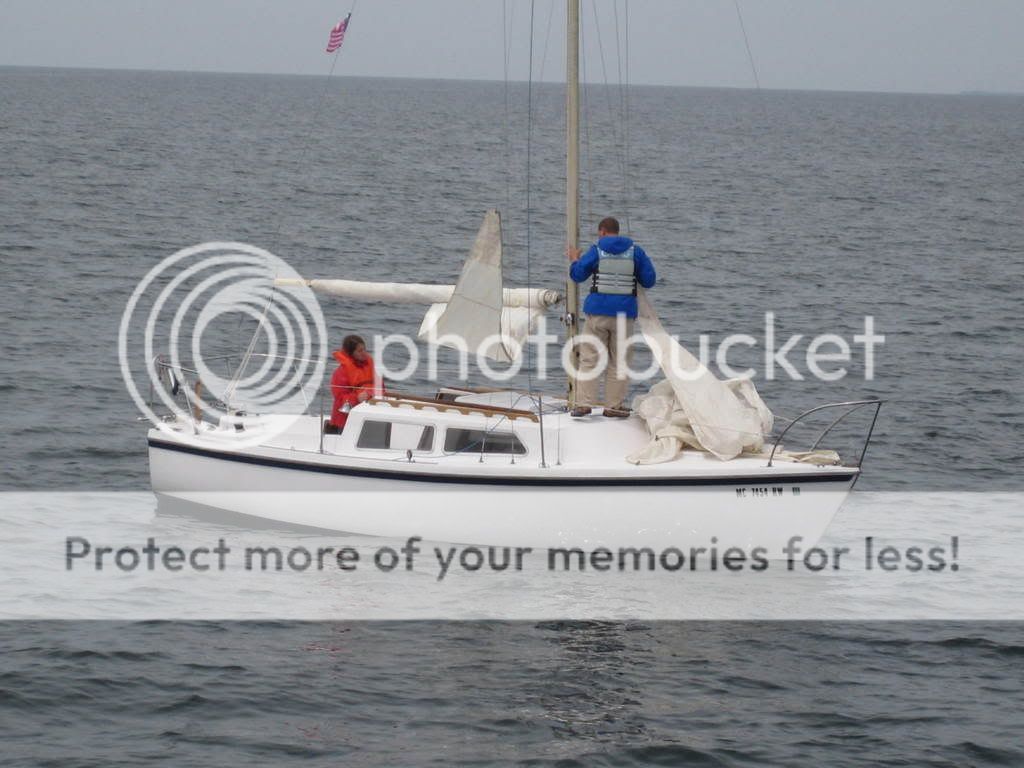
Our first sail on our "new to us" boat was short but ever so sweet!
We tried our sails and running rigging at the slip before departing for the lake. Everything seemed like it was working as it should, so we shoved off for Lake Michigan. Once reaching the big lake, we motored out about a half mile before shutting down the outboard and preparing to hoist the sails. Erin took the helm as I scurried about the deck and cockpit setting the sails and sheets. Once the jib went up, we were off! The conditions were light (wind to 10 knots from the North), but we made headway and enjoyed every minute of the first sail. We practiced making a couple of tacks and alternated between beam and broach reaching.
On the way in we encountered engine problems, as the pull cord for our outboard broke, the choke stuck open and caused the engine to run poorly and to top it all off, it wouldn't stay in gear! Luckily we had my mom and dad nearby with the mothership (their Carver motoryacht) for assistance if we needed it. Erin and I both were nervous bringing the boat back to the marina and slip while dealing with a motor that kept stalling, but we did so without incident. Erin worked the tiller like an experienced helmsman!
Here are a few pictures from the outing taken from the "Mothership".
Motoring out of the marina:

Readying the sails:

Sailing!:

|
|
05/09/2008, Grand Haven, MI
The big days for our little boat keep rolling in. Today we splashed her at her new summer home, North Shore Marina in Grand Haven.
The marina staff used a modified fork lift that is typically used for their "in and out" service to lift the boat off the trailer and set her gently down in the water. Even though the staff knew exactly what they were doing, I was still quite nervous as I watched the boat lift from the trailer and be set into the water.
I was also nervous after the hull hit the water. Would it keep the water on the outside where it belongs? Or did I miss some hidden spot on the hull where water could get inside? Will the swingbolt for the centerboard be water tight? Time will tell.
Anyway, here are a few pictures (courtesy of my mom):


And finally, resting peacefully in her slip:

|
|
05/07/2008, Grand Haven, MI
Finally...the day I've been anxiously awaiting since last fall has arrived. Today we stepped the mast. Obviously, this is a big day since it moves us that much closer to actually sailing our "good old boat". But despite my excitement, I was also very anxious because of the unknown. I've never stepped a mast or rigged any sailboat larger than a Laser.
Luckily, I received a lot of great advice from forums members at Sailnet and a few other trusted Helms owners. Based on this advice, I constructed a gin pole from Home Depot materials (10' 2"x6", 4 eye bolts, ratchet strap) that made the job very manageable. I cut the gin pole to fit around the base of the mast and used the ratched strap to hold it in place. We then attached the forestay to the opposite end of the gin pole and ran a line from the same end through a block on the bow and back to the sheet winch in the cockpit. One person stood holding an extension ladder which supported one end of the mast. Another person operated the winch. Yet another stayed at the mast hinge to keep the mast from tipping to either side. The fourth person moved frantically about the deck attaching stays and shrouds to chainplates. It was a beautifully orchestrated dance, in hindsight, of course.
I was fortunate enough to enlist the help of my wife, mom, dad and two little girls. Six novice "steppers" working together to get the mast up before sunset. I'm happy and proud to report that we did it without incident! Yes, we had some tense moments when I thought the halyards had come off the sheaves after the stick was up and when the weight of a heavily leaning mast lay on my shoulder when we forgot to cleat off the tailing end of the line from the sheet winch. But I can't express the shear joy of seeing our little boat with an upright mast waiting just feet from the water for her day to be splashed!


|
|
05/07/2008, Grand Haven, MI
Today was a big day for our sailboat. Most of the hard restoration work has been completed and she's moving to her new home in Grand Haven on Lake Michigan. We loaded her up with all of our crusing gear and towed her west.
Recently completed projects include:
-New compainionway hatchboards installed
-New teak handrails installed
-Refinished teak railslides installed
-Transom boarding ladder installed
-Fishing rod holder installed
-New dinette table built and installed


|
|
05/07/2008, Grand Rapids, MI
It's been a while since I've made a blog post, but I have a legitimate excuse: I've been busy with spring boat projects!
Over the last three weeks, I finally finished up the new paint job. We painted everything above the waterline on the boat (hull sides, boot stripe, cove stripe, deck, non-skid, cockpit). As with many projects, the preparatory work was the hardest part. In preparation for painting, I sanded the entire boat first with an orbital sander, than by hand. Next, I washed over the sanding residue with warm water and a bit of soap.
I then applied one coat of Interlux Pre-Kote. This, of course, was followed up with another round of sanding. Then the next coat of Pre-Kote primer was applied. Followed by more sanding. Needless to say, my forearms are now Popeye-esque from all the sanding.
After priming, my dad (thanks dad!) helped me roll and tip two coats of Interlux Brightsides polyuerethene onto the hull. We were both very impressed by the ease of application and the end result of a shiny, hard finish. I also used Brightsides for the new dark blue boot stripe, dark blue cove stripe and white cockpit. Interlux Interdek was used on the non-skid portions of the deck. Interdek is a polyuerethene very similar to Brightsides, but with small polymer beads added for traction. It also has a low sheen/gloss finish to cut down on glare. What follows are before and during pictures. Stay tuned for some "after" pictures very soon!


|
|
03/16/2008, Grand Rapids, MI
Today I picked up a of Lewmar #7 single speed winches from a fellow sailor who was scrapping one of his sailboats. The winches are in excellent condition and should make good spares or upgrades for both my halyard and jibsheet winches. My starboard side jibsheet winch is currently dismantled in my garage and in need of a tune-up. I may replace it with one of the Lewmars.
Anyway, I took the two Lewmar winches apart for cleaning and oiling. As soon as the weather gets warm enough to apply adhesives (3M 5200), I'll look into installing them.
|
|
Nice job, good luck,
Wayne
greg
03/13/2008, Grand Haven, MI
So the calendar says there's only one week to go until spring. Today I got anxious and decided to take a drive out to the big lake and see how she's doing. As you can see from my pictures below, we here in Michigan still have a fair bit of thawing to do before we can declare the boating season open.


|
|
03/12/2008, Grand Rapids, MI
As spring draws closer, we're getting more and more excited about the upcoming sailing season and "splash day" for our sailboat.
We now have our slip reserved at North Shore Marina in Grand Haven, Michigan. We can't wait to enjoy the summer breezes coming off of Lake Michigan while we rock away the days on the boat. We're also very excited to be able to have a spot at the same marina where Kevin's parents keep their boat.
Bring on summer!

|
|
01/21/2008, Grand Rapids, MI
As you may recall from some posts late last summer, most of the teak on our sailboat's deck was severly rotted. Perhaps the most rotted of all were the teak railslides for the sliding companionway hatch. I was fortuntate enough to come acrossed a fellow Helms 25 owner who happened to have a spare set of used railslides for that fit my boat perfectly (Thanks Wayne!). I continue to be amazed at the level of support and information provided by other sailors whom I've met online at places like Sailnet and the Yahoo Helms forums.
The railslides I received from Wayne were dirty and definately in need of some cosmetic work, but the teak wood was solid. I begin restoring the old railslides by sanding them. Next, I washed them in our shower much to the chagrin of my wife with a mixture of dish detergent, TSP and bleach. Then I carefully applied three coats of Minwax Helmsman Spar Urethane over the course of four days. I also used more epoxy to patch a couple of spots on the bottom of the railslides where the screws had damaged the wood.
I'm very pleased with how the railslides turned out. As you can see in the pictures below, they're quite an upgrade over my old rotted wood. The first picture shows (from top to bottom): 1) sanded railslide 2) railslide as received in the mail 3) my old rotted railslide.
The bottom picture shows the finished product!


|
|
01/17/2008, Grand Rapids, MI
This post will briefly highlight the cosmetic enhancements we made to our auxillary outboard. As previously mentioned, the motor cowling fell off on the highway while the previous owner was towing his boat. During the tumble down the highway, the cowling sustained cracks, scrapes and broken corners.
I start the repairs by filling in the hollow spaces between the fiberglass outer-cowling and the foam insulation with styrofoam. Then I used hand moldable "metal" epoxy putty from PC Products (similar to the PC-11 marine epoxy used on the hull) to pactch the cracks and holes in the cowling. The epoxy sets really fast, so you need to be quick with shaping it. Unfortunately, this epoxy doesn't sand down very nicely, so you're mostly stuck with whatever shape the epoxy sets in.
Next, I cleaned the cowling and sanded it with fine grit sanding sponges to remove grime and painted decals. I then used 3 coats of an exterior latex paint with ceramic additives to finish the job. All in all, the cowling came out looking much better than when I started. After we settle on a bootstripe color for the sailboat, we may come back and add a decorative stripe to the motor cowling to break-up the generic looking white.


|
|
01/07/2008, Grand Rapids, MI
After a lot of research and much debate about how much of the overall restoration budget should be spent on an outboard motor, we finally made a purchase. We ended up spending well below our targeted price of $600 and picked up this little Johnson for $240.
There are some old salts that will tell you a sailor doesn't need a motor at all. After all, sailing is about coming to balance with the forces of nature (wind, currents, waves, etc.) through a sailboat. However, we feel having auxillary power will be a huge blessing on those days when the wind doesn't blow. We also anticipate using the motor to move to and from our mooring as well as helping us navigate through busy channels and marinas without having to use our sails. And of course there's an argument that a motor on a sailboat can provide a bit of safety if your rigging gets damaged. Whatever the ultimate reason, we're happy to have an outboard.
We spoke with several other Helms 25 owners as well as owners of similar size/displacement sailboats. The concensus was that a longshaft outboard from 8 to 15 horsepower would do the job. Considering that we'll be sailing on the Great Lakes and won't have to deal with strong currents or tides and will try to avoid conditions with large waves, the 9.5 horsepower our choosen outboard should be sufficient.
Our Johnson is a 1973 9.5 horsepower 2-stroke outboard. I've read that this particular model was produced from the mid-1960's through 1974. They are said to be very reliable and very repairable. Many parts are still readily available. Another benefit is that the motor only weighs 60 pounds, which is lighter than most comparable 9-10hp motors and is more similar to the weight of many 6hp models.
Our particular motor seems to run and start very well. Cosmetically, it could use some work. The previous owner had the engine cowling fly off when he was towing his boat down the highway. So the cowling has several scrapes and a few holes in the fiberglass. I'll post another blog entry detailing the cosmetic repairs that I'm doing.


|
|
11/12/2007, Grand Rapids, MI
Tiller: A lever attached to a rudder post/stock of a boat in order to provide the leverage for the helmsman to turn the rudder.
Yes, it is possible to steer a sailboat without a rudder and tiller by using only the sails and the wind. But this sailor prefers to have the smooth wood of a finely crafted tiller in his hand. So in order to have the "smooth wood of a finely crafted tiller" part of that preference applicable to our boat I decided to refinish our "tiller". I say "tiller" in quotation marks because our tiller is actually a wheelbarrel handle that replaces the original tiller.
What started out as a dingy, gray, rough piece of equipment intended for work around the yard is now a "finely crafted tiller" with a nice smooth finish and a golden hue reminiscent of the summer sun.
I started refinishing the wood by sanding it down. I then applied four coats of semi-gloss Minwax Helmsman spar urethane. Between coats I sanded the urethane finish with fine grit paper. The end result looks great and will no-doubt make steering our vessel that much more enjoyable.

|
|
10/29/2007, Grand Rapids, MI
I spent a lot of laboriously joyful hours on the boat this summer and fall. I've made a lot of progress towards making her seaworthy for next season. She's also half-way presentable now, after 4 months of TLC.
Even though our Helms 25 was never in the water during the 2007 season, it's still a sorrowful day when she has to be wrapped and stored, not to be uncovered again until spring of the new year.
But don't shed a tear for me. I've got plenty of sailboat related activities to take care of over the winter. Here's a partial list: patch the sails, clean the sails, cover the foam cushions, begin sorting/organizing gear into bins, learn knot tying skills, and on and on and on. I'm actually looking forward to the sailing off-season and all of the things I'll learn, read, build and restore.
|
|
10/12/2007, Grand Rapids, MI
I was messing around with MS Paint and decided to see what color combination we might want to use when we paint the hull next spring. The line drawing in this post is something similar to what we're thinking of. Ideally, the blue would be a darker color, but you get the idea. The gelcoat is beyond repair and my several epoxy patch jobs have left the hull looking rather dull. So we'll definately be painting it early next spring before the splash day!
|
|
10/08/2007, Grand Rapids, MI
For this week's quote, I'll borrow from the 19th century writer/poet, Oliver Wendell Holmes. This is another quote about taking whatever life brings in stride, said with sailing metaphors, of course. To achieve, we must take the first step and keep moving!
"I find the great thing in this world is not so much where we stand, as in what direction we are moving: To reach the port of heaven, we must sail sometimes with the wind and sometimes against it - but we must sail, and not drift, nor lie at anchor."
- Oliver Wendel Holmes
|
|