Change in Latitude, Change in Attitude
30 January 2008 | Moraga, Ca.
23 January 2008 | San Diego, Ca.
20 January 2008 | Pacific Beach, San Diego
18 January 2008 | San Diego, California
17 January 2008 | 7 Miles South of the San Diego/Tijuana Border
15 January 2008 | Ensenada, Mexico
15 January 2008 | 100 MIles South of Ensenada
13 January 2008 | Isla Benitos
09 January 2008 | Bahia Santa Maria
08 January 2008 | 100 Miles South of Magdalena Bay
07 January 2008 | Cabo San Lucas, Mexico
06 January 2008 | Rounding Cabo Pulmo
05 January 2008 | La Paz, Mexico
25 December 2007 | Moraga, Ca.
15 December 2007 | Ensenada de Los Muertos, Mexico
10 December 2007 | Los Frailes, Mexico
05 December 2007 | Smack Dab' In The Middle
02 December 2007 | Mazatlan, Mexico
30 November 2007 | 128 Miles South of Mazatlan, 28 Miles Offshore
27 November 2007 | 15 miles Northwest of Manzanillo, Mexico
Onward We Go
15 January 2008 | 100 MIles South of Ensenada
Andrew
After having a wonderful time on Isla Benitos, we are currently rocketing through the water and heading toward Ensenada, our next scheduled stop. As many of you know, Ensenada is just 60 miles south of San Diego, which means that we are well within reaching distance of the good ole' U.S. of A. I can almost taste an In N' Out "Double Double....Animal Style". The Santa Ana winds have kicked up in the L.A. basin area and help us sail north in good time. The prevailing North/Northwest winds have shifted to Northeast, which provides us with a much better angle to sail. We are no longer banging into the waves but rather reaching towards land in a steady and efficient way. The only downside of the Santa Ana condition is the fact that the winds can be particularly strong at times, which we saw this morning with 24 knot sustained and gusts upwards of 28 to 29 knots. Once again, this brings me back to the construction and seaworthiness of a Swan and the way Cisnecito is rigged. Just a few minor sail adjustments are needed to handle the strong wind, which she does so effortlessly.
Yesterday was definitely a highlight of the trip, and probably the most fun I had on this last and final passage. After getting a great night's sleep and catching up on the much needed rest, I awoke with a clear head and energized spirit. Julie baked fresh scones which went down nicely with a hot cup of coffee. I spent the majority of the morning puttering around the boat and reorganizing things in my berth. Any item that isn't properly tied or lashed down tends to get thrown around a bit in rough seas. For instance, the medicine cabinet in my bathroom contains all sorts of fun goodies and was complete mess after heeling so hard and banging up and down with the waves. I spent the remainder of the morning retying the SSB radio antenna to the backstay. We use large zip ties to do this. Like all things that sit in the sun, the plastic breaks down after prolonged periods of UV and salt water exposure. Changing them out simply consisted of cutting off the frayed ones, and retying a new one. While Julie and Chris paddled ashore in the kayak I listened to Paul Simon's "Graceland" and enjoyed my little project. I found myself grooving to the African beats and singing along with the harmonious tribal background choir.
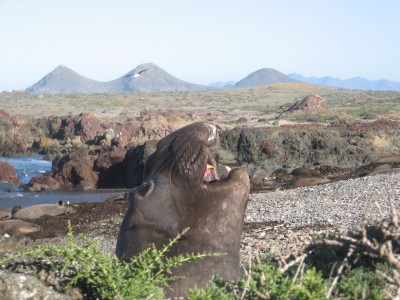
After lunch I had the opportunity to explore the island, which was an incredible experience. I planned on walking all over the island and checking out the entire place, but found myself totally mesmerized once I found a large elephant seal colony. I ended up sitting on the rocks with the seals and photographing them for hours. I've never been much a photographer but always appreciated a well captured glimpse of raw nature on film. Digital cameras have inspired me and I ended up taking about 100 photographs of the seals, their behavior, and their young and vulnerable pups. Elephant seals really are incredible creatures, often times growing to 2000 pounds or more. They are not your typical small and playful California coastal seal, but rather a monsterous creature with aggressive character traits. Some of the larger males were easily over 12 feet and occasionally sat with their chests high, a display of dominance. The section of the island was completely littered with them and I found myself surrounded by them numerous times. I estimate there were a few hundred of the noisy, smelly, and fatty creatures sunbathing on the warm sand, and making their way in and out of the chilly water. Although elephant seals are aggressive, I was able to get extremely close to many of them, which gave me a rare opportunity to photograph and video the incredible animals. At times I was less than 3 or 4 feet away from them and could actually smell their rank and sour breath as they deeply exhaled through their deep sleep. Being so close to such a large wild animal was a bit unnerving and something I will never forget. The picture taken above was especially fun for me because the large male sat below in a small rocky canyon, just large enough to fit his over-sized, blubber-filled body. I slowly crept up to the edge of the rock, stayed low, waiting for him to sense me, and eventually pop his head up. Sure enough Mr. Sammy the Seal Sr. noticed me, arched himself up to towards the sky, and cried out a deafening bark. His stained yellow K-9 incisors shined in the bright sun as he made his presence clear. Click! went my camera and I retreated back down the rocky hill.
As I walked back to the boat I thought about National Geographic photographers and what fun that must be. I love watching the nature channels and now greatly respect the individuals that spend weeks, months, or years capturing our world's precious animals, people, and lands. I feel very fortunate that I have been able to visit and photograph so many spectacular places over the past six months. I'm looking forward to getting home and compiling a slide show of the highlights, which there are many.
I returned to Cisnecito around 5 pm to find Chris and Julie preparing the abalone. Chris and I then cleaned the lobster (all 8 of them!) and giggled about the amount of seafood we planned on cooking for dinner. Everything turned out perfect and it was a brilliant meal and evening. We toasted to our last meal at an offshore island and enjoyed the moment.
Yesterday was definitely a highlight of the trip, and probably the most fun I had on this last and final passage. After getting a great night's sleep and catching up on the much needed rest, I awoke with a clear head and energized spirit. Julie baked fresh scones which went down nicely with a hot cup of coffee. I spent the majority of the morning puttering around the boat and reorganizing things in my berth. Any item that isn't properly tied or lashed down tends to get thrown around a bit in rough seas. For instance, the medicine cabinet in my bathroom contains all sorts of fun goodies and was complete mess after heeling so hard and banging up and down with the waves. I spent the remainder of the morning retying the SSB radio antenna to the backstay. We use large zip ties to do this. Like all things that sit in the sun, the plastic breaks down after prolonged periods of UV and salt water exposure. Changing them out simply consisted of cutting off the frayed ones, and retying a new one. While Julie and Chris paddled ashore in the kayak I listened to Paul Simon's "Graceland" and enjoyed my little project. I found myself grooving to the African beats and singing along with the harmonious tribal background choir.
After lunch I had the opportunity to explore the island, which was an incredible experience. I planned on walking all over the island and checking out the entire place, but found myself totally mesmerized once I found a large elephant seal colony. I ended up sitting on the rocks with the seals and photographing them for hours. I've never been much a photographer but always appreciated a well captured glimpse of raw nature on film. Digital cameras have inspired me and I ended up taking about 100 photographs of the seals, their behavior, and their young and vulnerable pups. Elephant seals really are incredible creatures, often times growing to 2000 pounds or more. They are not your typical small and playful California coastal seal, but rather a monsterous creature with aggressive character traits. Some of the larger males were easily over 12 feet and occasionally sat with their chests high, a display of dominance. The section of the island was completely littered with them and I found myself surrounded by them numerous times. I estimate there were a few hundred of the noisy, smelly, and fatty creatures sunbathing on the warm sand, and making their way in and out of the chilly water. Although elephant seals are aggressive, I was able to get extremely close to many of them, which gave me a rare opportunity to photograph and video the incredible animals. At times I was less than 3 or 4 feet away from them and could actually smell their rank and sour breath as they deeply exhaled through their deep sleep. Being so close to such a large wild animal was a bit unnerving and something I will never forget. The picture taken above was especially fun for me because the large male sat below in a small rocky canyon, just large enough to fit his over-sized, blubber-filled body. I slowly crept up to the edge of the rock, stayed low, waiting for him to sense me, and eventually pop his head up. Sure enough Mr. Sammy the Seal Sr. noticed me, arched himself up to towards the sky, and cried out a deafening bark. His stained yellow K-9 incisors shined in the bright sun as he made his presence clear. Click! went my camera and I retreated back down the rocky hill.
As I walked back to the boat I thought about National Geographic photographers and what fun that must be. I love watching the nature channels and now greatly respect the individuals that spend weeks, months, or years capturing our world's precious animals, people, and lands. I feel very fortunate that I have been able to visit and photograph so many spectacular places over the past six months. I'm looking forward to getting home and compiling a slide show of the highlights, which there are many.
I returned to Cisnecito around 5 pm to find Chris and Julie preparing the abalone. Chris and I then cleaned the lobster (all 8 of them!) and giggled about the amount of seafood we planned on cooking for dinner. Everything turned out perfect and it was a brilliant meal and evening. We toasted to our last meal at an offshore island and enjoyed the moment.
Comments
| Vessel Name: | Cisnecito |
| Vessel Make/Model: | 46 ft Nautor Swan |
| Crew: | Andrew Roberts |
| About: |
Gallery not available
Checked Out and Headed to Central America
Who: Andrew Roberts