The Cruise of Mariposa
24 November 2009 | Fondeadero San Carlos, Baja California Norte, Mexico
20 November 2009 | Turtle Bay, Baja California Sur, Mexico
19 November 2009 | Bahia Asuncion, Baja California Sur, Mexico
18 November 2009 | Punta Abreojos, Baja California Sur, Mexico
02 November 2009 | Bahia los Frailes, Baja California Sur, Mexico
01 November 2009 | Ensenada de los Muertos, Baja California Sur
30 October 2009 | Playa Pichilingue, Baja California Sur, Mexico
30 October 2009 | La Paz, Baja California Sur, Mexico
16 September 2009 | Puerto Escondido, BCS, Mexico
04 September 2009 | Puerto Escondido, BCS, Mexico
03 September 2009 | Puerto Escondido, BCS, Mexico
31 August 2009 | Puerto Escondido, Baja California Sur, Mexico
31 August 2009 | Puerto Escondido, Baja California Sur, Mexico
09 July 2009 | Puerto Los Gato, Baja California Sur, Mexico
07 July 2009 | San Evaristo, Baja California Sur, Mexico
04 July 2009 | Ensenada Grande, Isla Partida, Baja California Sur, Mexico
30 June 2009 | Southern Baja
22 June 2009 | Mazatlan, Sinaloa, Mexico
19 June 2009 | La Ventana, Baja California Sur, Mexico
19 June 2009 | Puerto Ballandra, Baja California Sur, Mexico
Fondeadero San Carlos
24 November 2009 | Fondeadero San Carlos, Baja California Norte, Mexico
Eric/Breezy sunshine
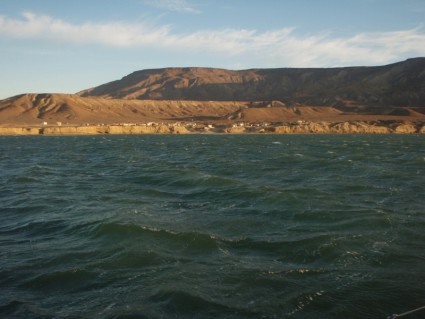
The weather was so good on our way here from Turtle Bay that everybody was in a good mood. The water was glassy calm well into the afternoon, and the air was cool and the sun was warm. This must be why the fishermen gave us all that lobster. And the octopus.
We left Turtle Bay at 0745 after listening to the weather and having it pronounced fine, clear and easy to predict. A Pineapple Express trailing off from the ITCZ put enough broken grey clouds overhead to make it a beautiful sunrise. The anchor came up with mud on it for the first time since I don't know when: Usually we're anchored on sand in Mexico.
By 1130 we were sunning ourselves in the Dewey Channel off Punta Eugenia, dodging the lobster pot buoys. Fishing boats buzzed back and forth with friendly waves; even the big San Diego charter boat seemed jaunty as it cut politely behind us, its short deep-sea rods bristling.
Around 1145 a big yellow panga came by our port side, one of its three crew holding up a struggling lobster. As they got close, he tossed it carefully into our cockpit. Then they told us to slow down, and sped over to a nearby buoy. Pulling it up, they extracted more treasures, and then came over to toss us three more lobsters and a two-foot-long octopus.
While these creatures thrashed around in our cockpit (by now I'd donned gloves) we asked the fishermen what they wanted in exchange. They said, "No! Nothing!" but eventually let us give them a big bag of M&Ms and a bottle of Pepto-Bismol: One of the poor guys was seasick. A few very hearty hello's later, we were on our separate ways again. What moving generosity!
The octopus glared at us so balefully that we had to return it to the sea, but within an hour we had boiled lobster tails over rice, with lime juice drizzled over.
The rest of our trip is not worth recounting, except to note that it was very long. The moon was out and the crisp November weather cooperated beautifully. We're now in Fondeadero San Carlos, a marginal anchorage off a twenty-five-house village just for the afternoon and overnight. We'll leave at dawn tomorrow, clearing risky Sacramento Reef by late morning, aiming for San Quintin by nightfall.
We left Turtle Bay at 0745 after listening to the weather and having it pronounced fine, clear and easy to predict. A Pineapple Express trailing off from the ITCZ put enough broken grey clouds overhead to make it a beautiful sunrise. The anchor came up with mud on it for the first time since I don't know when: Usually we're anchored on sand in Mexico.
By 1130 we were sunning ourselves in the Dewey Channel off Punta Eugenia, dodging the lobster pot buoys. Fishing boats buzzed back and forth with friendly waves; even the big San Diego charter boat seemed jaunty as it cut politely behind us, its short deep-sea rods bristling.
Around 1145 a big yellow panga came by our port side, one of its three crew holding up a struggling lobster. As they got close, he tossed it carefully into our cockpit. Then they told us to slow down, and sped over to a nearby buoy. Pulling it up, they extracted more treasures, and then came over to toss us three more lobsters and a two-foot-long octopus.
While these creatures thrashed around in our cockpit (by now I'd donned gloves) we asked the fishermen what they wanted in exchange. They said, "No! Nothing!" but eventually let us give them a big bag of M&Ms and a bottle of Pepto-Bismol: One of the poor guys was seasick. A few very hearty hello's later, we were on our separate ways again. What moving generosity!
The octopus glared at us so balefully that we had to return it to the sea, but within an hour we had boiled lobster tails over rice, with lime juice drizzled over.
The rest of our trip is not worth recounting, except to note that it was very long. The moon was out and the crisp November weather cooperated beautifully. We're now in Fondeadero San Carlos, a marginal anchorage off a twenty-five-house village just for the afternoon and overnight. We'll leave at dawn tomorrow, clearing risky Sacramento Reef by late morning, aiming for San Quintin by nightfall.
Turtle Bay
20 November 2009 | Turtle Bay, Baja California Sur, Mexico
Eric/Clear and Cool
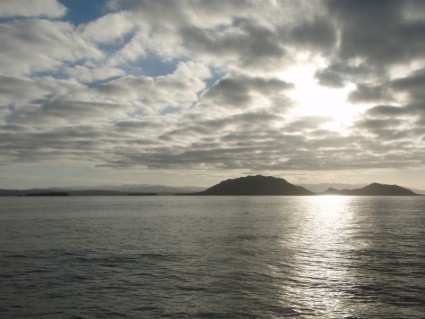
We got up this morning in Bahia Asuncion unsure whether we would make another leg of our journey north or sit tight and get some rest. Asuncion is a lovely bay with a plain but very sweet town, and it would be nice to visit it again as we did on the way down. Plus, we'd been traveling hard for a week.
But in the morning the weather forecast looked good and we weren't too tired, so we raised the hook and headed out. We're glad we did make the trip today, for these fifty miles were certainly the easiest and pleasantest we've experienced on the trip north. Our engine rumbled along at its usual cruising pace, but the weather was benign and perhaps we had a favorable current, so somehow we were able to make 5.2 knots for 10 hours today, probably a record speed for the boat. This is hardly the Baja Bash we'd dreaded.
Coming back to these ports feels like a homecoming. A year ago, Turtle Bay seemed like a dusty outpost: Arriving just after sunset this evening, we remembered the fist-shaped mountain to the northeast, and the lazy-looking navigation lights on Punta Sargazo (Kelp) and Punta Azufre (Sulfur) at the bay's entrance. Seals and dolphins splashed a greeting, and again the bay was thick with cormorants, gulls and pelicans. We looked for the radio towers in the middle of town, and the green boats of Servicio Anabel, the more reputable of the fuel dealers. Familiarity blunts the edges and at the same time makes the place seem sweeter.
We'll spend a couple of days here, changing the oil and refuelling and repairing the HF radio. And resting up for the next step, 300 miles to Ensenada.
But in the morning the weather forecast looked good and we weren't too tired, so we raised the hook and headed out. We're glad we did make the trip today, for these fifty miles were certainly the easiest and pleasantest we've experienced on the trip north. Our engine rumbled along at its usual cruising pace, but the weather was benign and perhaps we had a favorable current, so somehow we were able to make 5.2 knots for 10 hours today, probably a record speed for the boat. This is hardly the Baja Bash we'd dreaded.
Coming back to these ports feels like a homecoming. A year ago, Turtle Bay seemed like a dusty outpost: Arriving just after sunset this evening, we remembered the fist-shaped mountain to the northeast, and the lazy-looking navigation lights on Punta Sargazo (Kelp) and Punta Azufre (Sulfur) at the bay's entrance. Seals and dolphins splashed a greeting, and again the bay was thick with cormorants, gulls and pelicans. We looked for the radio towers in the middle of town, and the green boats of Servicio Anabel, the more reputable of the fuel dealers. Familiarity blunts the edges and at the same time makes the place seem sweeter.
We'll spend a couple of days here, changing the oil and refuelling and repairing the HF radio. And resting up for the next step, 300 miles to Ensenada.
Bahia Asuncion
19 November 2009 | Bahia Asuncion, Baja California Sur, Mexico
Eric/Calm, cool and collected
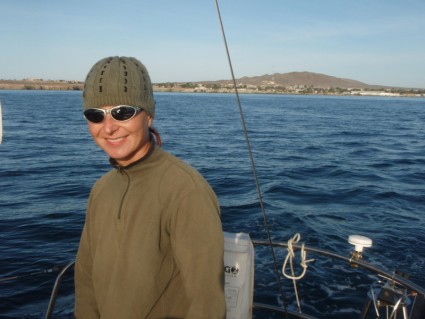
These fifty-mile legs are a lot easier than the 200-mile day and the 140-mile ones we made from Cabo. We left Punta Abreojos in the damp dawn this morning, rounded the point without incident, and proceeded north to this sweet, protected bay. Southbound we stopped long enough to take a hike on the hills above the town and to have lunch and buy a few parched groceries. This time we're trying to take advantage of the fine weather, so we'll just rest the night and head out again in the morning for Turtle Bay.
Today we saw kelp for the first time in a year, and a small whale surfaced right behind the boat, and curious fur seals popped up to have a look at us. Every day we see new varieties of creatures that don't make it south. And every day the air is chillier and we don another item of dress: One day, a sweatshirt; the next, socks. The change of seasons is accelerated when one moves up the latitudes.
A note on equipment: We love our radar. We don't use it every day, but when we're making passages like this and need to enter a bay after dark, it's worth every penny. As we came into Bahia Asuncion, the radar showed us the boats anchored around the bay long before we could see them with our eyes. Even after we were anchored, the lights of the town were so dazzling against the moonless night that we could only gradually pick out the hazards that showed up so evidently by radar.
Today we saw kelp for the first time in a year, and a small whale surfaced right behind the boat, and curious fur seals popped up to have a look at us. Every day we see new varieties of creatures that don't make it south. And every day the air is chillier and we don another item of dress: One day, a sweatshirt; the next, socks. The change of seasons is accelerated when one moves up the latitudes.
A note on equipment: We love our radar. We don't use it every day, but when we're making passages like this and need to enter a bay after dark, it's worth every penny. As we came into Bahia Asuncion, the radar showed us the boats anchored around the bay long before we could see them with our eyes. Even after we were anchored, the lights of the town were so dazzling against the moonless night that we could only gradually pick out the hazards that showed up so evidently by radar.
Punta Abreojos
18 November 2009 | Punta Abreojos, Baja California Sur, Mexico
Eric/Windy and cold, at least by our standards
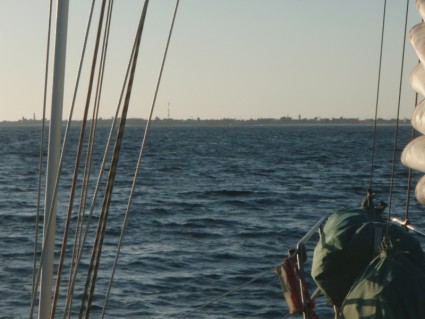
"Abreojos" means Open Your Eyes, and we just wanted to close them. After two nights' rest in lovely Bahia Santa Maria we headed 140 miles north to Punta Abreojos, a bleak projection into the Pacific known for its numerous navigational hazards.
The world is decidedly colder here than it was further south, and with the brisk wind and salt spray in the air we've definitely left the tropics. The passage was straightforward and took us about thirty-three hours, with moderate winds the whole way.
We stopped here briefly on the way down and it was windy and bleak then, too. But on our previous visit we were newcomers; now we feel like veterans. As we approached the anchorage there were three southbound Canadian boats in company, chattering away on the radio hailing channel, warning one another about lobster pots and risky reefs. Only one of them had a sail up despite the fine, easy breeze. The old hand, I got on the radio and asked them to find another channel so I didn't have to hear it. I just wanted to drop the hook and close my eyes.
The world is decidedly colder here than it was further south, and with the brisk wind and salt spray in the air we've definitely left the tropics. The passage was straightforward and took us about thirty-three hours, with moderate winds the whole way.
We stopped here briefly on the way down and it was windy and bleak then, too. But on our previous visit we were newcomers; now we feel like veterans. As we approached the anchorage there were three southbound Canadian boats in company, chattering away on the radio hailing channel, warning one another about lobster pots and risky reefs. Only one of them had a sail up despite the fine, easy breeze. The old hand, I got on the radio and asked them to find another channel so I didn't have to hear it. I just wanted to drop the hook and close my eyes.
Bahia los Frailes
02 November 2009 | Bahia los Frailes, Baja California Sur, Mexico
Eric/Beautiful November Weather
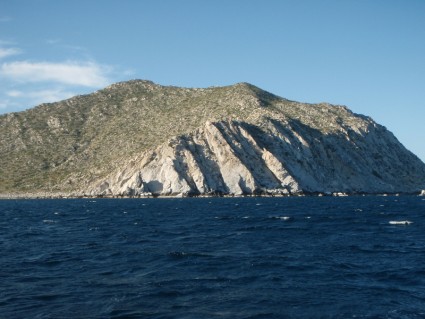
We are anchored right at the Tropic of Cancer, right under the inky line that runs right around your library globe, showing the northernmost limit of the sun's path. At noon on the longest day of the year in the Northern hemisphere the sun stands directly overhead here, more or less.
But it's not the longest day of the year, and at 6:00 it's already gotten dark. The moon, nearly full, glitters on the waves in this rather lonely anchorage whose vertically-striated cliff evidently reminded the 17th-century Spanish of friars leaning west. A couple of days ago, in the San Lorenzo Channel we passed Arranca Cabello Point, which seems to our modern ears a bit more honest. Arranca Cabello translates to Tear Your Hair Out.
In any case, today we had a lovely-and as the day wore on, increasingly blustery-sail past nearly fifty miles of points (Pescadero, Arena, Pulmo) before finally setting the hook in the lee of the Friars. Snorkelers ply the rocky shoreline, and we wish we could visit the reef a mile or so north; the only hard coral reef on the west coast of North America.
To our south, the Pacific; to the east, the Sea of Cortez. We have hardly any land left before we run out and head north. Here in the lee of the friars, with a stiff breeze and rolly waves just offshore we feel a bit as if we're clinging to a window ledge by our fingernails.
But it's not the longest day of the year, and at 6:00 it's already gotten dark. The moon, nearly full, glitters on the waves in this rather lonely anchorage whose vertically-striated cliff evidently reminded the 17th-century Spanish of friars leaning west. A couple of days ago, in the San Lorenzo Channel we passed Arranca Cabello Point, which seems to our modern ears a bit more honest. Arranca Cabello translates to Tear Your Hair Out.
In any case, today we had a lovely-and as the day wore on, increasingly blustery-sail past nearly fifty miles of points (Pescadero, Arena, Pulmo) before finally setting the hook in the lee of the Friars. Snorkelers ply the rocky shoreline, and we wish we could visit the reef a mile or so north; the only hard coral reef on the west coast of North America.
To our south, the Pacific; to the east, the Sea of Cortez. We have hardly any land left before we run out and head north. Here in the lee of the friars, with a stiff breeze and rolly waves just offshore we feel a bit as if we're clinging to a window ledge by our fingernails.
Ensenada de los Muertos
01 November 2009 | Ensenada de los Muertos, Baja California Sur
Eric/Warm northerly breeze
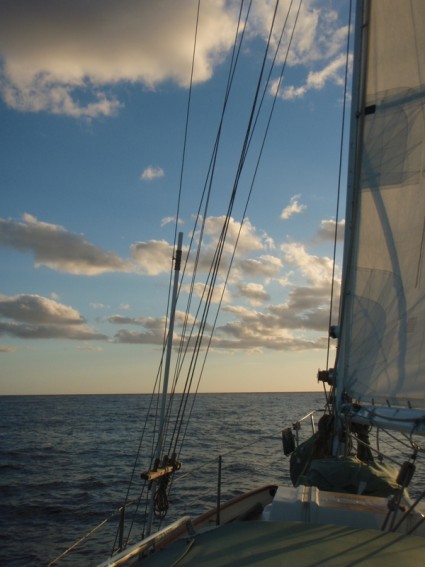
Our sail down from Playa Pichilingue was delicious. We got up at 4:45 in the morning and were under way by five so we could make the nearly fifty-mile journey by dusk. We plan our passages based on traveling at four knots, and the days are growing shorter. The moon set gloomily in the west as I raised the anchor.
I promptly discovered our stern running light was out, so along the way I changed the bulb, and was pleasantly surprised by my foresight to have carried one at all. We have spares for what seems like everything, but frankly I didn't quite believe that I'd thought of that one. I also managed not to drop any screws in the water, so it was a job well done.
We passed through the San Lorenzo Channel as dawn broke pink and yellow, drinking coffee and tea with milk and sugar and reveling in the freedom of cruising. The wind carried us along gently east, then southeast down the 25-mile Cerralvo Channel. This watery gap between Isla Cerralvo and the mountains of southern Baja narrows to the south, funneling the winds and often driving them against the current, raising steep waves and making for a rough trip. But downwind, with a favorable tide, we made good time and arrived at Ensenada de los Muertos (on the Dia de los Muertos, no less) well before sunset.
Ensenada de los Muertos was one of the places I'd heard about since Sausalito. What I'd heard I couldn't have told you, except that it's a jumping-off place for sailing to Mazatlan; the western end of the Southern Crossing. The bay provides good northerly protection, with a steep, long sandy beach. Some fancy but ugly houses and the Giggling Marlin restaurant line the shore; at one end of the beach were a couple of dozen pangas pulled up on the sand. There were two northbound sailboats and a big power catamaran to keep us company at anchor.
From what we saw, I wouldn't make it a destination, but it is a convenient stopover and something of a gateway to the Sea of Cortez. If you sail this way, you'll probably stop there too.
I promptly discovered our stern running light was out, so along the way I changed the bulb, and was pleasantly surprised by my foresight to have carried one at all. We have spares for what seems like everything, but frankly I didn't quite believe that I'd thought of that one. I also managed not to drop any screws in the water, so it was a job well done.
We passed through the San Lorenzo Channel as dawn broke pink and yellow, drinking coffee and tea with milk and sugar and reveling in the freedom of cruising. The wind carried us along gently east, then southeast down the 25-mile Cerralvo Channel. This watery gap between Isla Cerralvo and the mountains of southern Baja narrows to the south, funneling the winds and often driving them against the current, raising steep waves and making for a rough trip. But downwind, with a favorable tide, we made good time and arrived at Ensenada de los Muertos (on the Dia de los Muertos, no less) well before sunset.
Ensenada de los Muertos was one of the places I'd heard about since Sausalito. What I'd heard I couldn't have told you, except that it's a jumping-off place for sailing to Mazatlan; the western end of the Southern Crossing. The bay provides good northerly protection, with a steep, long sandy beach. Some fancy but ugly houses and the Giggling Marlin restaurant line the shore; at one end of the beach were a couple of dozen pangas pulled up on the sand. There were two northbound sailboats and a big power catamaran to keep us company at anchor.
From what we saw, I wouldn't make it a destination, but it is a convenient stopover and something of a gateway to the Sea of Cortez. If you sail this way, you'll probably stop there too.
| Vessel Name: | Mariposa |
| Vessel Make/Model: | 1979 Ta Shing Baba 30 |
| Hailing Port: | San Francisco, CA |
| Crew: | Sarka & Eric |
| About: | Sarka and Eric are on a 12-18 month trip to Mexico and the South Pacific. |
Gallery not available
Who: Sarka & Eric
Port: San Francisco, CA
SailBlogs Friends
