Cruising with s/v "Dream Chaser"....and still chasing the dream....since 2004.
Sharing the love we have for this lifestyle with stories full of fun and adventure.
16 January 2024
01 January 2019 | Little Harbor, Peter Island BVI
06 October 2017 | Dream Chaser in Hurricane Storage
12 February 2017 | The Highlands of Barbuda
12 February 2017 | Mangroves of Codrington Lagoon, Barbuda
12 February 2017 | Mangroves of Codrington Lagoon, Barbuda
12 February 2017 | Highlands of Barbuda
09 February 2017 | Cocoa Beach, Barbuda
09 February 2017 | Cocoa Beach, Barbuda
09 February 2017 | Codrington, Barbuda
07 February 2017 | Cocoa Point Beach and Anchorage, Barbuda
07 February 2017 | Cocoa Point Anchorage, Barbuda
07 February 2017 | Cocoa Beach Anchorage, Barbuda
04 February 2017 | In Codrington at Byron's Cafe, Barbuda
04 February 2017 | Barbuda's South Coast
04 February 2017 | Condrington Waterfront
04 February 2017 | Cocoa Beach aka Diana, Princess of Wales, Beach, Barbuda
03 February 2017 | Near Cocoa Point, Barbuda
02 February 2017 | Coral Beach, Barbuda
02 February 2017 | At Uncle Roddy's
Sailing with Mother Nature
04 April 2008

Thanks to Linda on s/v "Villomee" for this great picture of us anchored at Spanish Point, Barbuda
We will start by saying that this entire cruising season has been extremely unusual weather wise. It's been pretty crazy! You can ask any cruiser and they will agree. The hot topic at happy hour is how "cold" it has been and where did you ride out the recent blow. There has been more wind than in the past 3 seasons with most days blowing around 20-22 knots and sometimes even with much higher gusts. It has rained at least once nearly every day that we can remember, although it never lasts too long. There have been huge northerly swells that are caused by storms way up in the North Atlantic and make their way down to the Caribbean. During these times, sailing is next to impossible, unless your crazy, and it can be very dangerous. There have been tropical waves that bring in the weather with a lot of clouds. Don't get us wrong, we are not complaining....really....but Mother Nature is in charge here.
Its been quite a while since we have sent you an update but all is well and we are doing fine. At the end of January, after cruising Venezuela for a month, we were finally able to make the 30-hour passage from Coche, Venezuela to Hog Island, Grenada. We traveled with two other boats; our friends on Another Road and Island Dreamin'. We motor sailed against the seas and easterly wind and departed before sun up. The wind was only about 10 knots and the seas were 4 to 5 feet. We had planned on stopping at Los Testigos for the night to break up the trip but we were making such good time. Since the sea conditions were pretty good the decision was to keep on going. However, shortly after passing Los Testigos we ran into a strong NW flowing current that runs between Grenada and Los Testigos. At worst, we were motor sailing at 2500 rpms and only making between 2.7 to 3.0 knots. Without this current, we can do 6.5 knots. It made for rather a slow, bumpy trip. We arrived at Hog Island, Grenada the following morning, no worse for wear, and glad to not be pounding into the waves anymore.
Hog Island, Grenada is a comfy little anchorage with a cute little beach and Rogers Beach Bar. Roger puts on a BBQ every Sunday with chicken, ribs and fish. There are a lot of cruisers that attend plus some locals that come to join in the fun. On Super Bowl Sunday a bunch of cruisers got together to watch the game at a small marina and everyone brought thier own version of chili to share. Besides the social activities, there was a bit of shopping to be done, had our mainsail repaired after a rip occurred on our passage from Venezuela, and we purchased a few necessary items at Budget Marine. We have nicked named this wonderful boating store the "candy store" because there is every kind of boat part you could ever want or need. A store like this in Venezuela is hard to come by. Of course, we had major sticker shock when purchasing fuel for $5 dollars a gallon versus the 4 or 5 cents per liter in Venezuela. But it sure was nice to hear everyone speaking English again, even though the island twang is hard to understand sometimes.
After 10 days, a weather window opened up again to head from Grenada north to the Windward Islands. This is only a day passage and we were glad to be underway again and under sail in somewhat light weather conditions. We headed up to the Tobago Cays, Mayreau and Bequia areas in the southern Windwards and spent nearly 2 weeks.

Looking out at Horse Shoe Reef at Tobago Cays
During this time, Lucia became very sick for a few days and we still have not determined how or why. She had been on the boat for days, with the exception of playing on deserted beaches. Without going into too much detail, we knew it was painful for her to take a bowel movement because there was quite a bit of blood in the stools and she would cry and pant continuously. We felt helpless and desperate to find a vet. Early the next day we contacted the "Coconut Telegraph", a cruisers' network, on our single side band radio for anyone with any knowledge of a vet in the area. No one came back with any information but one cruiser mentioned there was a vet in Carriacou, which was about 20 miles away. Without thinking twice, we raised the sails and headed south to Tyrel Bay in Carriacou. However, it was a waste of time, because there was not a "real" vet on the island, only one that could set broken bones. The local dive shop told us about a German woman who lives on the island. She was a microbiologist and knows a lot about animals and diseases. We went to her house and she was very kind, gave us a few helpful suggestions and names of people to contact in Grenada. But, it was a Sunday, the local pay phone did not work, and our only real choice was to sail back to Grenada. However, it was now late in the day and the wind and seas had been building. It would be a terrible, uncomfortable ride. We decided to let Lucia eat that evening if she wanted to, and hope for the best the second night. She was hungry and seemed to be feeling better later that evening. She had a restful night and continued to get better over the next several days. We can only guess at this point that she probably ate something on the beach that was very toxic to her system.
The next morning we sailed back north to Mayreau & Tobago Cays and met up with Sara's sister and her husband who were chartering again. We spent several sunny days hiking, snorkeling, swimming with sea turtles and telling tall tales of the sea over cocktails and dinners. We showed them what its like to be a "real cruiser" with tips and helpful ideas on anchoring in front of reefs and what its like to do your own laundry onboard.
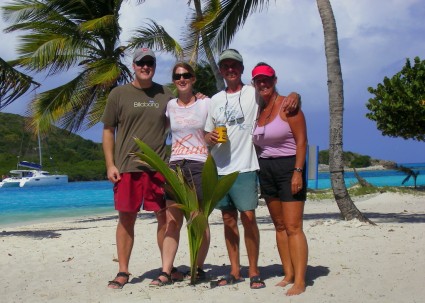
Brian, Susie, Shane & Sara at Tobago Cays
Toward the end of February we were beating our way into the wind from Bequia to St. Lucia. The morning we left, we were traveling with our friends again on "Another Road". The plan was to do an overnighter and sail the 130 miles to Guadeloupe. It was going to be a great sail, with the wind on the beam and the waves were predicted at 7 feet with18-20 knots of wind and we were looking forward to making some tracks north. However, on the way Another Road experienced some rigging problems. Plan B was put into place and unfortunately, it was to head more into the wind and make landfall at St. Lucia for repairs.
The passage between St. Lucia and St. Vincent can be terrible, the cruising guide we use calls it "hard on the wind and hard on the body", and they are right! The seas became nasty, mostly due to the current that flows between these islands. This is where we experienced a "rage". A rage is a period of steep, steep waves, very close together. One of these waves was about 12 feet tall, maybe bigger. It is hard to say, considering we did not see it coming until it was too late. It hit us on the front quarter and proceeded to break over the boat, came crashing into the dodger and bimini (the "windshield" and "sunshade" over the cockpit) and sent seawater rushing through every seam, zipper and anywhere it could find its way through. The water proceeded to smash into the rear durades (air vents) behind the cockpit, and gave a nice salt water bath to our bunk. We were soaked and so was Lucia and we finally made it to Rodney Bay, St. Lucia well after dark.
We were anchored in St. Lucia for 10 days for another bout of high winds and seas. We rented a car and did some inland touring, making our way down to the Pitons and up the east coast. We did the usual shopping and laundry and kept busy with boat projects to help pass the time. We were able to get internet on the boat from a resorts free wi-fi service. Being here was particularly hard on Lucia since she is forbidden to go ashore because she is from a country that has rabies (St. Lucia is rabies free). Even with her vaccinations and health certificate, this is a very stiff law and any animal found will be destroyed.
When we left St. Lucia, the weather conditions were still not the best but we chose the lightest of these days and took 3-day sails up island, making overnight stops at Dominica, Guadeloupe and then on to Antigua. We had a variety of wind and sea conditions and sometimes when we got behind the tall islands the wind would totally die and the motor would have to be turned on to make any time.
We love Antigua but not for the hustle and bustle of English, Falmouth and Jolley Harbors where most folks go. We prefer the off the beaten track anchorages, such as Five Islands and Green Island, where there are beautiful beaches, good snorkeling and conch hunting with just a couple of boats anchored here and there.
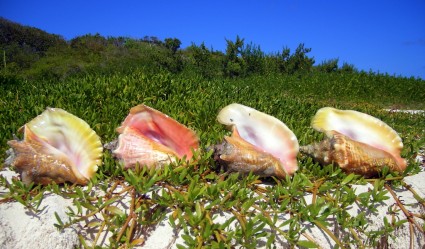
Another successful conch hunt!
After a relaxing week at Green Island, we set sail and headed northwest for the 34-mile sail to the island of Barbuda, which is still a part of Antigua. This is now probably one of our favorite islands in the Caribbean. It is pristine and deserted (except for the small town on the west). Amazingly, the weather had calmed down so much that we anchored at Spanish Point on the east end behind the reef for 5 days in crystal clear, aqua blue water with barely a breeze blowing. The snorkeling was fantastic and the reefs were alive with lobster, crab, and reef fish. A nurse shark seemed to reside under a ledge because we saw it here on several different days. We caught six small, but tasty Bar Jacks that clustered under our boat and they made for easy fishing. We loaded up our mountain bikes in the dinghy and took them ashore to ride on the coral/sand/dirt and salt encrusted road. The riding was a little tricky with lots of rocks and ruts in the road to avoid. We came across wild donkeys, a donkey bone yard, salt ponds, ruins, half built abandoned structures, a couple of deserted fishing camps and huge sand dunes that lined the west coast. The coastline was gorgeous with deserted white beaches and cliffs. On the 4-hour ride, we never came across a single person or vehicle on the road at this end of the island.
But as cruisers, Mother Nature determines our lives and once again, she was in control and about to end our beautiful weather. The weather reports were predicting a huge northerly swell to be building in 4 days and predicted to reach 18 feet. Apparently, there were some hurricane force storms way up in the North Atlantic that was bringing these sea conditions. Not many anchorages are safe in these types of conditions, but we knew of one up in St. Martin about 120 miles away. The Simpson Bay Lagoon in St. Martin is totally land locked and surrounded by high hills. There is 12 square miles of anchoring room and you enter the lagoon through one of two lift bridges. Unfortunately, we could not stay in Barbuda since the island is very low and not protected enough to ride out a swell at anchor that big. We were forced to leave this beautiful place just when we were really getting in to the groove of island time.
On the sixth day, we had a lovely sail back to Jolley Harbor, Antigua to clear out with customs. The next morning we departed at 6AM for the 80-mile downwind spinnaker run to St. Barts. The winds were still relatively light, the seas were small, and it made for a very enjoyable passage. This is only the fourth time we have used the spinnaker in our 4 years cruising. We pulled into the anchorage at Anse de Columbier for the second night, then on the third day it was just a short 3 hour spinnaker sail to Simpson Bay Lagoon, St. Martin for the big swell event coming in the next day.
That was 3 weeks ago and we are still here. The big swell is gone, but the winds keep on blowing causing the seas to be up to 14 feet. The winds over the last 4 days have been howling, with gusts up to 35 knots. The lagoon is packed, but not overly crowded with boats and mega yachts of all sizes seeking shelter from this crazy weather. It is a good placed to be "stranded". We have met a lot of new people and have seen friends we have not seen for a year or two. It is a wonderful place for shopping and inexpensive dining. There are good places to have boat repairs done, and if you're lucky, you can try your luck at the Princess Casino. We have taken the city bus to Grand Case and rented a car with friends to go to Orient Bay and around the island. We've been to the Cliffs, stood on Sunset Beach watching the huge swells roll in and to free Tequila parties at The Tijuana Yacht Club. We have not been too bored!
Next week the weather is actually going to become so light there may not be enough wind to sail. Maybe this is the change of seasons we have all been waiting for. We will head to the British Virgin Islands then whether we have to sail or motor!
We will start by saying that this entire cruising season has been extremely unusual weather wise. It's been pretty crazy! You can ask any cruiser and they will agree. The hot topic at happy hour is how "cold" it has been and where did you ride out the recent blow. There has been more wind than in the past 3 seasons with most days blowing around 20-22 knots and sometimes even with much higher gusts. It has rained at least once nearly every day that we can remember, although it never lasts too long. There have been huge northerly swells that are caused by storms way up in the North Atlantic and make their way down to the Caribbean. During these times, sailing is next to impossible, unless your crazy, and it can be very dangerous. There have been tropical waves that bring in the weather with a lot of clouds. Don't get us wrong, we are not complaining....really....but Mother Nature is in charge here.
Its been quite a while since we have sent you an update but all is well and we are doing fine. At the end of January, after cruising Venezuela for a month, we were finally able to make the 30-hour passage from Coche, Venezuela to Hog Island, Grenada. We traveled with two other boats; our friends on Another Road and Island Dreamin'. We motor sailed against the seas and easterly wind and departed before sun up. The wind was only about 10 knots and the seas were 4 to 5 feet. We had planned on stopping at Los Testigos for the night to break up the trip but we were making such good time. Since the sea conditions were pretty good the decision was to keep on going. However, shortly after passing Los Testigos we ran into a strong NW flowing current that runs between Grenada and Los Testigos. At worst, we were motor sailing at 2500 rpms and only making between 2.7 to 3.0 knots. Without this current, we can do 6.5 knots. It made for rather a slow, bumpy trip. We arrived at Hog Island, Grenada the following morning, no worse for wear, and glad to not be pounding into the waves anymore.
Hog Island, Grenada is a comfy little anchorage with a cute little beach and Rogers Beach Bar. Roger puts on a BBQ every Sunday with chicken, ribs and fish. There are a lot of cruisers that attend plus some locals that come to join in the fun. On Super Bowl Sunday a bunch of cruisers got together to watch the game at a small marina and everyone brought thier own version of chili to share. Besides the social activities, there was a bit of shopping to be done, had our mainsail repaired after a rip occurred on our passage from Venezuela, and we purchased a few necessary items at Budget Marine. We have nicked named this wonderful boating store the "candy store" because there is every kind of boat part you could ever want or need. A store like this in Venezuela is hard to come by. Of course, we had major sticker shock when purchasing fuel for $5 dollars a gallon versus the 4 or 5 cents per liter in Venezuela. But it sure was nice to hear everyone speaking English again, even though the island twang is hard to understand sometimes.
After 10 days, a weather window opened up again to head from Grenada north to the Windward Islands. This is only a day passage and we were glad to be underway again and under sail in somewhat light weather conditions. We headed up to the Tobago Cays, Mayreau and Bequia areas in the southern Windwards and spent nearly 2 weeks.
Looking out at Horse Shoe Reef at Tobago Cays
During this time, Lucia became very sick for a few days and we still have not determined how or why. She had been on the boat for days, with the exception of playing on deserted beaches. Without going into too much detail, we knew it was painful for her to take a bowel movement because there was quite a bit of blood in the stools and she would cry and pant continuously. We felt helpless and desperate to find a vet. Early the next day we contacted the "Coconut Telegraph", a cruisers' network, on our single side band radio for anyone with any knowledge of a vet in the area. No one came back with any information but one cruiser mentioned there was a vet in Carriacou, which was about 20 miles away. Without thinking twice, we raised the sails and headed south to Tyrel Bay in Carriacou. However, it was a waste of time, because there was not a "real" vet on the island, only one that could set broken bones. The local dive shop told us about a German woman who lives on the island. She was a microbiologist and knows a lot about animals and diseases. We went to her house and she was very kind, gave us a few helpful suggestions and names of people to contact in Grenada. But, it was a Sunday, the local pay phone did not work, and our only real choice was to sail back to Grenada. However, it was now late in the day and the wind and seas had been building. It would be a terrible, uncomfortable ride. We decided to let Lucia eat that evening if she wanted to, and hope for the best the second night. She was hungry and seemed to be feeling better later that evening. She had a restful night and continued to get better over the next several days. We can only guess at this point that she probably ate something on the beach that was very toxic to her system.
The next morning we sailed back north to Mayreau & Tobago Cays and met up with Sara's sister and her husband who were chartering again. We spent several sunny days hiking, snorkeling, swimming with sea turtles and telling tall tales of the sea over cocktails and dinners. We showed them what its like to be a "real cruiser" with tips and helpful ideas on anchoring in front of reefs and what its like to do your own laundry onboard.
Brian, Susie, Shane & Sara at Tobago Cays
Toward the end of February we were beating our way into the wind from Bequia to St. Lucia. The morning we left, we were traveling with our friends again on "Another Road". The plan was to do an overnighter and sail the 130 miles to Guadeloupe. It was going to be a great sail, with the wind on the beam and the waves were predicted at 7 feet with18-20 knots of wind and we were looking forward to making some tracks north. However, on the way Another Road experienced some rigging problems. Plan B was put into place and unfortunately, it was to head more into the wind and make landfall at St. Lucia for repairs.
The passage between St. Lucia and St. Vincent can be terrible, the cruising guide we use calls it "hard on the wind and hard on the body", and they are right! The seas became nasty, mostly due to the current that flows between these islands. This is where we experienced a "rage". A rage is a period of steep, steep waves, very close together. One of these waves was about 12 feet tall, maybe bigger. It is hard to say, considering we did not see it coming until it was too late. It hit us on the front quarter and proceeded to break over the boat, came crashing into the dodger and bimini (the "windshield" and "sunshade" over the cockpit) and sent seawater rushing through every seam, zipper and anywhere it could find its way through. The water proceeded to smash into the rear durades (air vents) behind the cockpit, and gave a nice salt water bath to our bunk. We were soaked and so was Lucia and we finally made it to Rodney Bay, St. Lucia well after dark.
We were anchored in St. Lucia for 10 days for another bout of high winds and seas. We rented a car and did some inland touring, making our way down to the Pitons and up the east coast. We did the usual shopping and laundry and kept busy with boat projects to help pass the time. We were able to get internet on the boat from a resorts free wi-fi service. Being here was particularly hard on Lucia since she is forbidden to go ashore because she is from a country that has rabies (St. Lucia is rabies free). Even with her vaccinations and health certificate, this is a very stiff law and any animal found will be destroyed.
When we left St. Lucia, the weather conditions were still not the best but we chose the lightest of these days and took 3-day sails up island, making overnight stops at Dominica, Guadeloupe and then on to Antigua. We had a variety of wind and sea conditions and sometimes when we got behind the tall islands the wind would totally die and the motor would have to be turned on to make any time.
We love Antigua but not for the hustle and bustle of English, Falmouth and Jolley Harbors where most folks go. We prefer the off the beaten track anchorages, such as Five Islands and Green Island, where there are beautiful beaches, good snorkeling and conch hunting with just a couple of boats anchored here and there.
Another successful conch hunt!
After a relaxing week at Green Island, we set sail and headed northwest for the 34-mile sail to the island of Barbuda, which is still a part of Antigua. This is now probably one of our favorite islands in the Caribbean. It is pristine and deserted (except for the small town on the west). Amazingly, the weather had calmed down so much that we anchored at Spanish Point on the east end behind the reef for 5 days in crystal clear, aqua blue water with barely a breeze blowing. The snorkeling was fantastic and the reefs were alive with lobster, crab, and reef fish. A nurse shark seemed to reside under a ledge because we saw it here on several different days. We caught six small, but tasty Bar Jacks that clustered under our boat and they made for easy fishing. We loaded up our mountain bikes in the dinghy and took them ashore to ride on the coral/sand/dirt and salt encrusted road. The riding was a little tricky with lots of rocks and ruts in the road to avoid. We came across wild donkeys, a donkey bone yard, salt ponds, ruins, half built abandoned structures, a couple of deserted fishing camps and huge sand dunes that lined the west coast. The coastline was gorgeous with deserted white beaches and cliffs. On the 4-hour ride, we never came across a single person or vehicle on the road at this end of the island.
But as cruisers, Mother Nature determines our lives and once again, she was in control and about to end our beautiful weather. The weather reports were predicting a huge northerly swell to be building in 4 days and predicted to reach 18 feet. Apparently, there were some hurricane force storms way up in the North Atlantic that was bringing these sea conditions. Not many anchorages are safe in these types of conditions, but we knew of one up in St. Martin about 120 miles away. The Simpson Bay Lagoon in St. Martin is totally land locked and surrounded by high hills. There is 12 square miles of anchoring room and you enter the lagoon through one of two lift bridges. Unfortunately, we could not stay in Barbuda since the island is very low and not protected enough to ride out a swell at anchor that big. We were forced to leave this beautiful place just when we were really getting in to the groove of island time.
On the sixth day, we had a lovely sail back to Jolley Harbor, Antigua to clear out with customs. The next morning we departed at 6AM for the 80-mile downwind spinnaker run to St. Barts. The winds were still relatively light, the seas were small, and it made for a very enjoyable passage. This is only the fourth time we have used the spinnaker in our 4 years cruising. We pulled into the anchorage at Anse de Columbier for the second night, then on the third day it was just a short 3 hour spinnaker sail to Simpson Bay Lagoon, St. Martin for the big swell event coming in the next day.
That was 3 weeks ago and we are still here. The big swell is gone, but the winds keep on blowing causing the seas to be up to 14 feet. The winds over the last 4 days have been howling, with gusts up to 35 knots. The lagoon is packed, but not overly crowded with boats and mega yachts of all sizes seeking shelter from this crazy weather. It is a good placed to be "stranded". We have met a lot of new people and have seen friends we have not seen for a year or two. It is a wonderful place for shopping and inexpensive dining. There are good places to have boat repairs done, and if you're lucky, you can try your luck at the Princess Casino. We have taken the city bus to Grand Case and rented a car with friends to go to Orient Bay and around the island. We've been to the Cliffs, stood on Sunset Beach watching the huge swells roll in and to free Tequila parties at The Tijuana Yacht Club. We have not been too bored!
Next week the weather is actually going to become so light there may not be enough wind to sail. Maybe this is the change of seasons we have all been waiting for. We will head to the British Virgin Islands then whether we have to sail or motor!
Comments
| Vessel Name: | Dream Chaser |
| Vessel Make/Model: | 2014 Fontaine Pajot Helia 44 (FKA a 1981 Bristol 45.5) |
| Hailing Port: | Minneapolis, Minnesota |
| Crew: | Shane, Sara & Lucia |
| About: | |
| Extra: |
Gallery not available
Dream Chaser's Crew
Who: Shane, Sara & Lucia
Port: Minneapolis, Minnesota
TABLE OF CONTENTS
SailBlogs Friends