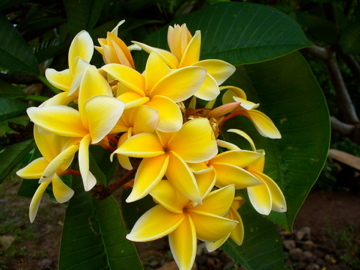
These are the flowers that you often see women tuck into their hair. They smell SO good. Over the right ear means you're married, left means you're available... or was that the other way round? Men will sometimes wear an unopened blossom.
|
|
05/27/2012, Sidewalk near the Catholic Church, Taiohae
So far the mind bullets aren't knocking them out of the trees, but we keep trying.
|
|
Hibiscus of different colours and varieties are everywhere.
|
|
05/27/2012, Taiohae Bay
A pictorial interlude while blog content is under construction...
|
|
We were downloading weatherfaxes from Pt. Reyes for most of the trip and could see where the ITCZ was. On April 20 it poked up from latitudes further south to meet us. We were at about 07 54 N and 123 09 W, and started heading south rather than southwest, with the idea of crossing the thing as quickly as possible. We did seem to do so: we had one particularly wet and windy night as a series of squalls blew us along with 20-25 knots of wind, and by the next day we were in calm weather, with a few squalls visible on the horizon.
In some ways we got very lucky with this area, as we never had any really violent weather nor were we ever very close to lightening; a boat just 120 miles behind us had several nights of lightning and thunder, which we could see in the distance. Several boats that were about a week ahead of us were caught in really violent squalls of 45 and 55 knots.
Slightly less luckily, however, we did see very light and variable winds from our first encounter with the ITCZ until the last few days of the trip. The wind would come and go and we'd sail if we could, but 'cheat' and use the motor once we felt that the slapping and shock-loading of the empty sails was driving us mad. At first we would rush around when the wind died, trying to make the drifter or spinnakers work, but this led to much frustration when the wind was too light but the swell still too big to keep air in even these sails, and led to a lot of halyard chafe as they whipped and thrashed to the rocking of the swells. Leaving the sails down and drifting was another option, but definitely not while we were in the equatorial counter-current, which was setting us southeast at about 1.5 kts. Eventually we adopted a routine where if the wind fell too light to sail we would motor at 3-4kts but as soon as the wind filled back in to a steady 5kts or so we would sail.
We never had a complete twenty-four hours without wind, it always filled in at least once a day. In the end we put about 70 hrs on Mr. Perkins, and saved ourselves much mental anguish. Around 01 N and 127 W we finally picked up the Equatorial current which gave us a push of up to 1.5 kts in the right direction and also smoothed out the sea, making it much less choppy and allowing us to sail much more effectively in the light winds.
On April 26, eighteen days from Mexico, at 21:30 utc we sailed across the equator! We dropped the spinnaker and gave a toast to Neptune (Thanks Michel & Frances) Then we went for a dip in the clearest water we have ever seen. If it had been a little less than six miles deep I am sure you could see the bottom, as it was we saw just how many gooseneck barnacles can attach in 18 days (at least 50 right aft at the waterline).
The trades finally filled in about four days from Nuka Hiva, at first an intermittent 8-10kts then steadily building so that the night before we made landfall we had 15kt SE with the most consistent swell direction of the whole trip. By the time we saw land in the distance, we were making 6-7kts on a broad reach. On the morning of May the 7th Mike who was on watch suddenly perceived a very large island about twenty miles of the port bow. "It was just kinda there, all of a sudden like." For the rest of the day we both hung out in the cockpit watching as the island of Ua Huka slowly took shape. We passed five miles north of it and from there it was a mere thirty-five miles to Nuka Hiva.
We sailed into Taiohae bay dropping the hook under sail amongst forty other cruising boats, all the while breathing in the rich smell of the impossibly green land surrounding the bay.
|
|
Zealand?!? Good to hear from you again -good writing! Waiting to hear of the next phase of the adventure. Love, Dad/Norm Mom/Myrna
Terry
05/21/2012, at sea
It only took a couple of days before the at-sea routine seemed like something that had always existed and would never end. We did three-hour watches, 'hot-bunking' most of the time in the starboard settee. It went like this: wake up, stagger and clutch your way forward to the head, where you brace yourself carefully, then groggily pull on clothes (optional but since the cockpit seats are pretty salty, probably a good idea) and flop into the cockpit. Hold on. Make sure we're still going the right way (thanks to Hand of Bruce, the Monitor wind steering gear). Wait three hours and push your sweetie mercilessly out of the bunk and dive in. Repeat for eternity. As it got hotter, we added the changing of the sheets, so that we didn't have to lie in each others' sweat, only our own, slightly less clammy sheet which aired out briefly.
Sometimes Mike would mix things up and appear blinking and confused in the companionway just an hour after he'd gone off watch - he was sent back down but this behaviour continued throughout the trip. When he's on, he's on and when he's off, he's still on. Marni NEVER did this but instead 'slept like a banshee.'
Usually we would both be awake for the afternoon and early evening. And we read a lot. The e-reader has now run for many hours and probably half the paper library has been gobbled up. Mike's favorite read: 2001 a Space Odyssey. Marni's favorite: a creepy tearjerker, Never let Me Go by Kazuo Ishiguro.
Every day at 0200 UTC we tuned in to the Pacific Puddle Jump net, made up of many boats traveling from Mexico to the Marquesas. This was a great way to talk with other humans and hear how everyone else's trip was going, what kind of weather they had, et cetera. Afterwards, we would switch up to the Ham (amateur radio) frequency 14.300 mhz at 0300 UTC and check in with them, and they plotted our position on the Yotreps web site. This is really an amazing network of people with monster radio signals who between them can hear pretty much anyone in the Pacific. It is really reassuring to know that they are there every day and that if you have a problem they're there for you.
We were happily ticking off the miles for eleven days, moving along at an average of 5-1/2 knots, until we reached the dreaded Inter-Tropical Convergence Zone (ITCZ) at about latitude 8 degrees north on April 20.
|
|