The New Pearson Wanderer
22 August 2010 | Rochester, New York
22 August 2010 | Rochester, NY
27 October 2009 | Rochester, New York
27 October 2009 | Rochester, New York
25 April 2007 | Sodus Point, New York
25 April 2007
25 April 2007 | Sodus Point, New York
25 April 2007 | Rochester and Sodus Bay, New York
25 April 2007 | Rochester & Sodus Bay, New York
25 April 2007
25 April 2007 | Lake Ontario
31 March 2007
05 March 2006 | South Shore, Lake Ontario
29 January 2006
29 January 2006
28 January 2006
28 January 2006
22 January 2006
22 January 2006
22 January 2006
Small Boat on a Big Lake
27 October 2009 | Rochester, New York
Peter O. Allen, Sr.
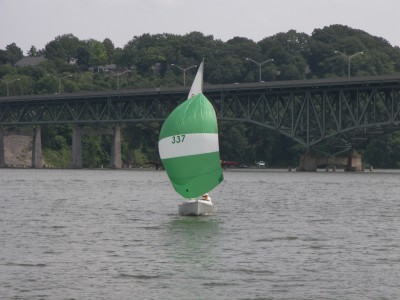
We started this blog talking about our wonderful Pearson Wanderer. We sold her in the Spring of 2007, when it became obvious that we were through with cruising. After an agonizing, nerve-wracking six-and-a-half boatless days we found and purchased a Cape Cod Bullseye, a design I had admired since 1967. when I saw my first Bullseye at the New York (City) Boat Show in the old Coliseum. But the Bullseye never seemed to fit our boating needs, for racing and cruising on Lake Ontario. Now it did. As of this writing we have completed our third season with the Bullseye, and are very happy with our choice.
The Bullseye was designed by Nathaniel Herreshoff in 1913 and converted to fiberglass construction by his son, Sidney DeWolf Herreshoff in 1948. Cape Cod Shipbuilding in Wareham, Massachusetts has been building the boat ever since. Yes, it's still in production by the company, which was founded in 1899 and has been owned by the same family since the late 1930s. The Bullseye is 15' 8.5" LOA, with a 12.5' waterlline. It displaces 1350 pounds, with a 750 pound lead keel which draws 27" The attached rudder helps point the boat in the right direction.
There is an active class association. Check them out at www.bullseyeclass.org
The builder's web site is: www.capecodshipbuilding.com
While many Bullseyes carry an outboard engine, we sail ours without an engine, although we occasionally do use a paddle. The standard fractional rig carries a self-tacking jib, while a genoa and spinnaker are optional. Our Bullseye has both a genoa and a spinnaker.
We have participated in two natioinal class regattas. The boat is easily trailed on her Triad trailer. Even boats built in the 1950s are still very competitive. The 2010 national regatta of the class will be held in March, in Key Largo, Florida.
Our Bay
One of the beauties of such a small (slow, at least in absolute terms) boat is that she has effectively quadrupled the size of Irondequoit Bay. At a half mile wide and over five miles long, the bay is a great place to sail. For most of the sailing season the sun warms the lands adjacent to and to the south of the bay. This generates a thermal breeze that funnels down the bay. The Bullseye loves a good breeze, as Capt. Nat had the heavy winds and tides of Buzzards Bay in mind when he created her design back in 1913.
We occasionally venture out on the lake, but mostly we stay in our bay, as the narrow bay outlet has enough boat traffic to make passage under outboard power desirable and we don't carry an engine. I do think occasionallly about adding a sweep and stern oarlock to give us a little more power than we get with our paddles. The boat does paddle very well.
The Bullseye was designed by Nathaniel Herreshoff in 1913 and converted to fiberglass construction by his son, Sidney DeWolf Herreshoff in 1948. Cape Cod Shipbuilding in Wareham, Massachusetts has been building the boat ever since. Yes, it's still in production by the company, which was founded in 1899 and has been owned by the same family since the late 1930s. The Bullseye is 15' 8.5" LOA, with a 12.5' waterlline. It displaces 1350 pounds, with a 750 pound lead keel which draws 27" The attached rudder helps point the boat in the right direction.
There is an active class association. Check them out at www.bullseyeclass.org
The builder's web site is: www.capecodshipbuilding.com
While many Bullseyes carry an outboard engine, we sail ours without an engine, although we occasionally do use a paddle. The standard fractional rig carries a self-tacking jib, while a genoa and spinnaker are optional. Our Bullseye has both a genoa and a spinnaker.
We have participated in two natioinal class regattas. The boat is easily trailed on her Triad trailer. Even boats built in the 1950s are still very competitive. The 2010 national regatta of the class will be held in March, in Key Largo, Florida.
Our Bay
One of the beauties of such a small (slow, at least in absolute terms) boat is that she has effectively quadrupled the size of Irondequoit Bay. At a half mile wide and over five miles long, the bay is a great place to sail. For most of the sailing season the sun warms the lands adjacent to and to the south of the bay. This generates a thermal breeze that funnels down the bay. The Bullseye loves a good breeze, as Capt. Nat had the heavy winds and tides of Buzzards Bay in mind when he created her design back in 1913.
We occasionally venture out on the lake, but mostly we stay in our bay, as the narrow bay outlet has enough boat traffic to make passage under outboard power desirable and we don't carry an engine. I do think occasionallly about adding a sweep and stern oarlock to give us a little more power than we get with our paddles. The boat does paddle very well.
Comments
| Vessel Name: | Col. Noah Lee |
| Vessel Make/Model: | Cape Cod Bull's Eye |
| Hailing Port: | Newport Yacht Club, Irondequoit Bay, New York |
| Crew: | Peter O. Allen, Sr. |
| About: | Peggy Crevey is my wife and primary sailing companion. I am blessed, in so many ways! |
| Extra: | |
| Home Page: | http://hometown.aol.com/pquorum/myhomepage/index.html |
Gallery not available
Our Pearson Wanderer
Who: Peter O. Allen, Sr.
Port: Newport Yacht Club, Irondequoit Bay, New York