
Tue Jan 18 21:58:11 EST 2011
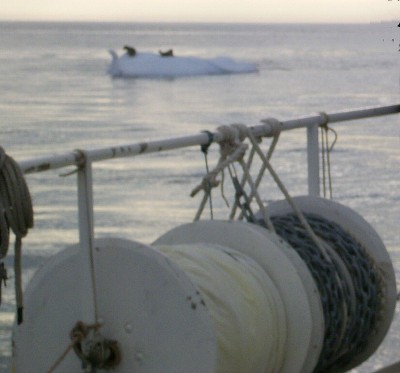
To answer George's comment about the reels of rope on deck. One reel stores 100m (330') of 22mm(7/8") polyester and 10m chain. The other reel stores 200m (660') of 20mm (3/4") blue polyethylene rope (underneath a cover for UV protection).
These ropes are used for anchor rodes, sea anchor rodes, and as shore lines (tying the boat to shore as well as using an anchor to limit how far it will swing).
We used these ropes a lot in Labrador, where we often wanted either a second anchor or a shore line. Having reels makes it quick and easy to handle long ropes. Since it is handy to have the ropes available, I leave the reels on, even when not expecting to need them for anchoring, or shore lines.
The disadvantage of having these reels is that they are pretty heavy when the rope is on them, which is weight in the wrong place, and also that thay stick out, so the boat cannot go alongside a wall on the port side. Not being able to go alongside a wall on the port side is usually not a big deal, and has only occasionally been an inconvenience.
The rope reels are stainless steel with plywood bolted onto the ends. There is a solid stainless steel rod going through them which they turn on.
The picture was taken this summer in Hudson Strait. In the background is an ice floe with two seals on it.
|
|
Mon Jan 17 16:48:34 EST 2011, Toronto, Canada
Much less appealing a picture than one of sailing in Labrador in summer, this is how Issuma looks now, frozen into the ice. Note the icicles that have formed on the chimney.
Forecast is for warmer weather tomorrow, though not warm enough to melt the ice around the boat :(.
|
|
The BTU/hour rating of the Sigmar 120 diesel heater in the pilothouse is 5,000-12,000. The BTU/hour rating of the Dickinson Alaska diesel heater up forward is 6,500-16,250. I am in the process of replacing the Sigmar 120 with a Dickinson Lofoten, which has a BTU/hour rating the same as the Alaska, but should put out a lot more heat.
With the two heaters I have, the boat can be kept 25 degrees C (~45F) above the 0utside temperature, or 20 degrees C above the outside temperature when it is windy. I am hoping the bigger heater in the pilothouse will improve things.
I used the Delta-T both for insulation (mostly for keeping heat of the sun out of the interior), and for non-skid (they do not market it as non-skid), as the embedded ceramic particles mean the paint will never go on smoothly. I will soon be painting over it with epoxy with sandpaper grit particles (I am told this is what all the tugboats in NY use on their decks) to get a better non-skid surface.
My experience with the insulating paints is that they make a noticeable difference for thermal and acousitc insulation, however, they are nowhere near as effective as foam insulation. If I was ever to consider painting the bilge in Issuma, I might put a coat of thermal insulati
Those are interesting pumps in your links.
Sat Jan 15 18:57:36 EST 2011
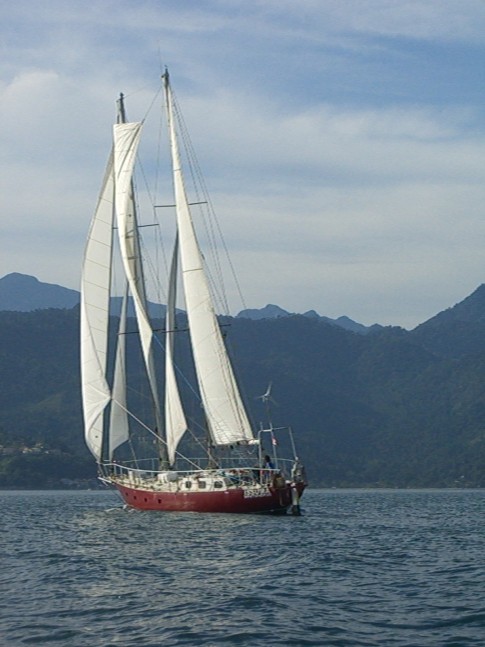
This is a picture of Issuma in August, just north of Nain, Labrador, taken from the sailboat Evensong.
At present, Issuma is frozen into the ice in Toronto.
|
|
After I've set the storm jib, I often don't bother to take it down until I'm next motoring or going into port. When I take it down, it gets lashed ondeck, without a cover, until reaching port, so it doesn't see much less UV when lashed ondeck than it does when set.
Thu Jan 13 19:05:17 EST 2011
This is a view of the harbor in Nain, Labrador last August. The masts of Issuma are visible to the right of the ship.
Brian, in his comment to the previous post, points out that there is still no ice in Nain, which is incredible for January.
|
|
Mon Jan 10 18:38:30 EST 2011, Toronto, Canada
We tried to leave the harbor today for a short sail but, after an hour of breaking ice, decided to wait for a warmer day when the ice is easier to break. We could have broken our way out the rest of the channel, but I don't really know how much ice this hull is designed for, so thought it better to wait for a warm spell before going sailing next. The temperature has been between -5C and -10C for the last few days and the ice quickly closed in and got thick. The ice we were breaking was about 13cm/5" thick, composed of a clear, hard layer of ice and a softer, white layer of snow that became ice.
In the picture, Don is pushing one of the chunks of ice down with a pole so the thickness and layers can be seen.
|
|
Wed Dec 22 19:01:11 EST 2010, Toronto, Canada
After a total of two hours (including the turn) to get thru 300m of 3-4" (8-10cm) ice, we were free to exit the harbor.
Once out of the harbor, we had a pleasant afternoon sail with mild temperatures, gentle winds and light snow.
My neighbors at the marina took pictures and video of Issuma pushing thru the ice. There are pictures at
Don Proctor's Infrequent Photo Blog,
and video on Joe Berta's www.cruisingdog.com
|
|
You and the crew have a merry festive season.
Ian McCoglin who is on Woodenboat forum and Brion Toss forum is a good thinker w/ experience in these things.
That's an interesting idea of moving the bobstay up and keeping the main reefed and not using the outer headsail during the winter. It wouldn't be a lot of work. Hmmmm. In the very short term, I'm planning on disconnecting the bobstay, then reconnecting it before setting sail. Thanks for the suggestions.
(1) If you don't use the outer jib and keep the main reefed then a bobstay that is shifted up seems worth thinking about a bit more.
(2) If Issuma's stem is strong enough you could theoretically beef up the bowsprit, the bobstay and the bobstay raised attachment point/area and let it go at that. I wouldn't know who to ask about a gut feeling for what you can get away with except Yann. (3) You might want to some trigonometric calcs to see how the compression loads on bowsprit and tension loads on the bobstay increase as the bobstay attachment moves up and angle between bowsprit and bobstay decreases.
I read Georges, I understand what he means
the problem is that the diameter of the bobstay is the same than for the mainstay, and the load is at least the double when you compare the angles; this means you would have to increase its size if you want to lift it; and about beefing up the bowsprit, I wouldn't like the idea to increase the weight of the bow! friendly
The bobstay is 13mm, the outer jib stay is 10mm.
I tried disconnecting the bobstay at the top, it didn't work out so well, as it got banged up a fair bit at the bottom when breaking ice. Disconnecting at the bottom to break ice and reconnecting to sail is looking more difficult than I first thought, due to how far down in the near-freezing water one has to reach from a dinghy to re-attach it.
At the moment, I have the spinnaker halyard rigged as a temporary stay from the top of the foremast to the bow. When the wind dies down (its too cold to get much work done aloft now), I'll see about putting something stronger in place.
I'm working on the load calculations, but its been a long time since I've done this math :).
The best answer seems to be to remove much of the bowsprit. While that might be straightforward if I moved back both the outer jib and the inner jib, that means two sails to modify, two stays to shorten, and
Wed Dec 22 18:59:13 EST 2010, Toronto, Canada
After getting thru the 90 degree turn, it got much easier to break the ice. The problem with Issuma in breaking this type of ice is that the bobstay (the pipe structure in front of the boat is called the bowsprit, the wire that supports the bowsprit from the bottom is called the bobstay) is low enough that it sometimes cuts the ice, instead of the hull riding up on the ice and then using its weight to break the ice. The bobstay supports the masts via the jibstay, so, even though I wasn't using much power (to reduce strains), it is not that good for the bobstay to be cutting ice.
Issuma is loaded heavily, and floats lower than it would in seawater (because freshwater is less buoyant), so the bobstay hits the ice more than it might otherwise. I think the solution is to remove the bowsprit (not a simple thing to do, it involves moving the jibstay back and shortening the jibstay and the jib and probably needing to compensate the sail area change forward by removing the roach from mainsail).
|
|
something could eventually break, but nobody knows if it is the bobstay, the main stay , the backstays or one of the masts! hope everything is OK :) happy christmas (should I say christmast?)
I think next time I go out I will disconnect the bobstay, then reconnect it if we use the jib (last time the jib furler line was frozen so we couldn't unfurl the jib anyway).
Merry Christmas
Wed Dec 22 18:56:13 EST 2010, Toronto, Canada
From where Issuma is (was) docked, getting out of the marina involves a 90 degree turn shortly after leaving the dock. This turn is quite difficult to do in ice, as it is hard to apply a lot of power in turning. Having two propellers helps a lot, but it still took an hour of back and forth and chopping at the ice with boathooks etc from the bow, to make this turn.
The auxiliary rudder was removed (you can see it on the dock), as I wanted to try breaking the ice in reverse as well as forward, and felt that might put too much of a strain on it. Issuma can only break very thin ice in reverse, as otherwise the ice is too close to the propellers (which would be very expensive to have to fix or replace). I think the main rudder (steel, controlled by hydraulics) is strong enough to back down into ice (slowly) without straining it.
|
|
Wed Dec 22 18:53:03 EST 2010, Toronto, Canada
It is getting more difficult to go out sailing. The ice in the marina is now 3-4" (8-10cm) thick. Issuma has gone backwards and forwards to break a path thru the ice.
|
|
Sun Dec 12 19:32:53 EST 2010, Toronto, Canada
Customs cleared me into Canada the morning after I arrived, and then Martin and Magdalene came aboard for the sail to the marina I'd arranged a berth in (Bluffers Park Marina).
It was a nice, pleasant, relatively warm (ie, above freezing) day with a light tailwind. We motored out of the harbor, then had a nice sail to near the marina, doused the sails, raised the keel most of the way and motored into the marina.
My assigned dock in the marina was a long way from the entrance, so after entering the marina, we had about 300m off thin ice to plow through. This was no problem, the ice only being about 1/2" (1.3cm) thick. In the picture, the boat is reversing towards the dock, and you can just see the ice that it has broken.
|
|
Someone once told me it is never too cold to sail :).