
Sun Apr 17 9:29:38 EDT 2011, Toronto, Canada
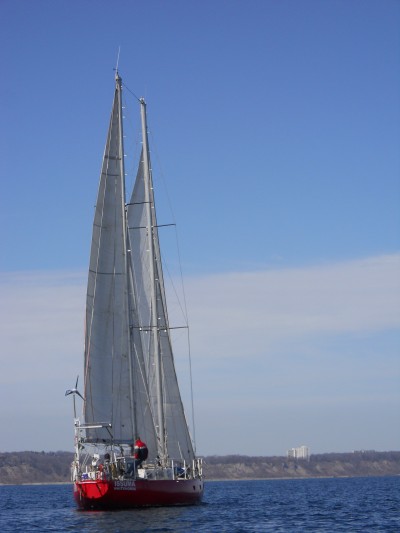
Too windy (there is a gale) today for a daysail, so here is a picture from a couple of weeks ago.
|
|
Sat Apr 16 9:54:03 EDT 2011
In a comment to an earlier post, my friend Bonnie noted that as she was blogging about the fate of New York's South Street Seaport Museum, she was reminded of a pleasant sail there on a nice December day on my pinky schooner, Rosemary Ruth (which is still for sale ) a while back. Bonnie's story about the sail is here.
|
|
https://picasaweb.google.com/georgeconk/RrSpring2007#
Tue Apr 5 8:36:42 EDT 2011, Toronto, Canada
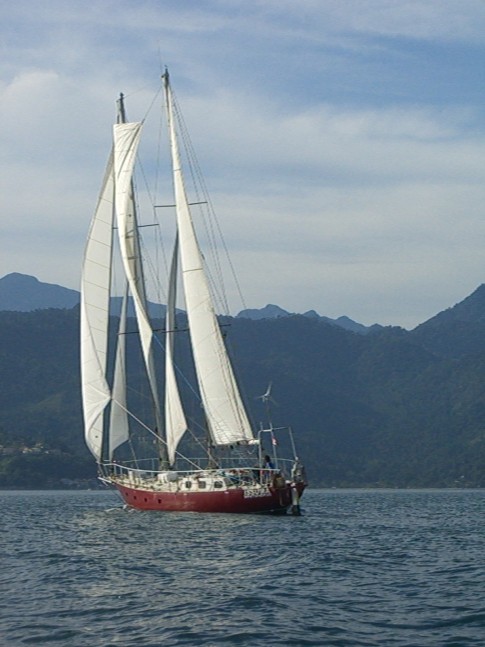
Sailing downwind in light air. After the bowsprit changes, with the two headsails almost side by side, the sails are well-separated all the way.
|
|
S
Tue Apr 5 8:33:37 EDT 2011, Toronto, Canada
After the bowsprit changes, on port tack, the two headsails touch at the bottom, but are separated farther up.
I have not yet moved the yankee jib sheet lead aft, but probably will have to. The yankee jib can now chafe on the lower spreader tip, so I will be padding that soon.
|
|
Mon Apr 4 22:38:50 EDT 2011, Toronto, Canada
This is what was done on the bowsprit to move the outer jib inboard so that the bobstay (wire connecting end of bowsprit to hull that takes a beating when pushing through ice) could be discarded. A new tab was welded on for the yankee jib (outermost sail) to attach to, the yankee jib stay and furler were shortened 23cm/10". The inner jib was moved back a bit and to the side a bit. The bowsprit was welded all round to the hull, to handle twisting loads when only one headsail is set. In the picture, Joe is welding the side of the bowsprit to the hull (they were only bolted before)
The two roller furling headsails were moved to be pretty much side-by-side, with the anchor between them.
All the tests done so far have gone well, there is no problem tacking, the boat seems to sail fine with the yankee jib in its new position.
The next step is to cut off the parts of the bowsprit that are no longer needed to save the weight up forward.
|
|
Thu Mar 31 9:00:14 EDT 2011, Toronto, Canada
Yesterday had pleasant, light winds, which were good for testing the yankee jib (the big, high sail at the front of the boat). The stay (wire) that the yankee jib is on has been moved inboard about 1m (3'). More on this later. Now both jibs are almost side-by-side.
So far, it looks like the yankee jib is setting well enough, and there don't seem to be any problems tacking. The sail can snag the spreaders now (because it goes farther back), but I can work around that with padding on the spreader tips. Next I need to test it in stronger winds to see if I really need to move the sheet lead aft or not--in light winds it seems fine where it is.
|
|
Mon Mar 28 7:53:42 EDT 2011, Toronto, Canada
The ice has gone from the harbor and we finally got out sailing again yesterday. It was windy and just below freezing but clear and sunny, so a nice day for a sail.
|
|
Now, may I get nostalgic for a moment?
All the sad goings-on at the South Street Seaport sent me back in my blog archives to revisit a post about what is still one of my favorite days on the waterfront...
http://frogma.blogspot.com/2005/12/sundays-changed-plans.html
http://www.frogma.blogspot.com/2005/12/sundays-changed-plans.html
Tue Mar 15 22:51:56 EDT 2011, Toronto, Canada
In the background, the traveling channel marker has been tied to the dock. I believe these are trumpeter swans (the yellow things on them are number tags).
|
|
Sat Mar 12 8:22:08 EST 2011, Toronto, Canada
The ice brought one of the channel markers into the harbor.
|
|
friendly
Tue Feb 22 18:39:49 EST 2011
The heating system on Issuma consists of two drip-pot diesel heaters. The pilothouse is heated by a Dickinson Lofoten heater, which is also used for cooking (though most cooking is done by a gas stove/oven). The forward part of the boat is heated by a Dickinson Alaska heater (see previous blog entry).
Fuel for the heaters is gravity-fed from the daytank, through a fuel
filter/water separator. The drip-pot diesel heaters will not run if there is water in the fuel. A little water in the fuel will result in it boiling loudly as it enters the combustion chamber, and the heater might stay running, but with a lot of water in the fuel, the flame will go out, and the regulator needs to have the water removed from it (there are no drain plugs, so the way I've done this is to suck it out with a copper tube).
Between these two heaters, the inside temperature can be about 25 degrees C higher than the outside temperature, or about 20 degrees higher if it is windy.
This works well down to about -10C/14F (and not so well at -20C/-4F).
Previously, a wood stove was used. This put out a decent amount of heat, but had to be tended every hour or two, so, over the course of 24 hours, didn't put out as much heat as a diesel heater did. The wood stove was more suitable for heating when there are several people aboard, to share the task of tending the stove.
|
|
The Sigmar 120 heater I used earlier had the ability to draw air from outside, but I never configured it that way. I ran that heater both in the location up forward and in the pilothouse, and it worked well in both places, but just wasn't big enough for heating in winter. The balanced air intake pipe that heater had on the bottom did pull quite a bit of moist air out of the bilge, and was a nice feature.
When I replaced the Sigmar 120 with the Lofoten, I tried installing the Sigmar in the bedroom, for use as a third heater for when it was really cold. I used an existing vent hole in the centerboard trunk for the chimney, which involved two 90 degree turns, and the draft never worked out. It would work if I put the chimney thru the deck, but it was a temporary install for use in -15 to -20 temperatures only (otherwise it is too big a heater for the bedroom), and the cold weat
I abandoned the idea of getting either of these heaters working under sail. Neither chimney location is free of downdrafts while sailing, and both have high stacks, which prevent backdrafts, but also get in the way of sails and lines if trying to sail with them.
While it would be comfortable to have a warm boat while sailing, no heaters are really reliable (diesel heaters stop when out of fuel, or too much water or dirt in the fuel, or when chimneys fall overboard), so one always needs sufficient clothing for the temperatures one sails in. Not having a warm cabin when sailing results in wearing suitable clothing for the temperatures, so isnt a real disadvantage.