
Tue Nov 8 15:49:03 EST 2011, Cape Spencer, Southeast Alaska
The gales and storms continued as one low pressure system after another reached Alaska. Unexpectedly, one day we suddenly had a forecast of relatively light (25-30 knots) and often favorable winds for several days.
For the fourth time, we left Yakutat.
We motored (and added sails when the wind was favorable) as quickly as we could, not sure that we really could trust being so lucky as to have several days of light and often favorable winds. The current was at first strong against us, then lessened as we made our way down the coast.
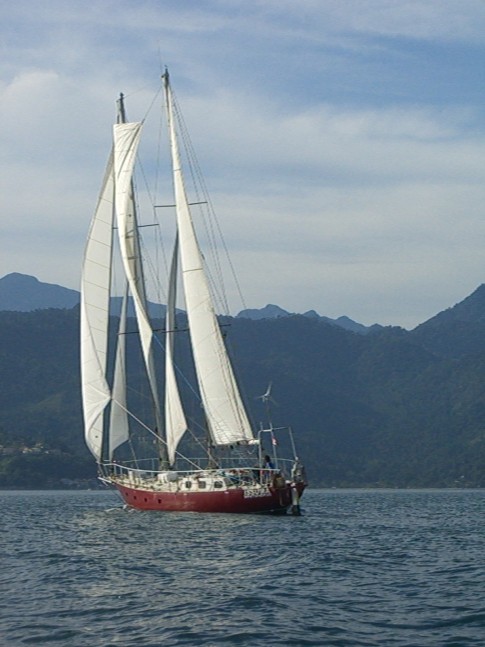
Late the next day, we approached Cape Spencer (picture) in good conditions, with a tailwind, intermittent rain and hail from a mild frontal passage, and 5m/16' following seas.
|
|
NOAA is reporting winds to 90 mph on the Bering Sea Coast today!
Here's to winter in Vancouver!
I am also relieved to hear that you may be safer from what the headlines here are proclaiming to be an unusually significant approaching Alaskan storm. When they're making a big deal in the press in NY about a storm in the Bering Sea, you know that there's a truly big blow afoot. Take care, and smooth sailing in all things large and small.
George, thanks, if I go to Puget Sound I will look up your friend.
I am really glad to not be anywhere near that unusually strong storm in the Bering Sea! I saw it forecast on the weatherfax the other day as 941mb and 70 knot (64 and above is hurricane force) winds--way more than I'd want to be out in.
Mon Nov 7 2:00:00 EST 2011, Alaska
Picture is of the sea buoy off Yakutat at dawn.
Leaving Yakutat seemed like such an easy trip--about 140 miles southeast to get into Cross Sound (an entrance to the Inside Passage where there are many places to anchor or dock).
Our first attempt to leave Yakutat was aborted when a 49knot squall that was not forecast (and caught the fishing fleet by surprise as well) came up as we were about to clear Yakutat Bay.
Our second attempt was aborted when we found an unexpectedly strong 1.5knot current running against us. We had only two days before a SE storm was to arrive and the timing of getting into an unfamiliar port in time to secure for a storm was too tight for comfort, so we returned to the safety and comfort of Yakutat again.
Low pressure systems kept coming into the Gulf of Alaska, and bringing mostly strong to storm-force SE winds to the coast where we were. There wasn't much of a gap between the storms, and they seemed to be forming faster and faster as October ended and November began.
The pilot chart (which shows average winds and currents for the oceans) showed pretty much no prevailing winds (but that is for a larger area). The Coast Pilot mentioned a current running along the coast that was variable in direction and speed, and mentioned that winds tended to run along the coast (in either direction) instead of crossing it.
On our third attempt, we left before dawn with a forecast for east winds, 30 knots, with 50 knots out of bays and passes, and almost two days before the next southeast storm. It didn't sound great, but it did sound possible.
We couldn't quite sail the southeast course without tacking, so motored close to shore, in relatively shallow water where we expected the least current. This time, the current was running two knots against us. The first bit of the coast was fine, then the wind steadily increased and our speed dropped. Motoring as fast as possible, we spent several hours making 1 to 1.5 knots.
I considered setting sails to go faster, but that would have taken us farther from the shelter of the shore, so the waves would have increased and waves from storm-force (50 knot) winds are never good.
We hand steered to maintain course. Because we were close to shore, the waves were small--less than a metre, but many were crossing the deck and most were getting the tops blow off by the wind, so it was very wet on deck.
The temperature was a few degrees above freezing and forecast to go well below freezing that night.
A friend on a fishing boat ahead of us radioed to say that the wind eased ten miles further. Only ten miles! The sun was soon to set, and at 1 to 1.5 knots, we would need to hand steer outside for several hours after dark until we got to where the wind was less. It would be quite tough on us standing outside steering with the constant spray in the below-freezing temperatures at night.
The critical thing to keep in mind about travelling in high latitudes is how easy it is to get into a survival situation. The Gulf of Alaska (and anywhere that far north) is a really unforgiving place in November. We weren't in any danger, but, if we wore ourselves out by getting cold hand-steering outside for hours in freezing spray, the danger was that if anything went wrong (like an engine problem, or taking on water), we would be exhausted, and not necessarily capable of quick, rational thinking and action.
We had tried for several weeks to leave Yakutat, and knew this break in the weather might be the last one until spring.
It is really hard to turn back, when you know you are likely to make it if you just persevere and tough it out. But while the risk of something going wrong was small, it was still there, and I decided it was better to return to Yakutat.
We turned around. Before easing off the throttle and setting sails (as the wind was now with us), we were making 8.7 knots. We had spent all day coming less than 30 miles, and we were soon back at the dock in Yakutat,
Was Issuma going to spend the winter in Yakutat?
--
|
|
Sun Nov 6 16:22:30 EST 2011, Yakutat, Alaska
November in Alaska. Hmmm.
|
|
Sun Nov 6 15:56:22 EST 2011, Yakutat, Alaska
My notes on Weather Forecasts for the Northwest Passage are now on my website at Northwest Passage Weather Forecasts
|
|
A rapidly intensifying storm was approaching the west coast of Alaska on Tuesday and could become "one of the worst on record" for the region, the National Weather Service said in an alert.
http://goo.gl/jFOWt
Weather looks to improve slightly Wednesday night...
Victor, I like ZyGRIB, and use it when I have a WiFi connection, but for most of the world, I believe it is providing GRIB data from the NOAA GFS model (which is the most commonly used one that I am aware of in general).
Doug, yes, Yakutat is a nice place. I really wanted to stop in Gjoa Haven, but conditions were against me, so I did miss out on visiting that really historic part of the NW Passage.
Amos, thanks for the link.
Richard
Sat Nov 5 20:04:07 EDT 2011, Yakutat, Alaska
This former APC (I think this is a military surplus Armored Personnel Carrier) was used to transport fish in Yakutat for several years.
|
|
Thu Nov 3 17:38:45 EDT 2011, Yakutat, Alaska
The rarely-ending rain in Yakutat results in moss growing on the trees.
|
|
Mon Oct 31 19:20:43 EDT 2011
I used a variety of gloves and mitts this year in the NW Passage. This is what I found to be useful for cold-weather sailing.
As a general rule, insulated gloves of various kinds work well in temperatures 8C/45F and above. For colder temperatures, mitts are the only things to keep hands warm.
Note that I don't pull on ropes with any of these gloves or mitts--I don't think any of them will last long if used for pulling hard on ropes with. As most of ones time is not spent pulling on ropes, it isn't much of a problem to remove gloves/mitts to pull on ropes (reef/tack/gybe/etc), then put the gloves/mitts back on to warm back up.
Sealskin Mitts with Felt Lining (top left):
Not generally found in stores, I got these in the Northwest Territories many years ago. One of the mitts is now missing the (removable) felt liner--otherwise, these would have been the warmest mitts I had. Excellent for keeping the hands warm (especially with a spare set of liners so one can be drying below while the other is in use), and very easy to get on and off. Too hot to be worn above 10C/50F.
Rabbit Fur Mitts with Polyester Insulation (middle left):
These are made in China, and sold in Canada (and probably USA) at outdoor equipment stores for about $30. They are the warmest mitts I had aboard. Even when moderately wet they were still warm (though when it rained a lot, I switched to the blue insulated rubber gloves). Too hot to be worn above 10C/50F.
Insulated Yachting Gloves (top right):
I got the West Marine insulated gloves several years ago and never used them until this year. They work well in mild temperatures, and are a bit warmer than the insulated rubber gloves when it isn't really wet. Quite comfortable to steer with. Warm down to about 8C/45F.
Blue Insulated Rubber Gloves (middle right):
I got a pair of these in Rimouski, Quebec for about $10. I only bought one pair because I wrongly figured I could buy another pair along the way at any fishing supply store. It wasn't until Alaska that I found another pair. Excellent in wet weather, and warm to about 8C/45F. Loose and stiff enough to be easy to take on and off. They take a long time to dry the insulation out, though, so best to have more than one pair.
Green Plastic Gloves with Separate Cotton Liners (bottom):
In Cartwright, Labrador, I was told all the fishermen had switched to using waterproof gloves with separate liners, that way, when the liners got wet, they just changed liners. Though I'm sure it worked for the fishermen, I didn't find this combination all that useful. This combination did work, but it takes a while to take off both an outer and inner glove, so didn't work all that well with my habit of taking off gloves/mitts before pulling on ropes. If I only took off the outer glove (which was easy), then I'd wet the cotton liners handling the wet ropes (and wet cotton has no insulation value). This system would work better if one had enough of the outer gloves aboard that one could just wear the gloves while handling ropes, let the gloves wear out and replace the gloves as they wore out (buying replacements as you go along is not practical in the NW Passage, where you can't rely on being able to buy anything, so if you don't have it with you, you may need to do without it).
|
|
The South awaits!
Is this feasible? Chewing nails...
Amos, thanks, that was the Yakutat Bay forecast you are quoting. The ones to look at for the coastal route are the Cape Edgecumbe to Cape Fairweather and Cape Fairweather to Icy Cape. Those forecasts (east 30-50 knots) were not quite good enough for Issuma for Wed/Thursday.
Sat Oct 29 18:00:00 EDT 2011, Yakutat Bay, Alaska
Imvubu sailing ahead of Issuma (picture taken Oct 17).
The edges of the sails that are set on Issuma have tattered cloth hanging off them. The tattered cloth is the remnants of the ultraviolet protection cloth that is put on roller furled sails (so the sails are shielded from UV when they are furled). The cloth that is typically used for UV-protection on sails (sunbrella) has poor resistance to abrasion. The cloth has been abraded by rubbing against rigging wires when tacking. While the UV-protection cloth does need to be replaced (preferably with something more durable), one of the advantages of sailing in an area where it is cloudy and rainy most of the time is that there is hardly any UV around to damage things, so this repair can wait :).
I'm not entirely sure how I'm going to fix the UV-protection on these sails--I'd like to find a more durable cloth (maybe in black so it definitely blocks UV?) and probably glue it on (no stitches to get abraded away).
|
|
Glad to see your are posting often - keep them coming. When I see you next month I'll suggest several sailmakers with furler cover solutions.
:-)
Doug
Doug, that's a good point, I'll be more careful with the implications of the dates I post. I'd definitely like to talk to sailmakers with an idea for something other than the standard sticky-back sunbrella for UV protection.
Victor, I was thinking in terms of gluing a UV protection strip on (I repair sails with polyurethane adhesive sealant and it works well), as stitches get chafed and don't tend to last long. Not sure I understand what you mean about black--isn't anything black likely to block all UV?
Terry, being the boat behind the other boat, I will of course say it was not a race :).
Jerry, thanks for the suggestion, I will email them.
Doug, that's a good point, I'll be more careful with the implications of the dates I post. I'd definitely like to talk to sailmakers with an idea for something other than the standard sticky-back sunbrella for UV protection.
Victor, I was thinking in terms of gluing a UV protection strip on (I repair sails with polyurethane adhesive sealant and it works well), as stitches get chafed and don't tend to last long. Not sure I understand what you mean about black--isn't anything black likely to block all UV?
Terry, being the boat behind the other boat, I will of course say it was not a race :).
Jerry, thanks for the suggestion, I will email them.
I doubt there was all that much UV in the NWP -- skies were mostly cloudy as I recall. Chafing the wire stays seems to be what did in the sun protection cloth.
Fri Oct 28 20:44:05 EDT 2011, Yakutat Bay, Alaska
Bergy bit with a hole big enough to kayak thru (except for the extreme danger that doing so would present if the ice rolled over).
|
|
Thu Oct 27 18:59:16 EDT 2011, Yakutat Bay, Alaska
In 1792, Alessandro Malaspina, an Italian nobleman and Spanish Naval officer, was looking for the Northwest Passage for the King of Spain. Sailing up Yakutat Bay until stopped by the ice from the glaciers, he named the NE part of Yakutat Bay Puerto del Desengano (Disenchantment Bay).
|
|
I don't recall the temperature...definitely above freezing so not really cold , probably about 5C/40F. Temperatures have dropped in the last week, and are much closer to freezing now.
The growlers and bergy bits aren't really a danger to the hull, at least at low speeds and in low concentrations. The hull is designed to handle a lot of ice pressure, and to be forced up in the case of a lot of pressure (rather than be crushed), but there are no ice ratings for yacht-sized vessels.
The ice is definitely a danger to the propellers if they hit a big piece (which doesn't move fast out of the way) or if a piece gets between hull and prop so prop blade takes a big load. With no/light winds and daylight, when able to see the ice and stop the propellers before they hit it, there is no problem.
As for going south, we're all for the idea--just waiting for the wind to do something other than strong to storm-force headwinds for long enough to get down the coast and inside :).