
Thu Jan 12 11:38:37 EST 2012, Sitka, AK
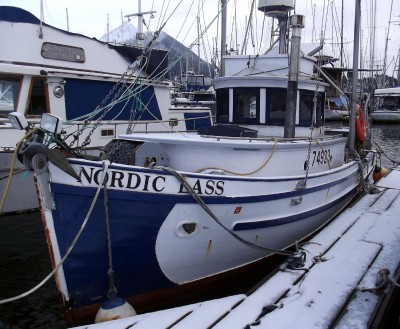
The anchor chain is quite visible on Nordic Lass's anchor winch. I'm sure there is wire cable on the drum under the chain.
|
|
Wed Jan 11 14:12:36 EST 2012, Sitka, AK
|
|
The fishing boats do have lead weights, though (for fishing with), and they can be slid down the wire cable to where the chain attaches, adding a lot of weight close to the anchor.
I can't say quite what depths or what scope is used, but Alaska is a deep-water place.
The cable is just galvanized steel wire, nothing special as far as I can tell.
A few weeks back we discussed the use of wire for anchor cable in more detail here, http://www.sailblogs.com/member/rhudson/?xjMsgID=203250 .
I'm quite interested in the use of wire/chain anchor rodes, but am not using them myself.
Terry, yes, wire is much cheaper than chain and rope. A drum winch that brings a long mixed (ie chain and wire, or chain and rope) anchor rode up without any messing about with stopping off one part while switching to a different type of winch drum has a lot of appeal.
Sun Jan 8 12:00:00 EST 2012, Sitka, AK
|
|
Sat Jan 7 12:20:38 EST 2012, Sitka, AK
|
|
Fri Jan 6 9:42:42 EST 2012, Sitka, AK
|
|
Thu Jan 5 12:43:48 EST 2012, Sitka, AK
This is the tachometer in the engine room of Adak.
As it is a big, slow-turning engine. the redline is about 350 rpm in either forward or reverse.
|
|
Wed Jan 4 12:52:02 EST 2012, Sitka, AK
The starboard side of the engine. As I understand it, this is both the intake and exhaust manifold.
|
|
Mon Jan 2 15:08:32 EST 2012, Sitka, AK
Brendan, the owner of Adak, stands on the port side of the engine.
The engine is connected directly to the prop shaft, there is no transmission (marine gear). The engine is air started. Changing from forward to reverse involves stopping the engine and restarting it in the other direction. One cannot frequently change from forward to reverse and back again because it takes time to build up enough air pressure to stop and restart the engine.
This makes for interesting boathandling.
|
|
Interestingly, we still see quite a few vessels with direct coupled shafting.
Mariposa Cruises' 144 foot dinner-cruise boat the Captain Matthew Flinders, docked at the foot of Bay Street at TO's Harbourfront has such equipment, albeit with DC electric engine cranking.
In more modern engine applications with reverse gears, air cranking of the larger engines is actually a preferred and sometime only viable method.
Air or pneumatic cranking is common however. Some large engines even have a smaller diesel engine dedicated to cranking - there are some pretty big internal combustion engines out there in commercial shipping....
xoxo c!
Richard
Mon Jan 2 14:00:00 EST 2012, Sitka, AK
Built in 1944, the wooden tugboat Adak is quite an interesting vessel. More to follow.
|
|
Richard
Sun Jan 1 12:01:03 EST 2012
For those readers in New York, I'm giving a talk about Sailing the Northwest Passage on Wed January 18. Details are at http://www.meetup.com/gotham-city-sailing-association/events/42647082/
Today in Sitka there is a storm. It is pleasantly warm and dry below on Issuma, tied to the dock, listening to the wind howl in the rigging and heeling over in the gusts.
The picture:
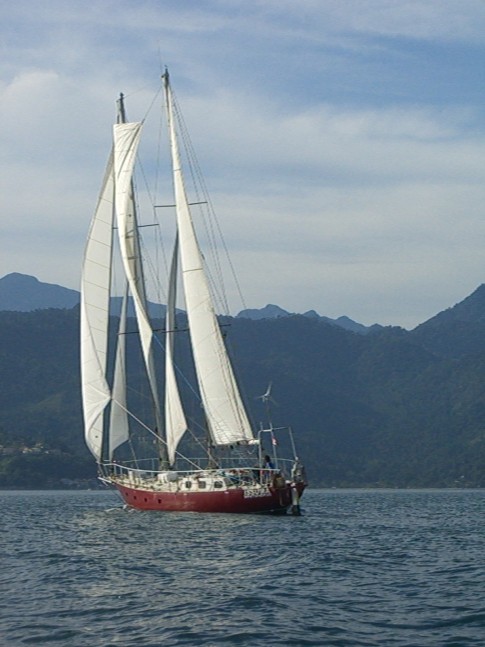
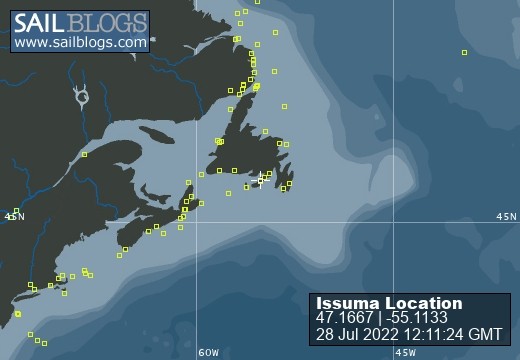
In July, we spent two weeks at the dock in Cartwright, Labrador, fixing the engine and converting the forestaysail from (broken) roller-furling to hank-on (shackle-on actually, as I could not buy hanks in Labrador).
For our departure, the wind was favorable, so we sailed off the dock, out of the harbor, and on to Greenland. Blair Gillis took this picture as we sailed through Cartwright harbor.
|
|
hope all is well,
AM
Amos, thanks very much. Best wishes for the new year.