Issuma

28 July 2022
28 July 2022
08 May 2022
18 April 2022
07 April 2022
04 March 2022
17 February 2022 | Little Bay, Marystown, Newfoundland, Canada
16 February 2022
09 February 2022
06 February 2022 | Little Bay, Marystown, Newfoundland, Canada
05 February 2022 | Little Bay, Marystown, Newfoundland, Canada
01 February 2022 | Little Bay, Marystown, Newfoundland, Canada
30 January 2022 | Little Bay, Marystown, Newfoundland, Canada
25 January 2022 | Little Bay, Marystown, Newfoundland, Canada
24 January 2022 | Duricle Cove
17 January 2022
11 September 2021 | Little Bay, Marystown, Newfoundland, Canada
27 August 2021 | Grey River
26 August 2021 | Grand Bruit
26 July 2021 | Isle Valen
Off With The Bowsprit! Part 2
17 April 2012 | Sitka, AK
Richard
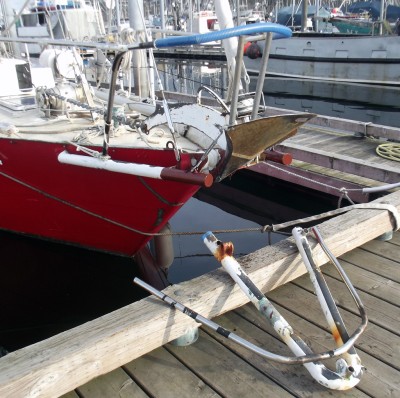
The easy part was cutting off the old bowsprit with an angle grinder. Then, without the bowsprit in the way, I could see how the anchor could be made secure.
I had some stainless steel pipes bent to the angle of the plates where the bow rollers were, and welded them on (the anchor shank and chain run between them). At first I used my wire-feed ReadyWelder, which is a device that runs on batteries--12, 24 or 36 volts. I welded the first pipe on with 24 volts, and, after doing some hammering, it broke off, as the penetration wasn't good enough. I had better results from adding another battery to get to 36 volts, but even better results when a neighbor on the dock lent me his stick welder (which plugged into shore power). Another neighbor who was a former pipeline welder helped me get the machine setup correctly.
I tried to bend the old pulpit into shape to be able to use it, but was not successful, so put a piece of blue, reinforced plastic hose in place for now.
The anchor is now held in place by the windlass holding the chain, a safety chain hook, and by turnbuckles on either side that attach to shackles in holes drilled into the anchor. I think the anchor will stay securely in place well when the waves push across it.
Final painting is still to be done.
I had some stainless steel pipes bent to the angle of the plates where the bow rollers were, and welded them on (the anchor shank and chain run between them). At first I used my wire-feed ReadyWelder, which is a device that runs on batteries--12, 24 or 36 volts. I welded the first pipe on with 24 volts, and, after doing some hammering, it broke off, as the penetration wasn't good enough. I had better results from adding another battery to get to 36 volts, but even better results when a neighbor on the dock lent me his stick welder (which plugged into shore power). Another neighbor who was a former pipeline welder helped me get the machine setup correctly.
I tried to bend the old pulpit into shape to be able to use it, but was not successful, so put a piece of blue, reinforced plastic hose in place for now.
The anchor is now held in place by the windlass holding the chain, a safety chain hook, and by turnbuckles on either side that attach to shackles in holes drilled into the anchor. I think the anchor will stay securely in place well when the waves push across it.
Final painting is still to be done.
Comments

| Vessel Name: | Issuma |
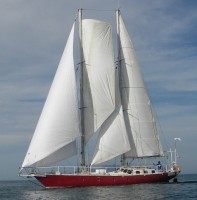
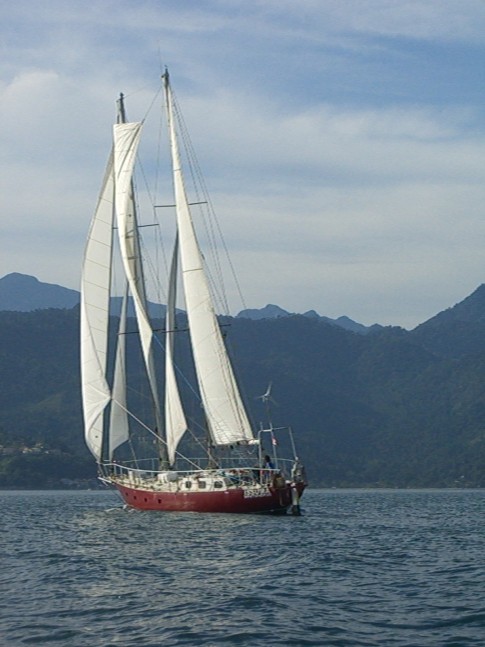
| Vessel Make/Model: | Damien II, 15m/50' steel staysail schooner with lifting keel |
| Extra: | Designed for Antarctica. Built in France by META in 1981. Draft 1.3m/4.5' with keel up, 3.2m/10.5' with keel down. More details at http://www.issuma.com/rhudson/issumaboat/IssumaDetails.htm |
| Home Page: | http://www.issuma.com/rhudson/ |
| Social: |
|
Issuma's Photos - Main
 |