
Fri Apr 10 9:30:00 EDT 2009
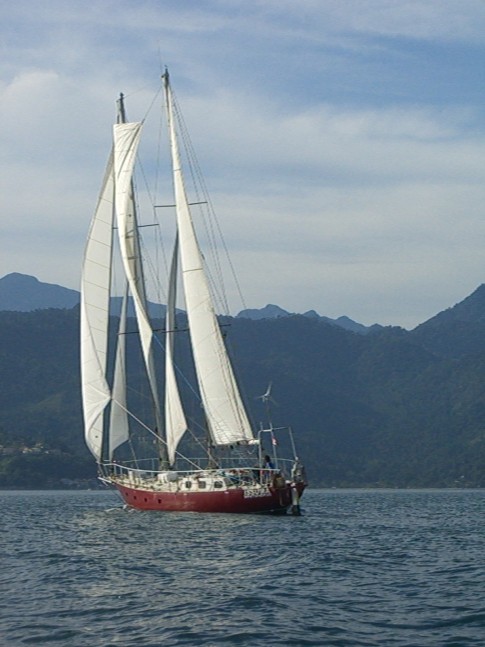
Had great wind yesterday (picture is from a couple of days ago, in light wind), force 3-6 from behind. Sailing farther offshore now to go around a Brazilian oilfield where access is restricted.
|
|
Thu Apr 9 10:20:00 EDT 2009
The rain (the dark area underneath part of the cloud in the picture) ahead has a squall (sudden increase in wind speed and often direction) with it. When this is coming for you, you get down some sails to be prepared for the much higher wind that you expect the squall to have. After a few minutes, it is generally over, and you tend to have the same wind speed and direction as you did before the squall.
There is an old sailor's rhyme about dealing with squalls: When rain comes before the wind, topsail sheets and halyards mind When wind comes before the rain, hoist your topsails up again
Yesterday the wind varied from Force 0 to Force 7, as it was mostly a squally day requiring lots of sail changes. The wind direction was favorable, though, so that was nice.
|
|
Tue Apr 7 20:50:00 EDT 2009
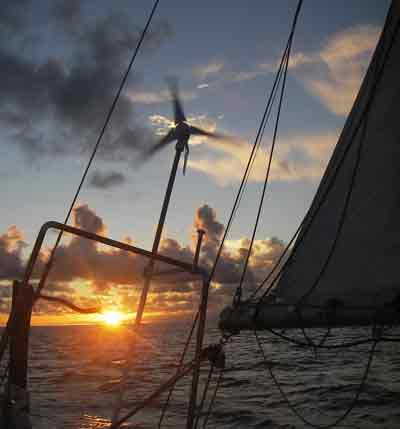
Have had a lot of light winds, mostly from ahead, so far this trip. While that has resulted in really slow progress, it also makes for a lot of pretty sunsets.
|
|
Fair Winds,
George
Tue Apr 7 10:00:00 EDT 2009
The fisherman sail is a four-cornered sail that sets high up, between the masts of a schooner. The name fisherman comes from the use of schooners for fishing off the east coast of North America, where fisherman would hang their nets to dry between the masts. Later, sails put up in their place were called fisherman sails.
The fisherman sail is one of the nice things about the schooner rig, as it is not quite as difficult a sail to handle as a spinnaker (the multicolored balloon-like sails generally set poled out), and gets sail area up high, where there is more wind.
Originally, the fisherman on this boat was set from a roller-furling rig on the aft side of the foremast. That never worked well, as the roller-furling rig didn't entirely fit the sail, and setting the sail involved climbing 12m up the mast to pull the sail out of the furler. Instead of using the roller-furling rig, I had slides put on the luff (leading edge of the sail), so the fisherman is slid up and down the foremast for raising and lowering the sail. Keeping the luff attached to the foremast makes it much easier to raise and lower the fisherman by oneself.
Because I was not using the original furling mechanism, I started setting the fisherman upside-down from how it had been set before (it fit the space now available better that way). This resulted in different parts of the sail chafing against the wires of the rigging. So I had more chafe patches put on the sail to prevent the chafe from damaging it.
In Argentina, I asked a sailmaker to change the shape of the top, so that it fit the space even better. I wanted a panel added to the top, so the whole sail would be bigger, as well as one top corner cut down so it would be possible to raise it to the top of both masts. The sailmaker pointed out it would be easy to cut down one corner, but difficult to add to the sail. So the corner was cut down and the sail made slightly smaller.
I'm experimenting with how high I want the sail now (highest for getting the sail where there is the most wind, but the higher it is the harder it is to raise it without anything getting caught), which is why it isn't quite at the top of the masts in this picture. Raising it up is also going to change where the sail chafes against the rigging wires, so will involve some new chafe patches. The dark line in the sail is where the sail has rubbed against the rigging wires. After sailing with this for a while, I'll have a new line in the sail to look at to see where to put the chafe patches.
|
|
Mon Apr 6 10:00:00 EDT 2009
Sunset over Isla Gorritti, Punta del Este. The sun is being framed by the windvane self-steering gear platform.
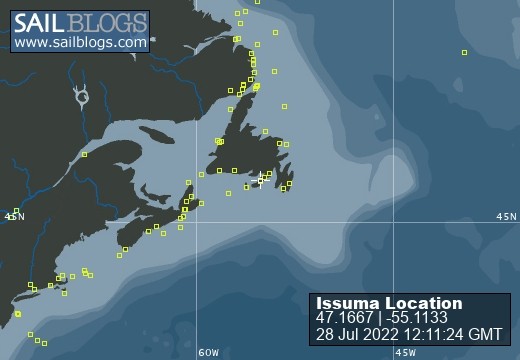
This picture was taken about 785 miles back (click on map for current location).
|
|
Sun Apr 5 10:00:00 EDT 2009
I mentioned getting the genoa made smaller yesterday. This sunrise picture shows the problem with waves hitting the foot (lower edge of the sail). The seas are not at all rough in the picture, the wind is light, but when the bow cuts into the waves, water is forced up and some of it still catches the foot of the genoa, which strains the sail and the furler it is attached to. Waves are not high enough in this picture to require reefing the genoa, but when they get a little higher, the genoa will need to be reefed (and the boat will go slower). Now that the genoa has been made smaller (cloth was taken out of it), waves hitting it are less of a problem than they used to be.
|
|
Sat Apr 4 10:00:00 EDT 2009
Ship crossing ahead. The genoa (the forward-most sail) was reduced in size in Argentina to make it easier to use. The foot is now higher and doesn't catch as many waves (also doesn't block visibility ahead so much).
|
|
Fri Apr 3 10:00:00 EDT 2009
A nice thing about getting up early is watching the sun rise.
|
|
Think it will be at least June before Issuma gets to New York (after all, have been sort of heading there since last May, so a little longer doesn't make much difference at this point :) ).
Thu Apr 2 10:00:00 EDT 2009
So far, the wind has mostly been light, and sometimes calm, so speed has been low. There was a great tailwind yesterday (the picture is from a few days ago), but it is lightening up now.
|
|
Tue Mar 31 18:00:00 EDT 2009
The wind finally went behind us (it has been pretty much light headwinds and some calms so far this trip), so the mainsail could come down (the other sails stayed set) for some minor work. The slides that attach the sail to the sail track in the mast were originally attached with toy plastic shackles--too weak for the job, but designed to fail so that damage to the sail itself was prevented. Since the shackles all failed so frequently, they have been slowly replaced by either thin rope (which works, but doesn't stretch much to absorb shocks), or shock cord (which is what I'm sewing on in the picture).
|
|