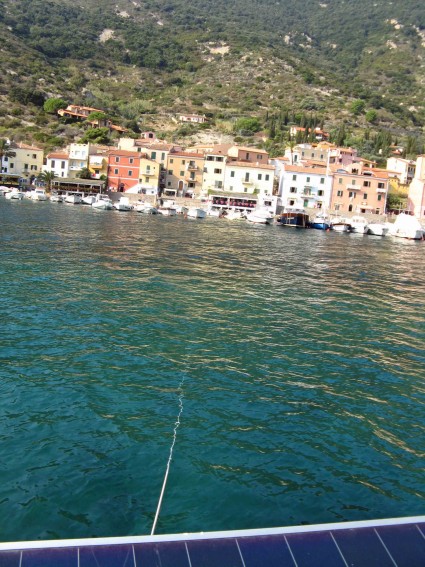
This is the stern line. The water is so clear, it's hard to tell how deep it has become - an additional frightener when the ferry is looming above the decks!
The town itself is very sweet but very touristy. Lots of over-priced restaurants. Above the port is a walled village, dating back to when this island was ruled from Aragon. Unfortunately we didn't get there. On Saturday morning, we were told we had to leave, as a big fishing festival and competition was being held that day and the harbour was full. What's more, we had to be gone by 1100, as yet another ferry would be using the quay. That cut our time short, but we hope to go back another time and see more of the island.
We had been pronouncing Giglio with two hard 'g's - a laughing island. In fact, both are soft, making it more like Jeelio, which is Italian for lily. We left the island of the laughing flowers for Isola Giannuttri, just 12 miles south.
| Life on Roaring Girl |
|
It's a wee step, about 30nM, to Isola Giglio, the next accessible island in the archipelego. Both Montecristo and Pianosa lie temptingly to the south, but neither can be visited in your own boat, as they are protected marine reserves.
There are a couple of suggested anchorages on the island, both just south of the harbour. We nosed into them, to find them deep, over 25m of water until you are very close in. One yacht appeared to be using one of them, but possibly only as a lunch stop. So we turned into the harbour, which was its own adventure.
Definitely a stern anchor stop. This was the first test of our new set up. Mostly it worked absolutely fine, although we discovered that the shackle connecting the 10m of chain to the warp will need to be changed, as it didn't fit through the roller. Ho hum: some minutes spent getting the split pin off whilst tethered off the stern in the centre of the port. A very interested audience gathered!
In the end, however, we made it all work, dropped it in good time and, for our first time, spent the night with our own stern anchor holding us off the quay. And it even came up again in the morning, which was a relief! Still some fine-tuning to do, but the basic principle works.
You can see here that you come through the entrance, and the quay is to port. The pilot book suggests a visitors pontoon ahead of you: the pontoon is still there but was stuffed full of what looked like permanent boats. The quay itself does get busy with lots of fishing boats, and we can imagine the place is packed in the high season.
Several ferries come in here, presumably from Porto San Stefano. One, a small Torremar, does a three point turn in this harbour, a spectacular sight. It would be something of a deterrent to a boat much bigger than Roaring Girl, especially with a long line out astern,
| Life afloat (containing pilotage notes) |
|
The town itself is very sweet, if well-touristed. It is slightly reminiscent of Cornwall: steep slopes, pretty buildings and loads of little craft shops with jewellery, ceramics, painting and tapestry.
The central square is elegant, with cafes around it. This town used to be famous for housing one of the most hard-time prisons in Italy, in the large fort that looms on a ridge over the bay, known as Longone. Some while back they rechristened the place as part of cleaning it up for tourism, a regeneration effort which appears to have worked very well.
| Places and people |
|
We had a very pleasant sail down the eastern coast till the wind dropped completely about three miles from the headland north of Porto Azzuro. Entrance is very easy, and, as the chart suggests, you simply keep going into the bay till you reach the top. There are various anchorages scattered around the indented coast, but it was noticeable that most boats had used those as a lunchtime stop, coming into the head of the rade for the night.
We got there ahead of most and secured a decent place in about 9m of water, just before the mooring buoys proliferated. As you can see, it's a dramatic and beautiful spot. On the south side is a big boat yard; off one of its moles, two wooden masts stick up from the water! A barge was moored next to them, and buoys marked them out, so we must hope that whatever elegant hull lies beneath them will soon be rescued.
Our night was very peaceful; even when the wind changed from a south westerly to a northerly, we felt no swell. However, in an easterly, we can imagine there is significant swell in here. Judging from the very heavy chains on boats permanently moored in the little harbour, they need some serious protection from the waves and surge.
Dinghying ashore here was very easy, with lots of places on the pontoons, and nobody seeming to take much notice. (There is a beach, but it has a very steep drop-off and quite a bit of surf in the swell.) This might be different in the high season, but certainly gave us a relaxed change from the exigencies of Portoferraio.
| Life afloat (containing pilotage notes) |
|
As you come round Capo Vita heading east, there are several islands scattered across the sea between Elba and the mainland. In the wonderful clear air of Tuscany, they all look very close. A frantic search of the chart reveals the previously unnoticed dot of Isola dei Topi, which is really close. There is a narrow channel between it and the mainland, which we saw boats use, but we noted the rocks on its south-eastern flank and went round the outside.
Beyond that, some distance away is Isola del Palmaiola, with its lighthouse, hidden behind our genoa on this picture. And away in the distance, just to the left of Palmaiola, another one of no interest to us at all. And even further away is the hazy mainland.
| Life afloat (containing pilotage notes) |
|