North of Capo Testa, the chart and pilot book suggest a couple of possible anchorages. The actual series of rock-strewn tiny indentations are more than a little intimidating. In the end we rounded Pte Acuta and came to this excellent little anchorage just north of the narrow isthmus. There were two other boats anchored there and we were very comfortable in 5m of water.
The forecast suggested a F6 westerly in the straits of Bonifacio this afternoon, so we got up very early to cross. In fact there was virtually no wind at all and after doing two of the eight and a half nautical miles in about 90 minutes, we gave in and switched the engine on.
| Life afloat (containing pilotage notes) |
|
The wind faded until we got to Capo Testa, the extraordinary weathered promontory that marks the narrowing into the Bonifacio Strait. Our first thought had been to anchor in Baie Colba to the south of the headland, but found it much more open to the west than the chart suggests. The northwesterly was also curving around the rocks, creating a strong breeze into the bay.
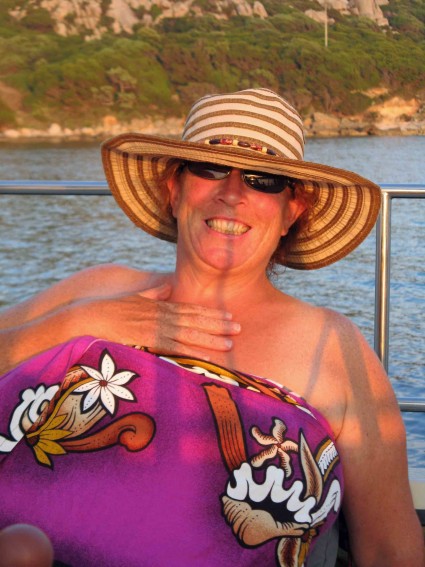
So we jibed round and stood well off to clear the rocks. Of course, once we were more than half a mile out, the wind died again. The picture is actually from Baie s reparata looking west back to Capo Testa.
| Life on Roaring Girl |
|
It was a very Mediterranean passage. No wind at all. Then we reached the point where the small northwesterly breeze cleared the point of Isola Asinara and kicked up a fetch across the bay. After ploughing into that a bit, we came past Capa Vignola and were able to sail for a while.
Sometime ago Pip acquired Gullivette, a fluffy white mascot who lives in our cockpit. Here she is, helping with the helm, andin the album you can see her participating in several activities aboard ship.
| Life on Roaring Girl |
|
From Castelsardo we turned north. The coast is not particularly exciting, but for this rather undistinguished small range with the suggestive name of Sarra Tamburra. The Sardinian version of the skippers name?
| Life on Roaring Girl |
|
The potted gardens of Castelsardo's high town are striking in their variety and luxuriance. No need for guerilla gardeninghere!
| Places and people |
|
In the streets of the old town, amidst the cafes and souvenir shops , women are still weaving. Many are sticking to the older forms, which presumably sell well, but some are experimenting with other colours and shapes. We were very interested in the similarities and differences with the flax weaving practised across the Pacific. This tradition is alive and well in Aotearoa/New Zealand. When we were there in 2008, Pip's mother took us to the museum in Petone which had a special exhibition on about the work. Also, Lou, in Christchurch has done quite a lot of weaving, and some of her little baskets are on Roaring Girl today.
One of the major differences is that, here in the Med, it never seems to have become usual to use woven fibres for clothes, unlike the many skirts, hats and cloaks of the south.
| Places and people |
|
Castelsardo is a major centre of the ancient Mediterranean art of weaving vegetable fibres to make important utensils. Historically they used a very wide range of materials, such as myrtle twigs, reeds, and palm fibres. The castle houses a small museum of the craft, which includes this wonderful boat. These fassois were used by the lake fishermen of Oristiano, who quanted them with long reed poles, and laid woven basket nets to trap their prey.
| Places and people |
|
One of our reasons for visiting the town was to see its spectacular castle. Originally built in 1102 by the Genoese, the mediaeval town was called Castelgenovese. When the Aragonese got possession, they called it Castelaragonese. It was not until 1769 when the Kingdom of Savoy got control, that they felt secure enough to give it its present name.
The bell tower, originally the lighthouse, has this wonderful polychrome dome, unique in Sardinia.
| Places and people |
|
The town here is very easy to recognise from the extraordinary castle and belfry atop a great wall cascading down the steep promontory. This picture is taken looking sou-sou-west from the castle walls. The marina is actually slightly southwest of the headland and the entrance is difficult to see till you are quite close. As you can see, there are lots of rocks under the headland so although the entrance is very straightforward once you have it clear, do not close the shore to less than 20m depth till you are sure of your position.
Incidentally, one suggestion for getting into town is to take your dinghy to the town beach, at the bottom left of the picture, and walk from there. We wouldn't advise this. The beach is a crowded place to leave your dinghy unattended. And you still have a fantastically steep walk. Instead, take the 70 cent bus from the port to the castle. The capitainerie will give you the timetable.
The marina is simple, and ormeggiatori were on the dock to call us in, although we had got no answer on the VHF. Tailed lines lead from the quay and there was certainly plenty of space for us. On 1 July we paid EU40 for the night, including water and power.
There are reasonable showers as well, which were a great luxury. This is the first time Pip has had unrationed water (not fees, not buttons to push, no Navy showers) since leaving Ostia two months ago.
Although the marina staff were friendly, we were sadly taken aback by the unabashed snootiness of the blue-ensigned UK yacht berthed next-door but one. We have never been cut so dead before. They lived up to any and every comment we (and others) have ever made about yachties who feel such a sign of prestige makes them senior to rest of us. No wonder so many other countries think pommies are so stuck-up!
| Life afloat (containing pilotage notes) |
|
Asinara has been isolated for a very long time so despite its proximity to Sardinia and Corsica it has various unique flora and fauna. Of these by far the biggest are the albino donkeys.
Now, when you see the tourist photos these are white, fluffy and cute. In real life, they are grey, grubby and bored rigid with being cooed at by tourists in a wide range of European languages. They can probably determine the make of your camera by the shutter click alone. This donkey graciously allowed herself to be petted, but the curled lip and cross ears showed her preference for an undisturbed siesta.
The unique sound of Asinara, amidst the ubiquitous cicadas and screaming gulls, is braying donkeys, calling to each other across the gently rolling scrub at dawn and dusk.
| Places and people |
|
Once round the beacon the mooring field is clear. There are about 20 yellow buoys, all of which (except possibly number 9) have 3-10m of water all around them. They have long trailing lines, which are easy to pick up but have rather a small loop on the end. Too small for our samson post or cleats, anyway. That's what all our other ropes are for.
The mooring field lies inside a large jetty, to which a twice daily ferry to Porto Torres ties up. It's also the base for the very active diving business. Alongside this jetty is a small pontoon which does have electric and water points., We saw a catamaran lie alongside briefly, but it would be challenging to make sure a yacht of Roaring Girl's size and draught got in there safely.
It is a reasonable dinghy dock, however. We motored ashore, as we have seen many others do, only to be told off very sternly by the Parks police. Our timing was poor, and with the threats of fines, we have quietly rowed ever since.
The picture is of Roaring Girl in the crystalline water, taken from the small nature trail that runs along the edge of the low cliffs. The orange beside her is the Wala Wahini, our inflatable kayak, on her first outing of the summer.
| Life afloat (containing pilotage notes) |
|
To get into the Realle mooring field, you must then round the Neri Reef, the western (inland) end of which is marked by this big beacon. It may be possible to go between he reef and Pte di Trabuccatto, but if so it will be in 5m or less. We saw one yacht arrive by this route. We went round the outside.
The beacon should be bearing not less than 305 degrees, and on that heading you will see at least 13m of water along the fringe of the rocks.
| Life afloat (containing pilotage notes) |
|