SailBlogs
Bookmark and Share
Sailing the Pacific
Tonga
James
14/10/2010

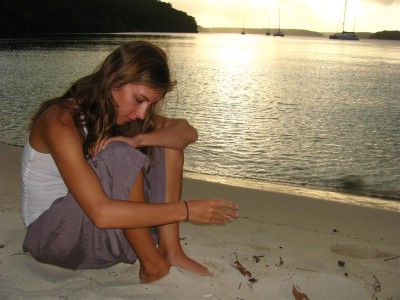
Time for a sundowner.


Beveride Reef to Tonga, a little over 300 miles.

We had quite a rip to go through as we negotiated the pass to leave Beveridge, but managed to find a relatively clear lane more to one side.
We had about 20 to 25 knots of wind behind us most of the way and gusts to over 30 on the second day with some of the more impressive waves we have seen to go along with it.

We had the mainsail double reefed and this was all fine except that the upper part of the sail occassionaly got caught behind the side stay that holds up the mast. That third, windy, wavy morning, Isabelle was asleep below and the sail was caught as described. All it would take to fix it was a little gybe to get the wind on the other side of the sail and then back again. All was going to plan when a wave hit the boat at the critical moment of the gybe and flung the boat around broadside to the waves and wind and tipped us suddenly. I looked below just in time to see poor, asleep Isabelle flung right out of her bunk, clear across the boat to the bunk on the other side without so much as touching the floor.
What a rude awakening. She sat there rather stunned for a while.

We arrived at Tonga in the middle of the night and spent the early hours hove to outside the sheltered harbour as it was much too dark to navigate by eye, with rain squalls added, and we were also unsure of the accuracy of the charts compared to the GPS. Turns out we were wise to not trust the GPs as there is quite a discrepancy between charted position and GPS position in Tonga. About 0.2 of a nautical mile. Enough to put you ashore in a narrow pass.

The part of Tonga we had arrived at was the Vava'u group. A beautiful group of many, many islands and anchorages without very many coral dangers. The anchorages were tranquil and close to the wooded shores. It was unusual for us to hear birds singing in the trees while we sat at anchor. Something we had not heard for about seven months!

The Tongans are very friendly people and we enjoyed our four week stay there. Some of our highlights were: Fish and Chips (for the first time since leaving home!) and being able to eat out at reasonable prices for the first time since the Galapagos, snorkelling over the best coral we had seen all trip, hearing whales under water, Isabelle's swim with the whales as detailed in another post as is Mariner's Cave, catching up with friends we have made along the way, and making new ones, enjoying the peaceful anchorages and sundowners on the beach.


Climbing the Mast
James
14/10/2010

Not quite the conditions when climbing the mast as this post relates.


It's been a long time since I updated you all about our travels since Beveridge Reef way back in August, ( Isabelle's been doing all the work) so I'll try to add a few posts in the next couple of days to fill you in from my side. James

At Palmerston Atoll, it had been a stormy day and everyone was feeling a little uncomfortable on the moorings there, where we were positioned outside and quite close to the fringing reef. The wind was always threatening to turn onshore to, a dangerous situation. Finally it did turn onshore and as our bow started digging under the waves as it tugged on the mooring, we decided it was time to depart. Five other boats did the same, leaving only one remaining who had only just arrived.

After it had just turned dusk, which also means night as there is hardly any twighlight in the tropics, our headsail suddenly started falling down. When we brought it all the way to the deck we could see that a shackle pin had fallen out, leaving the halyard and attached swivel at the masthead and the sail on the deck. With 500 miles to go to the next port and being unsure if the weather would get worse, I decided I should go up the mast while it was 'relatively' calm to fix the problem right then. It does not take very much movement at the deck to make a lot of movement once you are even half way up the mast. Even with the mainsail still up to steady the boat it was a nasty ascent. Try to imagine clinging to a narrow stick while some giant waves and flicks it around attempting to dislodge you, and you will get an idea what it is like to try to hang on. I made my way slowly to the top secured in our Bosun's Chair as Isabelle took up the slack on the halyard that it was attached to. My fingers sought out the gaps between the mainsail and the mast as i reached around, bear hugging the mast.

At last i reached the top and realised i had not brought a spare line to attach to the halyard so we could simply haul it down. Short of going all the way down and back up again ( not very desirable) my only solution was to go down via the forestay and take the swivel with me. Should be ok...
Turned out to be not so ok as each time the boat pitched on a wave it would make me do a lap around the forestay, first one way and then the other, like some evil fairground ride. I arrived on deck shaking and with grazed thighs and arms from trying to hang on, but we were able to hoist sail again.

I now have great admiration for all those brave people I've read about who have had to climb masts at sea, usually when it's rougher, a taller mast and even on their own.

Farming the Black Pearl
Isabelle
03/10/2010

Inside the Black-Lipped Oyster, the black, slimy part is the lip


Although we are now in Fiji, I have been meaning to write a more detailed post on the process of farming the Black Pearl. I'm doing a little overland travel and nestled in a cheap but lovely hotel, I've finally found the time to write the post. Here it is.

"Every woman wants a string of pearls... Isn't that right Isabelle?" Peter asked me outside a pearl shop in Fakarava. I thought for a moment, not wanting to be just like 'every woman' but I had to answer "I don't know about every woman, but I do."

Why do many women want pearls? I have no idea, but I can tell you why I am happy that I have some.

Jamie and I were anchored in Kauehi's Lagoon. The first thing that hits you about the Tuamotus is how remote and desolate the islands are. Not much grows on the atolls except for coconut palms. The people in the Tuamotus have two main sources of wealth- copra; which is rancid coconut meat used to make coconut oil for perfumes, cosmetics and cooking oil and the other is the Black Pearl.

We both wanted to see how black pearls are made and went asking around town. Soon enough we met a family who were in the pearl business and agreed to take us out the next day to visit the farm and see how they graft pearls.


Different coloured buoys mark pearls which are in various stages of growth


The start of every workday begins with a dive for oysters

Arrou is the eldest son and best grafter in the family. He has been grafting for over 10 years. He was a stock bloke with dark skin and tattoos. We met him at his office, a rickety old weatherboard shed on stilts in the water.


Wedging the host shell open

He took an oyster and wedged it open with a metal clamp, explaining to us that a Black Pearl is called a Black Pearl not because of the colour of the pearl but because it is made by a Black-Lipped Oyster. A black pearl can be green, purple, black, white, silver or gold depending on the depth the pearl is farmed at. But most of the time, a healthy black pearl will be very dark in colour compared with white or pink pearls which are farmed in Australia, China and Japan.

He then took a different oyster and pried it open completely, looking at the colour of the shell inside. "bad colour" he said in English and put the oyster aside. He opened another one and said "good colour". I couldn't tell the difference. He proceeded to slice off the black lip of the oyster, sliced the bottom part of the lip off the black part and cut it into tiny little pieces. "Very Important" he assured us.


Arrou slices the lip ready to place it in an oyster with a shell nucleus

Arrou turned his attention to the oyster that was wedged open. He took a small, round marble type thing, "shell nucleus, Mississippi" he said and with the help of a serious looking piece of surgical equipment he made a neat incision in the body of the oyster before delicately placing the nucleus and the piece of oyster-lip inside. We now understood that by placing a piece of lip inside a host oyster, you could transfer any colour you wanted to start growing around the shell nucleus and that together, these would become your pearl.

He told us that this pearl would be checked every six months but only after two years would it reach a decent size. Once that oyster had made the first pearl successfully, a new and slightly larger shell nucleus would be inserted and the process would begin all over again. This would happen until the oyster became too tired to produce any more pearls. One oyster can make up to four pearls before it becomes too tired and this is reflected in the quality of the pearls. One oyster cannot make two pearls at the same time.


Shell nucleus from the Mississippi and three Black Pearls

The majority of pearls that are made are not the perfectly round ones you see in shops, rather there is a variety of shapes. There are baroques, which have rings around them creating an un-even surface, there are raindrops, and there are Geshi, which are tiny misshaped ones that look like little shiny meteorites (my favourites). Very rarely you will get a smooth round one with good lustre (reflective quality), this is why the round ones are worth more even though they are the most boring ones.

Nui, one of Arrou's work mates told us that the price of pearls has dropped in the past two years due to an influx of mass-produced pearls from China and Japan to international markets.

On an average work day, Arrou and his two mates graft up to four hundred pearls. Seeing them dive for the oysters, clean them off then check for pearls, you do come to appreciate how much work they put in and how long it would take to create a string of perfectly round pearls of the same quality, size and colour.


Arrou

The next day we went out to the farm again to see how the pearls were removed once ready. We took along some friends who had just arrived. At the end of the visit we did some serious pearl trading which was heaps of fun. We took fishing lures, hooks and alcohol all of which are hard to get in such remote places. We had a really good time bargaining and both sides were happy at the end of the day.


First pearl of the day


Derek asking how many pearls the 'big lure' is worth

Not only that but the myth of the Tahitian Pearl was busted. I would guess that most 'Tahitian Pearls' are actually farmed in the Tuamotus. They should be called the 'Tuamotan Pearl'.


So to answer Peter's question, Yes, I do want some pearls. But what is more important than the fact that they are pretty and shiny is that they help me remember that I was there, in one of the remotest places on earth and I met a pearl farmer who showed me how they were created, who gave me Black Pearls for Rum and Gin and fishing gear and it was a great experience. I felt like a real pirate!


Whaleswim
Isabelle
15/09/2010, Vava'u, Tonga

When I saw a woman on some travel show swimming with Whales in Tonga in 2005, I knew it was something I wanted to do. In the confusion of wondering what to do after high school, I even remember writing an email to 'Whale Swim Adventures' asking for a job with them doing anything. I was even willing to scrub toilets. I never got a reply.

As luck would have it, I arrived in Tonga during Whale season five years after I sent that email.

When Lynn from La Graciosa said she had met this nice guy called Dave who does the whale swims and she could organise for us to go out the next day, I said I'd love to. Jamie decided not to come as he had stuff to do.

We left bright and early the next day and I was positive we would have a good swim. As the hours wore on I became a little frustrated. It seemed that none of the whales wanted to play with us, they all dove down when the saw us coming. Dave said he thought there might even be a submarine in the area causing the Whales some distress.

It was still a nice day. Dave told us some very interesting thing about whales- for example that the males of one Island group all sing the same song. Their song is extremely complex with not only separate notes but also chords. Their song this year goes for about 12 to 13 minutes and they often repeat it over and over again. There is a man in Tonga studying the Humpback whales here and a few weeks ago he took a recording device down 25 meters to where a male was singing. He was within 10 meters of the whale and his recording device was picking up the song at 160 decibels. Our eardrums burst at 180.
The female whales have to guard their Calves against not only sharks and other ocean predators but also against some other males. To provide more protection, often a nursemaid whale is swimming with a mother and Calf.
Anyway, as the day was coming to a close, I became a little disappointed but I thought 'Well at least I have tried. I can't say to myself that I didn't try to swim with them.' Dave also looked a little upset that we didn't get a chance to go for a swim and he wanted to stay out 'Just a little longer'.

Just as we were about to give up, we heard a whale spout behind us and we turned around to see a surfaced calf. We slowly followed it so as not to frighten it and eventually we were close enough to jump in. We all slipped quietly into the deep blue water and began to swim in the direction of the cub. Dave was ahead and he put his arm up to signal that he had found the Whale. As I approached, I saw the mother. She was sitting about 10 meters down. She was huge, majestic, incredulously beautiful. Then just to put the icing on the cake, a little head popped up from behind the mother and we got full view of the calf a new born 2 tonne baby. The baby turned towards us then surfaced 4 or 5 meters away from. We could see every detail on its body, its long fins, the remora hanging off it's stomach. Then it swam back down and gave it's mum a nudge.
What happened next was the best part. Both mother and baby slowly turned around and rose to face us. Us looking at them and them sensing us with their sonar, determining our shapes, acknowledging us. Then, gracefully, they slowly turned and swam away. Needless to say, we all came out of the water with smiles stretching from ear to ear.

That night, I lay in bed for hours, replaying every moment from when we jumped into the water, trying to remember as much as I could so that I will never forget it.

Mariner's Cave
Isabelle
02/09/2010, Vava'u, Tonga

My heart was thudding in my chest as we treaded water in 150' depth facing the rock-face. Jamie was on my left side and Adelle, a young Australian woman on my left. I looked down and could see the black hole of the cave wiggling beneath the surface of the water. A kind of excitement welled up inside me and my breath shortened. Before I could think too much about the fact that I was diving into a dark cave with no idea how long I would have to hold my breath for before I came to the air pocket inside, we'd dived together into the darkness.

We dove down three meters and then swam about five meters across, the rock above us, the inner surface shimmering before us. We surfaced and took a deep breath as much for wonder at the place as for the relief of air.

The cave was spacious inside, the rock ceiling reaching up and then dangling down in stalactital form. There was a high platform with enough space for someone to live on and as I treaded water looking around, Adelle told us the story of William Mariner and his bride to be. He had fallen in love with a Tongan princess when he arrived in Vava'u from England. Her father, the king, didn't approve and so William whisked her away and hid her in the cave for two weeks before they left for England. She became the first Tongan to ever go to England.


Inside everything was reversed. It was dark apart from the wobbling light, the exit to the outer world. The waters would gently rise and fall with the coming tide and as it rose, we all got a funny feeling in our ears and the whole cave would momentarily fog up before the waters dropped a few seconds later. Our goggles also fogged up with the pressure of the air being forced up in a sandwich between rock and water.

As I swam out, I looked up and clinging like puddles of mercury on the entrance ceiling were pockets of air. As we surfaced outside again, all I could say was 'Wow! That was so cool!'

We must also say a thank you to Claire O'Callaghan who also came with us to Mariners, took the amazing photos posted here and kindly let us use them on our blog.


Beveridge Reef
Isabelle
08/08/2010

It was nearing the end of the third day of our passage from Palmerston Atoll to Tonga when we started having a closer look at the chart of the area. We noticed an intriguing looking reef. Beveridge Reef. With some research of some articles we had on board, we read that it is a landless rim of coral. Pristine. Uninhabited. Both our eyes were alight at the thought of such an adventure, an entire lagoon to ourselves! A few minutes later we had made a 90 degree left turn, and were on our way, 100 miles to Beveridge.

On the chart there was a note telling us that the reef is actually 3 miles north-east of where it's meant to be. This just added to the intrigue of such a place.

As we were approaching, we were welcomed by a humpback whale which launched its whole body out of the water, creating a massive splash as it fell back down. It then surfaced about 15 metres away from the boat. The water was so clear that we could watch it gliding underneath the surface.

On our charts, Beveridge Reef is simplified to something like a children's drawing but fortunately the navigating is easy with the pass wide and deep and the lagoon deep enough to be straight forward.

A rim of shallow turquoise water stretches all the way around the atoll, on one side bordered by the outer coral reef, on the other it encloses the deeper sea-blue lagoon.

We anchored in 9 feet on a sandy bottom. The water is so clear that when we dived in, we could see the anchor 100 feet ahead of the boat and well beyond that with perfect clarity. It's also a delicious shade of blue under there.

We had anchored in the SE corner of the lagoon and noticed that at low tide a part of the coral reef was exposed. We hopped in the dinghy and went to explore the reef but on the way, our dinghy engine cut out. We found ourselves drifting fast in the current that is created by the waters leaving the lagoon after the waves crash over the barrier reef. I was trying to get the anchor out but it�'s bag that had been tied very tight with numerous knots. We were drifting fast, away from our boat and away from the shallows. Jamie untied the oars and we took one each, using them as if we were in a canoe. It was exhausting paddling against the current but we really had no other choice, we had to keep up the pace. It took us a long time of intense paddling to get back to Dagmar who was only about 50 meters away. Our muscles were burning and we both realised then that we must take more precaution than usual as there would be no-one to rescue us out here, in the middle of the ocean, alone.

When Jamie had fixed the engine, we went out to the reef. We walked over about 100 meters of shallows after we had anchored the dinghy, careful not to step on the coral, sea cucumbers, giant clams and especially not the sea urchins, the spikes of which look like they could pierce your skin with no effort at all. Eventually we made it to the outer reef about 30 metres of which was exposed before the breaking waves.

We were walking close to the breakers and it was exhilarating, occasionally a big wave would come up, foaming around our knees, threatening to take us back into the ocean with it. We were looking for lobsters in the holes near the breakers. I had walked up ahead of Jamie when I heard �"I�'ve found one!�" I ran back to where Jamie was and watched as he tried to locate the lobster in a big dark pool, the waves breaking over his back, making it impossible to see. It escaped into a dark crevice, but we then had hope that we would find others.

A few minutes later, I spotted one. I was peering into a dark coral hole, between waves the water became clear and I could make out the faint outline of the lobster below. My heart jumped. I took my spear as it was quite deep and aimed then speared straight down. I knew I had got it because my spear was jiggling around as the lobster tried to free itself. Jamie then came along and reached down as I brought the spear up with the lobster on it. He grabbed the lobster but while the opening to the hole was big enough for the lobster to fit through, it wasn�'t big enough for the rock which the lobster had taken hold of and so we wrestled there a moment while we pried the lobster�'s arms off of the rock. We got it out and couldn't believe the size, probably about 3 kg.

After that, it seemed easy to find lobsters, we spotted about twenty others in the space of an hour or two, even one scrambling overland.

We took one more which was even bigger than the first. Unfortunately, what we didn�'t notice until we had speared it was that it was pregnant. It held two eggs just near the opening to its mouth. It is hard enough killing something, but something which it breeding life�. a sad realisation. Later, long after the lobster had died we opened the two eggs to find tiny little lobsters forming, their tails already there and one of them was still moving.

Newer ]  |  [ Older ]


Who: James Thomson and Isabelle Chigros-Fraser
Port: Melbourne, Australia
View Complete Profile »


See our galleries
19 August 2010
13 Photos
23 April 2010
12 Photos
 
SailBlogs Friends
BLUEBOTTLE (ex-Aura) Freedom Trim Valiam  hlamff sailmaker - China 
 
'Twenty years from now you will be more dissapointed by the things that you didn't do than by the ones you did do. So throw off the bowlines. Sail away from the safe harbour. Catch the trade winds in your sails. Explore. Dream. Discover.' -Mark Twain