Semper Vivens
04 October 2010 | Berlin, DE
29 September 2010 | Düsseldorf-Köln-Düsseldorf
28 September 2010 | Muiden – Terborg - Düsseldorf
27 September 2010 | Amsterdam, NL
27 September 2010 | Callantsoog, NL (6m below sea level)
25 September 2010 | Callantsoog-Hoorn-Breezanddijk-Den Helder-Callantsoog NL
23 September 2010 | Arras, France
22 September 2010 | Dieppe-Picquigny-Albert-Vimy, FR
21 September 2010 | Pourville(Dieppe), FR
19 September 2010 | Le Mont St-Michel, Saint-Malo, Tréhorenteuc
18 September 2010 | Courseulles-sur-Mer, FR
17 September 2010 | St-Agnan-le-Malherbe and Bayeux
16 September 2010 | St-Agnan-le-Malherbe
15 September 2010 | Heuqueville, FR
07 April 2010 | HFX
07 April 2010 | HFX
23 December 2009
16 September 2009 | HFX
06 September 2009 | hfx
01 September 2009 | HFX
Vimy
22 September 2010 | Dieppe-Picquigny-Albert-Vimy, FR
PCldy, 20C
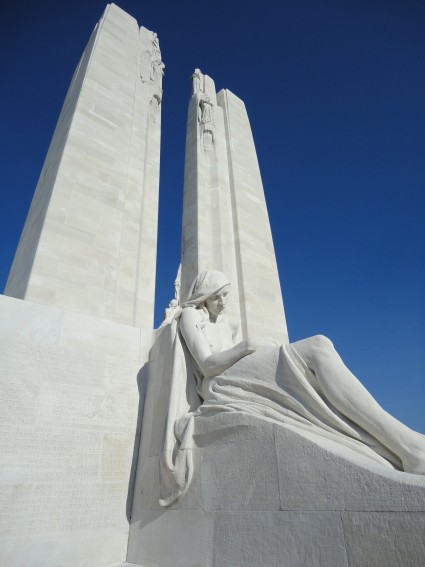
Photo: Vimy Ridge
From Pourville we drove east to the top of the cliffs overlooking Dieppe, where the Canadians staged their disastrous raid of 19 August 1942. From our vantage point high over what was the landing areas, it is difficult to comprehend why this particular spot was chosen, even with the advantage of surprise, which in the case of the Dieppe raid was lost when the assault force was discovered by the German Navy in the middle of the night as it crossed the English Channel. While the lessons learned at Dieppe were certainly applied to the D-Day landings two years later, it is still understandable why the decision to raid Dieppe remains controversial to this day.
From Dieppe we drove along the coast to le Tréport and then inland along the Somme River. Our first stop was at Picquigny, which is where my mother's family originated. Her ancestors crossed the Channel with William the Conqueror, and the name has been anglicised to Pinkney. We decided to check out the the Château de Picquigny, and found the deserted ruins of a splendid old castle, but unfortunately the main door was locked shut. Not to be deterred from checking out ancestral stomping grounds, I looked for alternate entry points, but the walls were simply too high. However, a second and closer examination of the barred gated revealed that it had a large enough gap at the bottom of the door, so I simply stuck my hand under, lifted up on the deadbolt, and voilà! I was in, with Marine hot on my heels immediately wanting to find secret stairways and dungeons. Steph and Judy soon joined us, and we spent the next hour roaming through various rooms, spiral staircases and pitch black vaults, using a headlamp to illuminate the twists and turns in the passageways. I locked up after we left, and Steph suggested that I reclaim the castle in the family name and set up summer residence there.
From Picquigny we drove to Albert, a town that was heavily damaged in the First World War. An iconic symbol of that war was Albert's cathedral, and its steeple that was partially shot away by artillery shells, causing the statue of the Virgin Mary to lean right over. Eventually, the rest of the cathedral was destroyed, but it was painstakingly rebuilt after the war to its original splendour. Next to the cathedral is the Somme 1916 Museum, which actually occupies a 250-metre long tunnel that was first built as shelter against invading Spaniards in the 1400s, and then was rebuilt to serve as an air raid shelter during the Second World War. The museum is stuffed with artefacts from the 1914-1918 War, and one factsheet illustrated that if the dead from all sides of the war were to march four abreast at 120 paces per minute, it would take eighty-one days and nights for them all to pass by.
From Albert we drove north, and one can not help but notice the increasing frequency of Commonwealth War Graves dotting the landscape, the scene of many bloody battles fought to gain a few kilometres of mud in either direction. We arrived finally at Vimy Ridge. This was my fifth visit to the Ridge, and familiarity certainly does not diminish the surge of emotion one feels when one first glimpses what I think is the most physically magnificent of any of the momunents built to commemorate Canada's sacrifices. For emotional impact, only Beaumont-Hamel surpasses Vimy, in my opinion, but I still think every Canadian should visit Vimy. The Vimy monument has been renovated, and the late afternoon sunlight against grey skies in the distance made the Ridge fairly glow. We we treated to a personalised tour of the monument by one of the Canadian guides working there, and we promised the girls to return the next morning for a tour of the tunnels.
From Pourville we drove east to the top of the cliffs overlooking Dieppe, where the Canadians staged their disastrous raid of 19 August 1942. From our vantage point high over what was the landing areas, it is difficult to comprehend why this particular spot was chosen, even with the advantage of surprise, which in the case of the Dieppe raid was lost when the assault force was discovered by the German Navy in the middle of the night as it crossed the English Channel. While the lessons learned at Dieppe were certainly applied to the D-Day landings two years later, it is still understandable why the decision to raid Dieppe remains controversial to this day.
From Dieppe we drove along the coast to le Tréport and then inland along the Somme River. Our first stop was at Picquigny, which is where my mother's family originated. Her ancestors crossed the Channel with William the Conqueror, and the name has been anglicised to Pinkney. We decided to check out the the Château de Picquigny, and found the deserted ruins of a splendid old castle, but unfortunately the main door was locked shut. Not to be deterred from checking out ancestral stomping grounds, I looked for alternate entry points, but the walls were simply too high. However, a second and closer examination of the barred gated revealed that it had a large enough gap at the bottom of the door, so I simply stuck my hand under, lifted up on the deadbolt, and voilà! I was in, with Marine hot on my heels immediately wanting to find secret stairways and dungeons. Steph and Judy soon joined us, and we spent the next hour roaming through various rooms, spiral staircases and pitch black vaults, using a headlamp to illuminate the twists and turns in the passageways. I locked up after we left, and Steph suggested that I reclaim the castle in the family name and set up summer residence there.
From Picquigny we drove to Albert, a town that was heavily damaged in the First World War. An iconic symbol of that war was Albert's cathedral, and its steeple that was partially shot away by artillery shells, causing the statue of the Virgin Mary to lean right over. Eventually, the rest of the cathedral was destroyed, but it was painstakingly rebuilt after the war to its original splendour. Next to the cathedral is the Somme 1916 Museum, which actually occupies a 250-metre long tunnel that was first built as shelter against invading Spaniards in the 1400s, and then was rebuilt to serve as an air raid shelter during the Second World War. The museum is stuffed with artefacts from the 1914-1918 War, and one factsheet illustrated that if the dead from all sides of the war were to march four abreast at 120 paces per minute, it would take eighty-one days and nights for them all to pass by.
From Albert we drove north, and one can not help but notice the increasing frequency of Commonwealth War Graves dotting the landscape, the scene of many bloody battles fought to gain a few kilometres of mud in either direction. We arrived finally at Vimy Ridge. This was my fifth visit to the Ridge, and familiarity certainly does not diminish the surge of emotion one feels when one first glimpses what I think is the most physically magnificent of any of the momunents built to commemorate Canada's sacrifices. For emotional impact, only Beaumont-Hamel surpasses Vimy, in my opinion, but I still think every Canadian should visit Vimy. The Vimy monument has been renovated, and the late afternoon sunlight against grey skies in the distance made the Ridge fairly glow. We we treated to a personalised tour of the monument by one of the Canadian guides working there, and we promised the girls to return the next morning for a tour of the tunnels.
Comments
| Vessel Name: | Semper Vivens |
| Vessel Make/Model: | Avance 40 |
| Hailing Port: | Halifax, NS |
| Crew: | Judy, Steve, Stephanie and Marine |
| About: | Having completed a nine-month voyage in 'Semper Vivens' in 2007/08, the crew develops itchy feet again and decide to head over to Europe for a four-month "land cruise"! |
Gallery not available
About Us
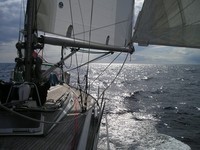
Who: Judy, Steve, Stephanie and Marine
Port: Halifax, NS
SailBlogs Friends
