03/09/2009, Navy Base Guam
After a very fun Bubble Maker class with 5 wonderful kids I discovered that one of the Dads was a Navy doctor running the base recompression chamber! After only a little pleading Dr. Rob agreed to take me on base for a visit.
We met Dr. Rob outside the base near the Navy's museum around noon. Hideko has not received her new Green Card yet and they would not let her in on the expired one (getting her finger prints done was a major reason to come to Guam). Miki, Hideko's cousin, has a US passport so they let the two of us in. We sadly left Hideko at the museum.
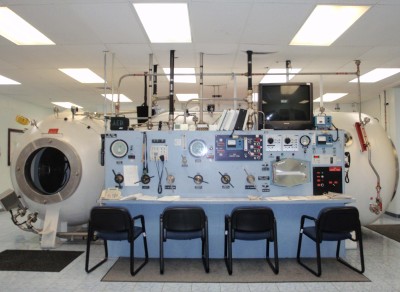
The chamber on the base is a RCF6500, one of seven in the Navy, and the most busy of them. The Master Diver was in his office when we arrived and he added a lot to the tour. For a mere recreational dive instructor, it was a great experience, being able to spend an hour with a diver who has 28 years of experience and a MD focusing on dive medicine.
I was particularly interested to find that the Navy is now using pure O2 for decompression at 30 feet. They have a surface supply setup that they use. This means that the divers are dealing with O2 partial pressures of almost 2.0! They have had zero problems. the new Navy tables have some interesting updates as well. The dive industry is still learning, I certainly learned a lot today.
The chamber is pretty big and has room for a patient or two and several attendants. There's a small pass through in the front of the chamber for passing food and what not in and out and there's an auxiliary chamber on the left to bring attendants up and down without surfacing the main chamber.
| Guam |
|
03/08/2009, Tumon Bay
Our cousin Miki arrived today. Emi, Miki's twin, crewed for us last year in the Caribbean. It was nice to have family visiting. We are still kind of broken up over Roq but Miki is a great comfort. We are getting some sight seeing in now that Miki is here. Eric, his new crew Julie, and the three of us circumnavigated Guam today. Jeff's Pirate cove was a nice spot for lunch on the windward side of the island. We also watched a reenactment of the Magellan discovery of Guam, today was the anniversary of the event.
| Guam |
|
03/07/2009, Tumon Bay
Hideko and I ran a Bubble Maker intro to Scuba experience for kids from the yacht club today. The kids were awesome and everyone had a lot of fun.
| Guam |
|
03/02/2009, MYC
We are still pretty broken up about losing Roq and have decided to shut down the blog for a while.
| Guam |
|
03/01/2009, Marianas Yacht Club
The saddest day.
| Guam |
|
Randy, Hideko-san, Roq had special happy life because of yours. He is smiling and keeping his eyes on yours and swinging on a star, I think.
For me, it was really shocked too. Actually I took care Roq pee and feed food every day in crossing South Pacific. Roq is one of the memory of swinging on a star's life.
In deepest sympathy,
That's just crushing. I came up here to check in after a couple of weeks away and was floored to see this. Well I guess he was up there in dog years and at least he was with you and you had those experiences together in his last years.
I tip my hat to the most loyal, loved and loving dog to ever set sail.
May he have all the best fun in Dog Heaven.
Markus
Love,
Ramos family
Again, I am sorry for your loss, my wife sends her best as well.
Dennis Paulsen
02/28/2009, Guam
We took Roq to visit Doctor "Smiles" today. We met his family here at the Marianas Yacht Club. Wonderful folks. Roq got cleared for shore duty and he also got a new Health Certificate. He has now received a new Rabies shot and will return on Monday for a shave, bath, and teeth cleaning. All set to woo the lady dogs and customs officials in Southeast Asia.
As I left the veterinarian's office I though to myself how opinionated some cruising guide books are. You may find comments like, "Leave your pets at home!" This is advice based on a very specific opinion. If you don't care much for pets, it is great advice. If your pet is part of the family, then perhaps you need a second opinion. If there is one thing that is true about cruising, it is that one size, most certainly, does not fit all.
Cruising with a pet has many unique benefits and challenges. That said, I believe that it is feasible anywhere in the world with enough energy put into the equation. The amount of energy depends on where you're going and what you want to do. This energy is also what you must weigh against how important it is for you to bring your pet.
I can only speak for dogs in particular, but where dogs are concerned I am fairly knowledgeable when it comes to Caribbean and the South Pacific customs. Much of what you hear about how hard it is to get pets through customs is similar to the hype about piracy.
There are some places that are fairly obsessive about animals importation, New Zealand and Australia in particular. In the Caribbean and tropical South Pacific you will find no place anywhere near as dog hostile as these two. The options are, skip these spots, or prepare well in advance. Do not listen to the advice of the many who will offer it, but have never been there before, nor the advice of those who went there in 1957. Call the officials in New Zealand and get the straight shot for the present day. If you fill out all of your forms, pay all of your fees and follow the rules, you can get Fido in. Whether you can stand the quarantine is another question, but even the quarantine clock can be started at sea, as soon as you leave Tonga, Fiji or wherever.
In the rest of the South Pacific we found no real hassles. Unfortunately in the tropical South Pacific, from the Galapagos (ok not really the South Pacific), to PNG you will need to keep the dog on board if you want a quick and easy clear in. If you have a Jack Russell this is probably fine. If you have a 2 year old Black Lab it may be impractical, or impossible given how well they swim. If you clear in the easy way (Spot stays onboard), and then dig into the officialdom after the fact, particularly by contacting a local vet to work with/through, you will generally find it easy to get your dog approved for shore access. This is worth the trouble in countries where you will stay for a while.
If you are not a stickler for the rules you will find many deserted, three palm tree islands and lonely beaches where no one will care, or know, if you walk your dog. I am not endorsing this behavior, but if you respect the concerns that are at the root of the dog laws then you are at least obeying the spirit of the law, which is the most important thing. The spirit of the law typically includes the following axioms:
1) Don't infect local dogs with disease. In most cases your dog is more at risk from the island dogs than they are from your dog. Island dogs are often nearly feral and rarely, if ever, have vet care. This is an easy rule to respect, simply don't go ashore in a place where there are dogs. You may be surprised how many places have dogs, man and dog seemed to travel together on those Polynesian canoes close to 100% of the time. Scout it out first, local dogs may attack new comers on sight or create other problems that you don't want to deal with.
2) Don't destroy local wildlife. Also easy to respect, simply stay with your dog and see that he doesn't bother wildlife, dig up ground nests, or hamper animals, plants or habitats in any other way. Again, the local, often feral, dogs are the real problem here.
3) Don't litter. Dog poo is biodegradable but no one wants to see it on that stretch of beautiful white sand beach. Leaving poo around is also a potential health risk. Pick up after your dog.
In the Caribbean you will have little problem with your dog and customs. Some places require onboard quarantine others don't. All of the islands that we ran across would allow the dog ashore after a vet check. The Bahamas were an exception and wanted a pet permit to be acquired in advance. The Bahamas are also a place that you could sail into and forget to mention your dog and never have a problem. We acquired the permit in advance without too much trouble when we visited, I'm just making an observation.
Many islands want to see a pet health certificate with proof of a rabies shot within the last year. A shot good for three years and only 1.5 years old may not be acceptable to the "one year only" countries. It is a good idea to get a health certificate and rabies shot each year from a good vet to keep onboard. The only place I can think of that actually looked at ours was Chuuk in the FSM. Many others asked if we had a heath certificate but never looked at it after we said we had one. If you keep the dog on the boat, the officials mostly seem to leave it at that.
We have visited the following countries/territories (in "just show up" with a health cert mode) with no problem: Turk and Caicos, Dominican Republic, USVI, British VI, Saint Martin, Saint Barts, Nevis, Montserrat, Guadalupe & the Saints, Dominica, Martinique, Saint Lucia, Saint Vincent and the Grenadines, Grenada, Trinidad and Tobago, Venezuela, Bonaire, Curacao, Aruba, Colombia, Panama, Ecuador, French Polynesia, The Cook Islands, Nuie, Tonga, Fiji, Vanuatu, The Solomon Islands, Papua New Guinea, Guam.
The Federated States of Micronesia were no problem for the dog just the people, Puerto Rico was no problem for us but we are Americans on a US flagged boat, and the Bahamas was easy but wants $300 for a cruising permit and a dog permit in advance.
So the real truth is that you will have a lot of hurdles to clear with your pet in New Zealand and Australia, but everywhere else is pretty straight forward. The only other chores are keeping them in food, dealing with poo and pee issues (can be a big one), keeping them onboard and out of trouble (like a kid), keeping them from overheating (don't bring your poor Samoyed to the tropics without a shave monthly), and picking up the fur.
On the up side, a dog will bring many benefits. If you love your dog, there is nothing like going on an adventure and being able to bring Bowser along. Also, if your dog is at all imposing, or even just loud, you will likely never have a boarder.
Our dog Roq, is getting pretty old and tired. He sleeps a lot and has a hard time getting around after his cruciate ligament surgery and considerable years. Even so, everyone who looks at him decides to stay off of our boat until invited aboard. More importantly he has been my loyal companion for over 14 years and I would not travel at length without him. He gave me the best years of his life and I am trying to make sure that his last years are as happy as they can be.
| Guam |
|
I wrote to you once before and still following your travel. I enjoy your blog and your postings are most interesting. I could not help write on this one to express my joy at how you view your loyal friend roq. You are a giant of a person and my wife and I and two siamese cats wish we could be friends.
Fair winds and good sailing
Clifford
02/27/2009, MYC
Actually they are already here. If you go to the tourist areas of Guam you will find scads of Japanese (mostly younger folks). The place is virtually tailored for the Japanese tourist. Lots of high fashion outlets and big stores with little knick nacks for the friends back home (buying gifts for friends when you travel is a long standing Japanese tradition).
Many signs in Guam give equal time to English and Japanese. Lots of people speak Japanese as well. Every menu has Japanese on it and even Denny's serves Ramen and other surprising eastern additions. There are some Korean tourists about and a few Chinese but these get by with English.
You really don't see any American tourists, unless you count the US Navy servicemen, 25% of Guam's population. Half the folks on Guam are of Chamoro descent (the native people of the Marianas Islands) and the other 25% are Philippino.
I was waiting in the parking lot at Kmart for Hideko when a guy came up to me wanting to sell his band's CD. It turned out he was from Palau, I got some good cruising tips in exchange for the CD (not my style). Another guy we met was from Saipan. He was surprised no one on Guam spoke the Chamoro language that all of his family on Saipan used daily. So while it seems that the American influence has created a fairly material situation here on Guam with the Japanese Yen and the US dollar running the show, it is one of the cleanest and safest islands, with the best schools, in this part of the pacific. Many islanders from all around come here to work and raise their families. The Marshal Islanders, FSM folks and Palauans can all come and go just like US citizens.
The Japanese we were interested in arrived today. There are normally 7 or more, but this year the economy dictated only two Japanese arriving to take part in the Marianas Yacht Club good will regatta. This weekend the two Japanese guests and a host of locals (plus Eric) will be taking part in a set of Laser races in the harbor. We still have winds 20-25 knots here so it will be an exciting, and likely wet, time for the whole club. The Japanese are reported to take 1st and 2nd every year.
Hideko is a wonderful ambassador for the Japanese folks we meet all over the world. She made short order of introductions and we all enjoyed chatting with the new visitors. We also have a new friend in the anchorage, Masa San. Masa San is a single hander who has sailed all around the Pacific on his Yamaha production sailboat Nuk (who knew Yamaha made a Beneteau like 37 footer?!). We first met Masa San in Tahiti. He is a big HAM and does weather in Japanese on at least one net from his boat.
As Hideko and I cruised the Caribbean we saw few Asians and it was an exciting time if we actually met another Japanese person. Now we are moving into an area where we see few westerners and it will be exciting to see another American. It is a vast and interesting world.
| Guam |
|