05/28/2012, Overnight Sail, Kauehi to Fakarava, Tuomotus
The trip to from Kauehi to Fakarava is only 30 miles and should only take 5-6 hours to sail there, however sailing is never simple in the Tuomotus. To get there safely one must still time the tides to exit and enter the passes, unfortunately, wouldn't you know it, the slack water high tide occurs at 4 in the afternoon, and the one in Fakarava occurs at 9am. So, instead of leaving in the morning and arriving in the afternoon, we needed to make a 6 hour sail a 16 hour sail.
We exited the pass about 4:30pm and proceeded to slowwww the boat down. We were between 3 islands, so we needed to stay in the middle of the three as best we could. The winds were steady but being between the 3 islands made the seas confusing. The boat was rocking back and forth, because it was not in her normal speed mode. Needless to say, nobody got much sleep that night after being tossed around for hours. I finally hove to for a few hours and that seemed to settle things down.
We entered the pass at 9:00am, right on the tide. The pass at Fakarava is about 30 yards wide, and can accommodate a good size cruise ship, as the channel is nicely marked. The town was about 5 miles from the channel, a nice motorsail over to the anchorage.
Dropped the hook in 40 feet of crystal clear water, with coral heads all around.
John
|
|
05/26/2012, At Anchor, Kauehi, Tuomotus
The four day passage to our first landfall in the Tuomotus went without incident. An easy offwind sail under reefed main and the big code zero. We averaged about 130 miles a day for the 530 day passage. In order to enter the atolls of the Tuomotus, one needs to time the entrance of the pass along with the tides. There is much information on the technique, but the basic approach is to enter the pass where the current and wind are in the same direction. Otherwise, dangerous standing waves can appear in the pass, that can have dire effects. The easiest way to accomplish this is follow the tide tables and plan your entrance through the pass at slack water, where the tide is at its high or low, thus no current. Well, sounds easy on paper, unfortunately, the tide data is only available for from to locations in the Tuomotus, Rangiroa and Hao, both a fair distance away. So the exact time of slack water needs to be estimated, based on these locations and your longitude. After careful study and analysis, we were able determine slack water comes a half hour before Rangiroa and 1.5 hours after Hao. This puts us enter the pass at daybreak.
All went as planned after a slowed down our speed for final night of the passage, where we threaded our way through two islands to be at the pass by daybreak. We transited the pass under full engine speed, but still encountered a 2 knot outgoing current, but no problems, Sherpa's "Iron Sail" pushed us through to the other side without any trouble.
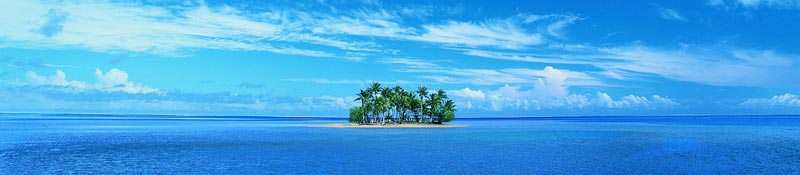
After running the pass, we plotted a course through the lagoon, to a remote anchorage on the SE side of the lagoon. with Paul at the bow watching for coral heads, and Pete watching the depth sounder we weaved are way to an idyllic spot, about 30 yards from the swaying palm trees on shore. The water is a light blue azul color, just what you would see in tourist books. The island are motus, or small dispersed islets, separated by water. Wow, amazing!!
The motus are all uninhabited, except for the occasional tourist that is dropped off for a picnic I think. We saw 4-5 foot black-tip sharks in the little lagoons that separate the motus, obviously looking for something to eat. They are said to be harmless, but I think we'll avoid them. The motus are about 200 yards across from the ocean from the lagoon, but I'm sure during a tropical storm or cyclone, these motus would be awash, as they only are about 8-10 feet above sea level.
The GRIB weather files call for increased winds for the next few days, so we will have to be hunkered up snug at our anchorage until weather improves for us to exit the pass and move on to Fakarava. As it turned out the winds have been a steady 15-25 knots for the about 36 hours now, but are anchor is holding us tight. It looks like they are starting to subside a little, which should allow us to leave Sunday, midday, as to arrive at the next location at the proper tide.
John
|
|
Have fun, keep smiling.......and send us an update....PLEASE.
05/22/2012, Underway-Nuku Hiva to Kauehi, Tuomotus
We have left the Marquesas Islands and are back at sea on a passage to the Toumotus. The French Polynesian Islands have 3 distinct territories. The Marquesas in the NE, The Tuamotus which are SW around 500 miles, and the Societies (which includes Tahiti) another 100 miles west . The Marquesas are huge volcanic lush green mountains that are spectacular for hiking. The Tuamotus are atolls, Islands at Sea level surrounded by coral reefs. These Islands are known for some of the best diving and snorkeling in the world. You just have to be aware of the sharks (and we have heard our share of shark stories already!). Navigation around the Tuamotus reefs can be difficult. We are headed for Kauehi which the chart books say has a wide passage to the inside. Kauehi is rather remote, well hang out there a few days and then move over to Fakarava the second most populated area in the Taumotus (700 people).
While at sea, life is rather simple. The boat, sleep, eat, the continuous rhythm of the ocean, the heavenly bodies. The sea provides one the time and space to become very reflective. Being outside life as we know it brings a strong clarity around ones true values.
We will miss the Marquesas, they are indeed a very special set of Islands whose images will forever remain etched in our minds and hearts. Comparing the Marquesas culture to America brings both appreciation and questions. We Americans are quite fortunate to have an abundance of fresh clean water, power at the flip of a switch, and an unbelievable mass volume of food products 10 minutes away. The Marquesas people are relaxed and never seem in a rush. Go to the Post Office and there is a chair to sit in while conducting business. There are more chairs outside so if you meet a friend, have a seat and chat a while. Community and spiritual centers are distinct and dominant. Financial institutions and products have to be searched for. So the question, just what is our rush about? How do we balance the many things we feel driven to maintain with our true values in Life. We reflective ones are sailing on, looking for Land. Have a seat and enjoy a cold drink for us!! Paul
|
|
05/19/2012, At Anchor Daniels Bay, Nuku Hiva
Daniel's Bay, as it is referred to by cruisers, is located about 6 miles west from the bay of Taiohae. We upped anchor at 8am, and had it back on the seafloor about an hour later.
The bay is a picturesque anchorage, surrounded by a sandy beach on one side, and 1000 foot peaks on the other. We counted about 14 boats in the anchorage. We quickly put the dinghy in the water and donned our backpacks and hiking gear for the 2.5 mile hike to "the waterfall". The waterfall, is supposed to be the third tallest in the world, towering up 900 feet to the top.
The hike took us through a small village, where dogs, goats, horses and even a few cows wandered about. The locals houses, although quite modest, all seemed to have manicured landscaping around their house, hedges, fruit trees all laid out symmetrically. There is a fresh water stream that runs thru the center of the community, which must be water that comes form the waterfall.
The hike was not difficult, but you do need to negotiate a stream crossing a few times, mud and lots of rocks to hike over. The trail takes you deep into a canyon, that has green walls that go vertically straight up. Along the way you encounter rock pilings, which I believe are called Pai Pai, or ruins form a time past. The trail takes you through banyon trees, coconut treas. We emerged in an opening only to se the waterfall in the distance. Looking up at it almost makes you dizzy, as it is so high, and the clouds blow by so quickly, you could easily loose your footing. The water comes tumbling off the top of the peak, from this vantage you can see about half of the 900 feet fall.
We trek further to the base of the falls. As you approach the falls you can hear the roar, a sign warns of falling rocks and a bucket of plastic helmets is available to wear should one want to heed the warnings. The base is covered in ferns and lily pad type vegetation and you have to crawl through a cave to enter the the pool and the cascading waterfall.
Off come the shirts, backpacks for a much deserved and refreshing swim. The water is cool, and there is a swift current that circulates around the pool. From the bottom, you can oly see up bout 100 feet or so, as it is a sheer ledge where the water cascades into the pool. The walls of the pool have been carved out from thousands of years of water washing of the them. Well worth the hike.
On the return trip we are waved over by Monette and her husband to their home for a refreshing jus de citron drink. Her French is about as good as mine, but are able to communicate a few words, and learn she was born there. They proceed to offer us papaya, pamplemoose, breadfruit and limes, as well as sell us some for our trip. What a wonderful way to end our trip in the Marquesas.
Tomorrow morning, after a good nights rest, we will up anchor, and go into "passage mode". Next stop, Kauehi, Tuomotus.
John
|
|
05/18/2012, Nuka Hiva
Our final island stop in the Marquesas is Nuku Hiva, which is the northern most point to check out of the chain before heading to the Tuomotus. After a 17 hour motorsail from Atuona we pulled into the Bay of Taiohae. The bay is an all weather anchorage and looks like it could easily accommodate a 100 boats as well as cruise ships that embark here from Papeete, we saw the cruise ship The World, leaving as we approached the bay. The village surrounds the bay from one end to the other, with the main road paralleling the coast at the end of the bay. Compared to Atuona, I find Taiohae is much more lovely and accessible, with easy access to the dinghy dock, fuel dock and a short walk to the post office,gendarmarie, stores and the few restaurants on shore.
The dinghy dock is part of the commercial dock, where local fisherman bring in their catches each evening to be sold to the stores, restaurants, resorts and locals. Tuna appears to be the poisson du jour, but one evening, we watched as one of the boats brought in a large marlin, the local "news" people, even had a small vhs video camera documenting the spectacle. Paul and I got the opportunity to take the lucky fisherman who caught back to his anchored boat the next day. He told us how he uses a tuna, a large one at that, to catch the really big ones. He was very helpful and directed us to the fuel dock.
One of the restaurants in the village is run by a former cruiser, Rose, who has kept it open after her husband passed away a few years back. As we wandered around the closed restaurant, waiting for it to open, Peter, the German manager, asked if we would like a drink, as he would open up the bar, perfect timing. Rose, who owns it, also has a musee and artisan shop with items from their years on the island. After quench our thirst, we decided to have dinner there that evening. There is no menu, but you van hve fish or beef, we opted for the fish, which was served w/ salad and bread fruit frites, and was quite delicious and reasonable.
As for provisioning, the village has excellent stores, fuel dock and of course a boulangerie. The only hiccup, we were told by Peter, in order to get fresh veggies, one needed to get there by 6am, at the latest, as they start selling on the dock at 4am. We thought, who would get up that early for veggies, well we arrived at 6:20am---the shelves were empty. Still not sure who was there to clean them out, but no fresh veggies for the passage.
The final chores on our departure to do list, was change the oil in the engine and and re-fuel. Both tasks went well, in fact we obtained our fuel duty-free, which saves about 40% off the bill.
Also in town, is a pizza place. We ran into some other cruisers we met in Atuona, and headed there the night before we departed. Another good restaurant and bar. The other cruisers, who had told us we can't miss Fatu Hiva, was adamant about hiking to the waterfall at Daniel's Bay before heading off to the Tuomotus. Well since we were still in "expedition mode", we made a small itinerary change, at will make one final anchorage about 6 miles west to hike to the waterfall.
John
|
|
05/17/2012, Nuka Hiva
So to catch you up on our sojourn, we were in passage mode now are back in expedition mode. We left Fatu Hiva early, 0500 AM to get across the 50 plus mile passage back to Hiva Oa. Started out motoring to get out of the island wind shadow for the reach back. We decided to leave the motor on and Genoa out for a quicker ride back. This topped off our batteries. Then we decided to add the Honda generator motor to the noise so we could make water. What a wonderful thing this water maker. John estimated we have made 300 gallons of fresh water so far this trip. Using a 110 Volt system makes more water faster then the DC version the marine industry is selling us. The anchorage at Hiva Hoa has not changed. Some cruiser we recognize are still there and some new ones. We decided to not anchor in the middle of everyone else so we went outside the break water in deeper water. We were only there to get the water pump for the boat motor which was suppose to have finally arrived. Mission accomplished, Sandra, our local agent, delivered it to the dingy dock. Since we are getting better as a team of dingy/motor mounting and dismounting things went fast. Then sundowners, dinner then couple hours sleep. Up anchor at about 2100 Hr for our 70 mile passage to Nuka Hiva. The night was very dark. There are no island lights, the clouds were covering the stars but off we went. The GPS guided us thru the passage of two islands and then off to Nuku Hiva. Only saw one ship light off in the distance at about 0300 HR, possible the supply ship for Hiva Hoa. The moon was just a sliver of itself but is did brighten the night finally. We motored all day, 17 Hr, no wind, no clouds it was hot. Finally saw clouds in the distance which indicated land ho. We came to the big anchorage of Taiohae on Nuku Hiva. Anchorage is like a lake, smooth but open to the trades when they blow, so could be rolley. We are expecting calm till Saturday when another front brings us wind. Then it is off to the Tuamotus 500 miles or 4 days sailing. In the mean time we are exploring the town, oh oh, today is a church holiday, everything is closed, stores, fuel etc. So today, catch up on sleep, do a walk about town then see if pizza restaurant is open. Tomorrow reprovision.
Pete
|
|