Voyageur C
27 July 2010 | Shelburne, NS
04 July 2010 | Marblehead, MA
01 June 2010 | Norfolk, VA
28 April 2010 | Hollywood, FL
18 March 2010 | Ile a Vache, Haiti
01 March 2010 | Salinas, Dominican Republic
02 February 2010 | Fajardo, Puerto Rico
01 January 2010 | Simpson Bay Lagoon, St. Martin
02 December 2009 | Point a Pitre, Guadeloupe
06 November 2009 | Clifton, Union Island, Carriacou
17 October 2009 | Guiria, Venezuela
03 October 2009 | Chaguaramas, Trinidad
23 August 2009 | Chaguaramas, Trinidad
28 July 2009 | Hog Island, Grenada
28 June 2009 | Bequia, Grenadines
19 May 2009 | Portsmouth, Dominica
22 April 2009 | Falmouth, Antigua
10 March 2009 | Fajardo, Puerto Rico
29 January 2009 | Norman Island, BVI
29 December 2008 | Antigua
The Road Less Travelled (Oct. 14/09)
17 October 2009 | Guiria, Venezuela
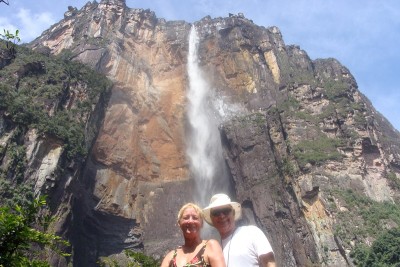
The south east region of Venezuela is defined by the Guayana Highlands, named after the neighboring country to the east. Though many people have never heard of the area, this is the home of Angel Falls - the world's most vertiginous waterfall with an overall height of 979 m (3,212 ft) and a clear drop of 807 m (2,647 ft). The falls, however, are just one feature of the area, which also hosts the Orinoco river and Tepuis, huge sandstone mesas that rise thousands of feet above the Gran Sabana, a vast grassland.
One September morning, Anne of Freya of Clyde asked on the Chaguaramas Ch. 68 net if any other cruisers would be interested in visiting Angel Falls. We replied yes, and the group eventually expanded to 6 couples from as many boats with 3 from Great Britain, 1 from Austria & Germany and 1 each from Canada and the USA. Evidently, no one had done the trip from here before - especially with our objective budget of $1000 US per head. Anne did all the legwork, coordinating with Branco and Betty in Maracaibo, Venezuela. Each week for four weeks we met to discuss preparations, logistics and the itinerary. Baggage limit was one back pack per person, and we anticipated rudimentary facilities at the two camps.
From Chaguaramas it is only about 330 miles to Angel Falls as the crow flies - but they don't have crows here. We had to follow an alternate route, one that involved 24 hours of travel by sea, road, air, curiara and foot.
First, we were off on Jesse James maxi-taxi to Pier One at 6:45 AM (7 AM check-in) to catch the 9AM Wednesday departure of the ferry to Guiria, the Venezuelan entry port on the Gulf of Paria. After 3 ½ hours, mostly passing the picturesque mountains of the Paria Peninsula we pulled into the harbour at Guiria, only to float around in the harbour for 1 1/2 hours waiting for the medical officer to come on board to check us for swine flu. When we finally pulled up to the dock, Anne was delighted to see Branco and Betty waiting for us.
Branco is Venezuelan and speaks passable English while Betty (from Czechoslovakia) is fluent in five languages including English and Spanish. They would accompany us for the duration of our visit. On our side, Connie from Tashtego had pretty good Spanish, while Jochen and Traudl from Blue Song had toured South America for four months and could get along fairly well in Spanish.
We celebrated our arrival in Guiria with local beer (3.5 Bf per bottle) and Cacique rum (35 Bf for a 750 ml bottle) and later dined on excellent Shawarma (18 Bf) while sitting at a table on the street wedged between the gutter and the traffic. To put prices in perspective, you can buy 5 Bolivar Fuerte (Bf) for ONE US dollar.
After our overnight stay at the Hotel Plaza (sounds grand -don't be misled) in Guiria we took a 12 hour bus ride to Ciudad Bolivar, founded in 1764 as Angostura. The bus, ably piloted by Carlos, was basically an extended air-conditioned van with little leg room and fixed seats. The occasional stops were greatly appreciated! Filling up the diesel van was an eye opener - the price was equivalent to one cent per liter! Gasoline is twice as expensive.
The trip took us through a surprising variety of topography from mountains to plains and then across the Orinoco River on one of only two bridges across the river in Venezuela. The Orinoco is the worlds 3rd largest river by volume and is 2140 km long. We stayed at the Da Gino hotel (a cut above the Plaza) beside the airport and dined on pizza and beer at the hotel restaurant.
Friday morning we went to the airport and divided into 3 groups for the 1 ¼ hour flight to Canaima in the Canaima National Park. The planes are 6 seaters (including the pilot) so everyone has a window seat. Maximum flying altitude was 6500 feet on the 119 mile trip so we had great views of the tepuys and waterfalls as we approached Canaima. Canaima sits on one side of Canaima Lagoon which is fed by four spectacular waterfalls on the Rio Carrao. After landing, we walked a short way and were then transported by canoe to Camp Bernal (www.bernaltours.com) on Isla Anatoliy which is situated in the lagoon between two of the waterfalls. On arrival we were given refreshments and presented with bead bracelets and necklaces. Native people here are the Pemon and guides must be native. We met our river guide Danielle at the camp. Danielle spoke English like a first language - it turns out all of the guides here must speak English, and a couple I spoke to were from British Guiana. The Bernal family who founded the business were originally from Peru.
We had the balance of the day at the camp so we wandered off on our own to see Salto Hacha (Axe Falls) - which featured a lengthy path under a rock overhang directly under the falls. It's slippery so socks are better than shoes or bare feet. Also, we're walking through serious downpours here - ladies hang onto the top of your bathing suits!
Later Danielle took us to a lovely sand beach (Playita) just below the Salto El Sapo (Frog Falls sounds less exciting) where we had a swim. Then we crossed through a path behind the falls - quite slippery with water dripping everywhere and very tunnel like with water on one side and rock on the other three sides - impossible to hear anything due to the roar of the water a couple of feet away! At the other side of the falls we climbed up and walked back across the top of the falls. Despite the torrents going over the falls, we could walk across the top with dry feet because most of the water flowed through channels cut into and under the rock.
We had opted for cabins (4 to a room) with private baths, but the rooms were very hot so Leona and I used the cabin for luggage and slept in hammocks under mosquito nets in the main lodge - basically a roof with no walls.
Saturday morning we divided our luggage in half, caught the canoe to Canaima and walked for ½ hour to the main curiara landing (Port Ucaima) above the falls at Canaima.
A word about the curiara - it held our party of 17, including the boat driver, guide and bowman with the other 14 of us seated 2 abreast and our luggage stored in tarpaulins between us and the driver. This presented a full load - especially since river depths were dropping as the rainy season comes to an end. The curiara is powered by a 48HP Yamaha (what else?) and probably draws about 6 inches. The boats are massively built of wood with pitch caulking - which is a good thing considering the number of rocks we bounced off or over on the river. They change the propeller and put on the rock prop when they leave the main river. In the rapids, the stern man is continuously tilting the motor up and down up and down and side to side to balance propulsion, direction and draft while the bow man calls the course and wields a large paddle of the Warao pattern to steer the boat. Any cross wind and the bow wave is in your face, and water often slops over the side in the rapids. Getting wet is guaranteed - even if it doesn't rain - which it did for an hour or so.
The curiara trip took us 24 miles up Rio Carrao and then 20 miles up Rio Churun to Refugio Rustico on Isla Raton, base camp for the hike to Angel Falls. We had to get out and walk for a half hour across Savannah of Mayupa about 10 miles up the Rio Carrao while the curiara ran the Mayupa rapids. One highlight of the trip upriver was the stop for a box lunch at a waterfall and bathing pool about 15 miles up the Rio Carrao where we spent an hour enjoying the rock pool and the natural shower. From there we entered the spectacular land of the Tepuys with steep mountains, forested lowlands and waterfalls around every corner.
Up till now, I thought the Gander River boats and their operators were the epitome of rapids runners - the Venezuelans have replaced them. While there are only a couple of rapids on the Rio Carrao, the run up the Rio Churun in particular involves 20 miles of mostly rapids and shallow spots and the water levels change rapidly with the weather. Elevation at the base camp was around 1300 feet, and at Refugio Rustico was 1600 feet or so. Allowing for the falls at Canaima that we walked around still left us climbing 200 feet in the rivers!
A couple of times a few of us had to walk around some of the rapids and once on the way up Devil's Gorge we all had to fend the boat off a humungous rock in mid-channel - on the first attempt we drifted backwards down river.
Over all, the upriver trip took seven hours including stops, and we arrived at Isla Raton around 5 PM. Refugio Rustico is an appropriate name - hammocks enclosed in mosquito nets slung over a dirt floor under a thatched roof with benches for dining and relaxing. No running water or electricity, but the food was excellent with large servings - especially the wood fired BBQ chicken!
Sunday morning we crossed the river and hiked for an hour toward Auyun Tepui (Evil Mountain) the home of Angel Falls. The trail is well marked by heavy usage with easy going for the first half but the second half is quite steep up to the Mirador Laime viewpoint elevation at 2300 feet. The view of the falls is spectacular - we lucked into a perfectly clear and sunny day. After lounging on the rocks at the viewpoint we descended a very steep trail to the pool at the bottom of the falls. Here we enjoyed a long swim washing off the trail grime and sweat.
There you have it - four days to get to the falls!
We returned to Isla Raton, had lunch and embarked on the down river trip. The water level had dropped so there were a couple more portages. At one point the boat was doing 21.7 MPH down the rapids. The trip was slower than the guides had planned so we made the Mayupa portage in twilight and the last 10 miles on the river in the dark - a tad unnerving, but we were past all the rapids. We docked at the upper end of Isla Anatoly between Salto Hacha and Salto El Sapo and then hiked down to Camp Bernal in the dark, thankful for our Petzl headlamps and Danielles knowledge of the trails. The trip downriver was faster by two hours, but 12 hours over two days sitting on a wooden plank screams for something soft on which to sit.
Monday morning we walked back to Salto Hacha, crossed under the lengthy waterfall overhang and climbed across a headland to swim in the forbidden pool under the adjacent falls, Salto Wadaima. We had a lot of fun getting pushed around by the downpour and resulting current.
Then, it was back to camp to pack up and have lunch. We were entertained by the village children's choir in native costume singing in spanish and pemon. Afterwards we rushed to the airport to catch the plane to Ciudad Bolivar.
Ciudad Bolivar was the headquarters of the revolution against the Spanish, and the Plaza Bolivar acknowledges the 5 countries liberated by Bolivar. We wandered around the town square looking at the restored buildings, but everything was closed due to a holiday. We then walked along the Paseo Orinoco to the Orinoco viewpoint for a beer and a photo and then back to the Casino near our hotel for dinner since the hotel dining room was closed for the holiday.
On the bus Tuesday, we enjoyed a daylight view of the 3 year old Orinoquia Bridge across the 3 km wide Orinoco River and stopped again at to see what trade goods the Warao had on offer at the bridge across Rio Morichal Largo. They would sell a small monkey for 500 Bf and also had a couple of agouti in cages for sale as well as the usual baskets. Along the way, we passed another person with an armadillo for sale!
We said goodbye to Betty and Branco in Carapano and arrived back in Guiria around 9 PM - yet another 12 hour bus trip.
Wednesday we found the shipping agency where we had to pay our 80 Bf departure tax and get our names on the manifest. (If you show up for the ferry without your ticket stamped to show the tax was paid you can't board!) We found a wonderful bakery for breakfast, then went back to the hotel for a round of Mexican Train dominoes to kill time before the ferry.
Venezuela is larger and far more varied than we had realized, and we found the people very friendly and concerned for our safety - don't walk there, etc. Many had far better English than our Spanish - we need to work on this. Certainly there is a lot more to see in Venezuela than our small sampling. All in all, a wonderful week.
PS: Ferry check in time was 2PM and we were back in Chaguaramas at 7:30 PM. The trip cost us $1969.63 Canadian over and above our normal living expenses - ON BUDGET!
PS: (Nov 1/09)
We have posted pictures in a separate album - Angel Falls.
These pictures were taken by everybody in the group - thanks to everyone for permission to use them.
One September morning, Anne of Freya of Clyde asked on the Chaguaramas Ch. 68 net if any other cruisers would be interested in visiting Angel Falls. We replied yes, and the group eventually expanded to 6 couples from as many boats with 3 from Great Britain, 1 from Austria & Germany and 1 each from Canada and the USA. Evidently, no one had done the trip from here before - especially with our objective budget of $1000 US per head. Anne did all the legwork, coordinating with Branco and Betty in Maracaibo, Venezuela. Each week for four weeks we met to discuss preparations, logistics and the itinerary. Baggage limit was one back pack per person, and we anticipated rudimentary facilities at the two camps.
From Chaguaramas it is only about 330 miles to Angel Falls as the crow flies - but they don't have crows here. We had to follow an alternate route, one that involved 24 hours of travel by sea, road, air, curiara and foot.
First, we were off on Jesse James maxi-taxi to Pier One at 6:45 AM (7 AM check-in) to catch the 9AM Wednesday departure of the ferry to Guiria, the Venezuelan entry port on the Gulf of Paria. After 3 ½ hours, mostly passing the picturesque mountains of the Paria Peninsula we pulled into the harbour at Guiria, only to float around in the harbour for 1 1/2 hours waiting for the medical officer to come on board to check us for swine flu. When we finally pulled up to the dock, Anne was delighted to see Branco and Betty waiting for us.
Branco is Venezuelan and speaks passable English while Betty (from Czechoslovakia) is fluent in five languages including English and Spanish. They would accompany us for the duration of our visit. On our side, Connie from Tashtego had pretty good Spanish, while Jochen and Traudl from Blue Song had toured South America for four months and could get along fairly well in Spanish.
We celebrated our arrival in Guiria with local beer (3.5 Bf per bottle) and Cacique rum (35 Bf for a 750 ml bottle) and later dined on excellent Shawarma (18 Bf) while sitting at a table on the street wedged between the gutter and the traffic. To put prices in perspective, you can buy 5 Bolivar Fuerte (Bf) for ONE US dollar.
After our overnight stay at the Hotel Plaza (sounds grand -don't be misled) in Guiria we took a 12 hour bus ride to Ciudad Bolivar, founded in 1764 as Angostura. The bus, ably piloted by Carlos, was basically an extended air-conditioned van with little leg room and fixed seats. The occasional stops were greatly appreciated! Filling up the diesel van was an eye opener - the price was equivalent to one cent per liter! Gasoline is twice as expensive.
The trip took us through a surprising variety of topography from mountains to plains and then across the Orinoco River on one of only two bridges across the river in Venezuela. The Orinoco is the worlds 3rd largest river by volume and is 2140 km long. We stayed at the Da Gino hotel (a cut above the Plaza) beside the airport and dined on pizza and beer at the hotel restaurant.
Friday morning we went to the airport and divided into 3 groups for the 1 ¼ hour flight to Canaima in the Canaima National Park. The planes are 6 seaters (including the pilot) so everyone has a window seat. Maximum flying altitude was 6500 feet on the 119 mile trip so we had great views of the tepuys and waterfalls as we approached Canaima. Canaima sits on one side of Canaima Lagoon which is fed by four spectacular waterfalls on the Rio Carrao. After landing, we walked a short way and were then transported by canoe to Camp Bernal (www.bernaltours.com) on Isla Anatoliy which is situated in the lagoon between two of the waterfalls. On arrival we were given refreshments and presented with bead bracelets and necklaces. Native people here are the Pemon and guides must be native. We met our river guide Danielle at the camp. Danielle spoke English like a first language - it turns out all of the guides here must speak English, and a couple I spoke to were from British Guiana. The Bernal family who founded the business were originally from Peru.
We had the balance of the day at the camp so we wandered off on our own to see Salto Hacha (Axe Falls) - which featured a lengthy path under a rock overhang directly under the falls. It's slippery so socks are better than shoes or bare feet. Also, we're walking through serious downpours here - ladies hang onto the top of your bathing suits!
Later Danielle took us to a lovely sand beach (Playita) just below the Salto El Sapo (Frog Falls sounds less exciting) where we had a swim. Then we crossed through a path behind the falls - quite slippery with water dripping everywhere and very tunnel like with water on one side and rock on the other three sides - impossible to hear anything due to the roar of the water a couple of feet away! At the other side of the falls we climbed up and walked back across the top of the falls. Despite the torrents going over the falls, we could walk across the top with dry feet because most of the water flowed through channels cut into and under the rock.
We had opted for cabins (4 to a room) with private baths, but the rooms were very hot so Leona and I used the cabin for luggage and slept in hammocks under mosquito nets in the main lodge - basically a roof with no walls.
Saturday morning we divided our luggage in half, caught the canoe to Canaima and walked for ½ hour to the main curiara landing (Port Ucaima) above the falls at Canaima.
A word about the curiara - it held our party of 17, including the boat driver, guide and bowman with the other 14 of us seated 2 abreast and our luggage stored in tarpaulins between us and the driver. This presented a full load - especially since river depths were dropping as the rainy season comes to an end. The curiara is powered by a 48HP Yamaha (what else?) and probably draws about 6 inches. The boats are massively built of wood with pitch caulking - which is a good thing considering the number of rocks we bounced off or over on the river. They change the propeller and put on the rock prop when they leave the main river. In the rapids, the stern man is continuously tilting the motor up and down up and down and side to side to balance propulsion, direction and draft while the bow man calls the course and wields a large paddle of the Warao pattern to steer the boat. Any cross wind and the bow wave is in your face, and water often slops over the side in the rapids. Getting wet is guaranteed - even if it doesn't rain - which it did for an hour or so.
The curiara trip took us 24 miles up Rio Carrao and then 20 miles up Rio Churun to Refugio Rustico on Isla Raton, base camp for the hike to Angel Falls. We had to get out and walk for a half hour across Savannah of Mayupa about 10 miles up the Rio Carrao while the curiara ran the Mayupa rapids. One highlight of the trip upriver was the stop for a box lunch at a waterfall and bathing pool about 15 miles up the Rio Carrao where we spent an hour enjoying the rock pool and the natural shower. From there we entered the spectacular land of the Tepuys with steep mountains, forested lowlands and waterfalls around every corner.
Up till now, I thought the Gander River boats and their operators were the epitome of rapids runners - the Venezuelans have replaced them. While there are only a couple of rapids on the Rio Carrao, the run up the Rio Churun in particular involves 20 miles of mostly rapids and shallow spots and the water levels change rapidly with the weather. Elevation at the base camp was around 1300 feet, and at Refugio Rustico was 1600 feet or so. Allowing for the falls at Canaima that we walked around still left us climbing 200 feet in the rivers!
A couple of times a few of us had to walk around some of the rapids and once on the way up Devil's Gorge we all had to fend the boat off a humungous rock in mid-channel - on the first attempt we drifted backwards down river.
Over all, the upriver trip took seven hours including stops, and we arrived at Isla Raton around 5 PM. Refugio Rustico is an appropriate name - hammocks enclosed in mosquito nets slung over a dirt floor under a thatched roof with benches for dining and relaxing. No running water or electricity, but the food was excellent with large servings - especially the wood fired BBQ chicken!
Sunday morning we crossed the river and hiked for an hour toward Auyun Tepui (Evil Mountain) the home of Angel Falls. The trail is well marked by heavy usage with easy going for the first half but the second half is quite steep up to the Mirador Laime viewpoint elevation at 2300 feet. The view of the falls is spectacular - we lucked into a perfectly clear and sunny day. After lounging on the rocks at the viewpoint we descended a very steep trail to the pool at the bottom of the falls. Here we enjoyed a long swim washing off the trail grime and sweat.
There you have it - four days to get to the falls!
We returned to Isla Raton, had lunch and embarked on the down river trip. The water level had dropped so there were a couple more portages. At one point the boat was doing 21.7 MPH down the rapids. The trip was slower than the guides had planned so we made the Mayupa portage in twilight and the last 10 miles on the river in the dark - a tad unnerving, but we were past all the rapids. We docked at the upper end of Isla Anatoly between Salto Hacha and Salto El Sapo and then hiked down to Camp Bernal in the dark, thankful for our Petzl headlamps and Danielles knowledge of the trails. The trip downriver was faster by two hours, but 12 hours over two days sitting on a wooden plank screams for something soft on which to sit.
Monday morning we walked back to Salto Hacha, crossed under the lengthy waterfall overhang and climbed across a headland to swim in the forbidden pool under the adjacent falls, Salto Wadaima. We had a lot of fun getting pushed around by the downpour and resulting current.
Then, it was back to camp to pack up and have lunch. We were entertained by the village children's choir in native costume singing in spanish and pemon. Afterwards we rushed to the airport to catch the plane to Ciudad Bolivar.
Ciudad Bolivar was the headquarters of the revolution against the Spanish, and the Plaza Bolivar acknowledges the 5 countries liberated by Bolivar. We wandered around the town square looking at the restored buildings, but everything was closed due to a holiday. We then walked along the Paseo Orinoco to the Orinoco viewpoint for a beer and a photo and then back to the Casino near our hotel for dinner since the hotel dining room was closed for the holiday.
On the bus Tuesday, we enjoyed a daylight view of the 3 year old Orinoquia Bridge across the 3 km wide Orinoco River and stopped again at to see what trade goods the Warao had on offer at the bridge across Rio Morichal Largo. They would sell a small monkey for 500 Bf and also had a couple of agouti in cages for sale as well as the usual baskets. Along the way, we passed another person with an armadillo for sale!
We said goodbye to Betty and Branco in Carapano and arrived back in Guiria around 9 PM - yet another 12 hour bus trip.
Wednesday we found the shipping agency where we had to pay our 80 Bf departure tax and get our names on the manifest. (If you show up for the ferry without your ticket stamped to show the tax was paid you can't board!) We found a wonderful bakery for breakfast, then went back to the hotel for a round of Mexican Train dominoes to kill time before the ferry.
Venezuela is larger and far more varied than we had realized, and we found the people very friendly and concerned for our safety - don't walk there, etc. Many had far better English than our Spanish - we need to work on this. Certainly there is a lot more to see in Venezuela than our small sampling. All in all, a wonderful week.
PS: Ferry check in time was 2PM and we were back in Chaguaramas at 7:30 PM. The trip cost us $1969.63 Canadian over and above our normal living expenses - ON BUDGET!
PS: (Nov 1/09)
We have posted pictures in a separate album - Angel Falls.
These pictures were taken by everybody in the group - thanks to everyone for permission to use them.
Comments
| Vessel Name: | Voyageur C |
| Vessel Make/Model: | Island Packet 35 |
| Hailing Port: | Halifax, NS, Canada |
| Crew: | Bill & Leona |
| About: |
Gallery not available
Who: Bill & Leona
Port: Halifax, NS, Canada